

What are the 5 Pillars of Islam?
The Five Pillars of Islam (Arkan al-Islam) are the foundation of ibadah (worship) and iman (faith) that guide a Muslim’s life and devotion. They are:
-
Shahadah (Declaration of Faith): Bearing witness that there is no god but Allah ﷻ and that Muhammad ﷺ is His Messenger.
-
Salah (Prayer): Establishing five daily prayers that connect the heart to Allah and nurture humility, discipline, and remembrance (dhikr).
-
Zakat (Almsgiving): Purifying one’s wealth by helping those in need, spreading mercy and unity across the Ummah.
-
Sawm (Fasting): Fasting in Ramadan to cleanse the soul, grow in patience, and strengthen taqwa (God-consciousness).
-
Hajj (Pilgrimage): Traveling to Makkah to fulfill the sacred duty of pilgrimage, a sign of unity, sacrifice, and submission to Allah ﷻ.
These pillars bring faith to life—linking belief with action and transforming worship into a complete way of living with sincerity, gratitude, and love for the Creator.
List of the Five Pillars with Arabic and English Names
 The Five Pillars of Islam (Arkan al-Islam — أركان الإسلام) form the foundation of iman (faith) and ibadah (worship) that shape a Muslim’s devotion and daily life. Each pillar has a beautiful Arabic name that captures its meaning, purpose, and the way it brings believers together in unity and remembrance of Allah ﷻ.
| English Name | Arabic Name | Transliteration | Meaning / Description |
| Faith (Declaration of Faith) | الشهادة | Ash-Shahādah | Proclaim tawheed — that there is no god but Allah ﷻ — and bear witness that Muhammad ﷺ is His Messenger. |
| Prayer | الصلاة | As-Ṣalāh | Establish five daily prayers that connect the heart to Allah, nurturing humility, discipline, and constant remembrance (dhikr). |
| Charity (Almsgiving) | الزكاة | Az-Zakāh | Purify and bless one’s wealth by helping those in need, spreading mercy and justice throughout the Ummah. |
| Fasting | الصوم | Aṣ-Ṣawm | Fast during Ramadan to cleanse the soul, strengthen taqwa (God-consciousness), and grow in patience and gratitude. |
| Pilgrimage (Hajj) | الحج | Al-Ḥajj | Undertake the sacred journey to Makkah as an act of unity, sacrifice, and submission to Allah ﷻ. |
How the Five Pillars Strengthen a Muslim’s Faith and Community?
The Five Pillars of Islam (Arkan al-Islam) strengthen a Muslim’s faith and bring the Ummah together in unity. Each pillar connects personal worship (ibadah) with social duty (mas’uliyyah), nurturing a life filled with taqwa (God-consciousness), empathy, and balance.
- Shahadah awakens true belief in tawheed — declaring the oneness of Allah ﷻ and directing every action toward His pleasure.
- Salah brings serenity and structure to life, aligning the heart and body through dhikr (remembrance) and congregational prayer (jama’ah).
- Zakat purifies both wealth and soul, spreading fairness and compassion throughout the Ummah.
- Sawm disciplines the spirit through fasting in Ramadan, teaching patience, gratitude, and empathy for those in need.
- Hajj gathers believers from all corners of the world, breaking barriers of race and status, and reminding humanity of equality and submission before Allah ﷻ.
Together, these pillars build strong hearts and strong communities. They remind every believer that true faith shines through compassion, justice, and unity — the essence of Islam’s divine design for a peaceful world.
Hadith Reference — Foundation of the Pillars
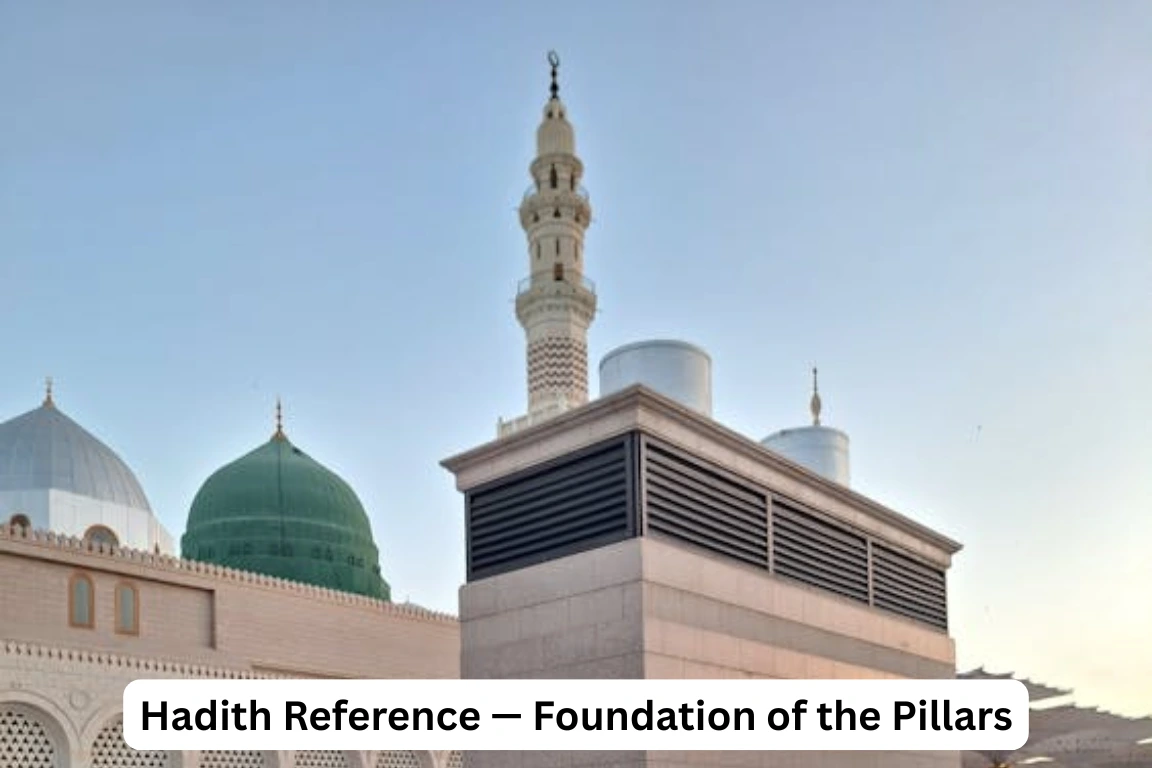 The Five Pillars of Islam (Arkan al-Islam — أركان الإسلام) were established through the words of our beloved Prophet Muhammad ﷺ, as narrated by ʿAbdullah ibn ʿUmar (رضي الله عنه) in an authentic Hadith. The Prophet ﷺ beautifully summarized the entire structure of deen (religion) in a single statement:
“Islam is built upon five: the testimony that none has the right to be worshipped but Allah, the establishment of prayer, the giving of zakah, the pilgrimage to the House, and fasting Ramadan.” — Sahih al-Bukhari (Hadith 8), Sahih Muslim (Hadith 16)This Hadith, known as Hadith al-Arkan (حديث الأركان), defines the foundation upon which Islam stands. Through these divine words, the Prophet ﷺ taught that true Islam is built on iman (faith), ʿamal (action), and ʿibadah (worship) — all flowing from submission to Allah ﷻ. Hadith al-Arkan continues to guide believers today, reminding us that each pillar strengthens the other. Together, they sustain our ʿaqīdah (belief), shape our fiqh (practice), and uphold the moral and spiritual unity of the Ummah.
FAQs — 5 Pillars of Islam
There are five pillars in Islam because they were ordained by Allah ﷻ to uphold the foundation of our dīn (faith). Each pillar is an act of ʿibādah — sincere worship that reflects tawḥīd, the belief in Allah’s oneness. Through Shahādah (faith), Ṣalāh (prayer), Zakāh (charity), Ṣawm (fasting), and Ḥajj (pilgrimage), Muslims express gratitude, obedience, and love for their Creator. These pillars shape a believer’s daily life — nurturing taqwā (God-consciousness), building unity within the Ummah, and keeping the heart connected to Allah in every action.
The first pillar of Islam is the Shahādah (الشهادة) — the Kalimah of Faith that declares tawḥīd, the oneness of Allah ﷻ, and affirms the risālah (Prophethood) of Muhammad ﷺ. It proclaims: “Lā ilāha illā Allāh, Muḥammadur Rasūlullāh” — There is no deity worthy of worship except Allah, and Muhammad is the Messenger of Allah.
The Shahādah is not just a statement of belief — it is a promise of devotion. Through it, a person turns their heart toward Allah, renouncing all false gods and submitting completely to His will. This simple yet powerful declaration opens the door to Islam and shapes a Muslim’s identity for life — uniting belief, words, and actions in sincere obedience to the Creator.
The Five Pillars of Islam are not mentioned together in a single āyah (verse) of the Qur’an, but each pillar is clearly established through Allah’s revelations. The Qur’an teaches īmān (faith) — “So know that there is no deity except Allah” (Surah Muhammad 47:19); commands Ṣalāh (prayer) and Zakāh (charity) — “Establish prayer and give zakāh” (Surah Al-Baqarah 2:43); prescribes Ṣawm (fasting) — “Fasting is prescribed for you” (Surah Al-Baqarah 2:183); and calls for Ḥajj (pilgrimage) — “Pilgrimage to the House is a duty owed to Allah” (Surah Āl ʿImrān 3:97).
Together, these verses form the divine framework of ʿibādah (worship) that shapes a Muslim’s faith and daily life. The Prophet Muhammad ﷺ later united these individual commands into a complete way of practice — known as the Five Pillars of Islam, a living connection between the Qur’an’s words and the believer’s devotion.
All Muslims believe in the Five Pillars of Islam as sacred farā’iḍ (obligations) that strengthen their dīn (faith) and guide their worship. These pillars — Shahādah (faith), Ṣalāh (prayer), Zakāh (charity), Ṣawm (fasting), and Ḥajj (pilgrimage) — are practiced throughout the Ummah (global Muslim community) as the foundation of Islam.
The way Muslims observe these pillars can differ based on niyyah (intention), ikhlāṣ (sincerity), and personal capacity. Islamic schools of law (fiqh madhāhib) may vary slightly in how they explain the details, but every scholar agrees that these acts remain farḍ (obligatory) for all who are able. Together, the Five Pillars unite the Ummah and express a Muslim’s love, gratitude, and submission to Allah ﷻ.
Neglecting any of the Five Pillars of Islam weakens a person’s īmān (faith) and obedience to Allah ﷻ. Each pillar is a sacred trust — a farḍ (obligation) that connects the heart of a believer to their Creator. Missing an act like Ṣalāh (prayer), Ṣawm (fasting), or Zakāh (charity) without reason is a serious fisq (sin), yet Allah’s door of tawbah (repentance) always remains open for those who return with sincerity.
If someone denies the obligation of a pillar, it becomes kufr (disbelief), but neglecting it out of weakness or heedlessness does not remove them from Islam. Through sincere repentance, a believer can rebuild their faith, renew their obedience, and seek Allah’s mercy. The Prophet Muhammad ﷺ said, “The head of the matter is Islam, its pillar is prayer.” (Jāmiʿ at-Tirmidhī 2616) — a reminder that while the pillars uphold Islam, repentance and hope in Allah keep it standing strong in the heart.
Complete Five Pillars Guide — All Pages
Also Essential Reading

Fathima Kausar K is a writer at Sukoonly.com, where she focuses on sharing authentic duas, Qur’anic supplications, and spiritually uplifting content that helps readers find peace, clarity, and closeness to Allah.
Her writing is rooted in the belief that duʿāʾ is not just a set of words, but a sincere conversation with Allah — especially during moments of sadness, uncertainty, gratitude, or quiet reflection. Through her articles, she aims to make authentic Islamic supplications easier to understand, meaningful to recite, and practical for everyday life.
Fathima carefully studies classical Islamic sources, authentic narrations, and well-known scholarly explanations, and presents them in a simple, gentle, and relatable way. Her focus is always on clarity, authenticity, and emotional connection rather than complexity or technical language.
Through Sukoonly, she hopes to create a peaceful space where readers can slow down, reconnect with their faith, and find comfort through remembrance, duas, and trust in Allah.