

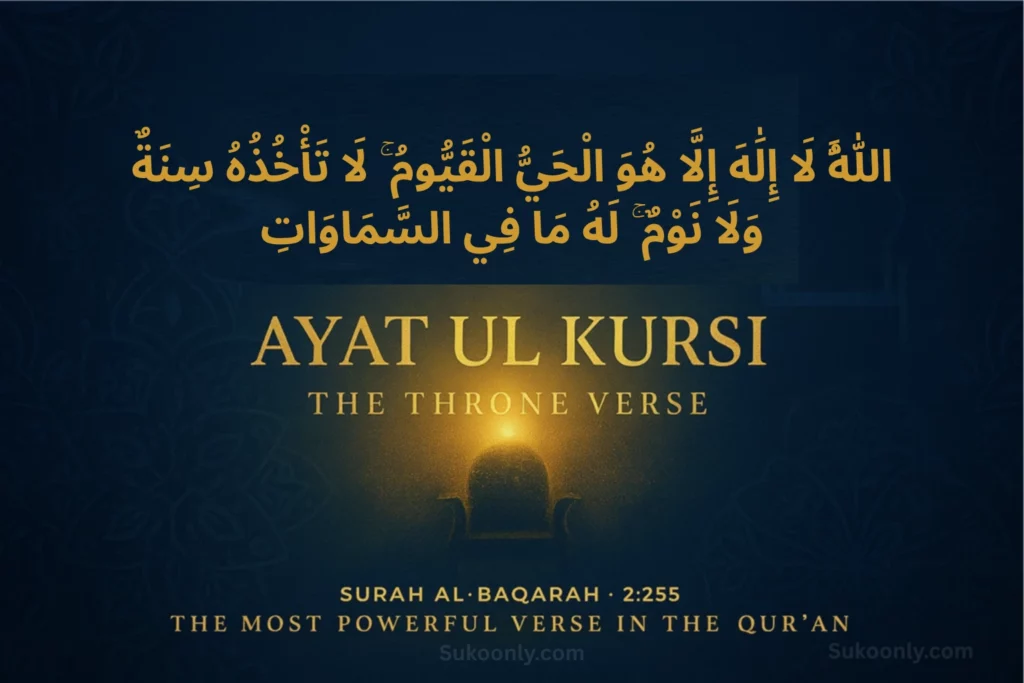
اللَّهُ لَا إِلَٰهَ إِلَّا هُوَ الْحَيُّ الْقَيُّومُ ۚ لَا تَأْخُذُهُ سِنَةٌ وَلَا نَوْمٌ ۚ لَهُ مَا فِي السَّمَاوَاتِ وَمَا فِي الْأَرْضِ ۗ مَنْ ذَا الَّذِي يَشْفَعُ عِندَهُ إِلَّا بِإِذْنِهِ ۚ يَعْلَمُ مَا بَيْنَ أَيْدِيهِمْ وَمَا خَلْفَهُمْ ۖ وَلَا يُحِيطُونَ بِشَيْءٍ مِّنْ عِلْمِهِ إِلَّا بِمَا شَاءَ ۚ وَسِعَ كُرْسِيُّهُ السَّمَاوَاتِ وَالْأَرْضَ ۖ وَلَا يَئُودُهُ حِفْظُهُمَا ۚ وَهُوَ الْعَلِيُّ الْعَظِيمُ
(Surah Al-Baqarah 2:255)
Allah! There is no deity except Him, the Ever-Living, the Sustainer of [all] existence… His Kursi extends over the heavens and the earth, and He feels no fatigue in guarding them.
Source: Surah Al-Baqarah (2:255) – Hadith: Most powerful verse in the Qur’an (Muslim 810)
Ayat ul Kursi (آيَة الْكُرْسِي) is verse 255 of Surah Al-Baqarah and is widely regarded as the greatest verse in the Qur’an. This powerful ayah declares Allah’s absolute sovereignty, eternal knowledge, and perfect authority over the heavens and the earth, beginning with the majestic words: “Allahu la ilaha illa Huwa.”
The Prophet Muhammad ﷺ described Ayat ul Kursi as a source of protection and blessing. Authentic narrations in Sahih al-Bukhari and Sahih Muslim mention its virtues, including protection from Shaytaan when recited before sleep and reward when recited after the obligatory prayers. For this reason, Muslims recite it daily as part of their dhikr and remembrance of Allah ﷻ.
Scholars across the Islamic tradition emphasize that Ayat ul Kursi is a powerful affirmation of tawheed (the oneness of Allah) and strengthens tawakkul (reliance upon Him). It is commonly memorized, reflected upon, and displayed in homes as a reminder of faith and divine protection.
Below, you will find the full Arabic text of Ayat ul Kursi, its transliteration and English meaning, along with authentic hadith about its virtues, tafsir insights, and guidance on how to apply it in daily life.
What Is Ayat ul Kursi and Where Is It Found in the Quran?
Ayat ul Kursi is Verse 255 of Surah Al-Baqarah, the second and longest chapter of the Qur’an, and it is considered the most majestic and comprehensive verse describing Allah’s divine attributes, authority, and guardianship over the heavens and the earth.
The verse begins with “Allahu la ilaha illa Huwa” — affirming the absolute oneness of Allah (Tawheed) — and continues by detailing His eternal life (Al-Hayy), self-subsistence (Al-Qayyum), and unchallenged dominion. It also explicitly declares that none can intercede without His permission, and that His Knowledge encompasses all, while His Kursi (Throne) extends over the skies and the earth.
Located in Surah Al-Baqarah (Chapter 2), Ayah 255, Ayat ul Kursi sits within a context of verses addressing belief, divine law, and moral guidance. Its placement after verses on charity and spiritual guidance further highlights its theological weight — serving as a divine pause that magnifies Allah’s majesty and authority in the midst of legal and ethical discourse.
Scholars from all major tafsir traditions — including Ibn Kathir, Al-Qurtubi, and Al-Tabari — emphasize that no other verse matches Ayat ul Kursi in its combination of divine names, metaphysical depth, and protective power. It has even been referred to in Hadith as Sayyidat Ayat al-Qur’an — the Master Verse of the Qur’an.
Whether recited during prayer, before sleeping, or in moments of fear, Ayat ul Kursi remains an unmatched source of spiritual strength, security, and divine connection for Muslims around the world.
What Is the Full Arabic Text of Ayat ul Kursi?
The full Arabic text of Ayat ul Kursi, as found in Surah Al-Baqarah (2:255), is one of the most frequently memorized and widely recited verses in Islam. It carries immense spiritual protection and theological depth, making it essential for every practicing Muslim to learn and understand.
Below is the complete and accurate Arabic script of Ayat ul Kursi, as traditionally preserved in the Uthmani Mushaf:
اللَّهُ لَا إِلَٰهَ إِلَّا هُوَ الْحَيُّ الْقَيُّومُ ۚ لَا تَأْخُذُهُ سِنَةٌ وَلَا نَوْمٌ ۚ لَهُ مَا فِي السَّمَاوَاتِ وَمَا فِي الْأَرْضِ ۗ مَنْ ذَا الَّذِي يَشْفَعُ عِندَهُ إِلَّا بِإِذْنِهِ ۚ يَعْلَمُ مَا بَيْنَ أَيْدِيهِمْ وَمَا خَلْفَهُمْ ۖ وَلَا يُحِيطُونَ بِشَيْءٍ مِّنْ عِلْمِهِ إِلَّا بِمَا شَاءَ ۚ وَسِعَ كُرْسِيُّهُ السَّمَاوَاتِ وَالْأَرْضَ ۖ وَلَا يَئُودُهُ حِفْظُهُمَا ۚ وَهُوَ الْعَلِيُّ الْعَظِيمُ
This verse is composed of exactly 50 words in Arabic and is often written in elegant calligraphy and displayed in homes, masjids, and prayer areas. Each word carries deep layers of meaning — affirming Allah’s singularity, eternal life, unrestricted knowledge, and unmatched authority.
When memorizing Ayat ul Kursi, ensure you follow a Qari with proper Tajweed, such as Mishary Rashid Alafasy or Yasser Al-Dosari, to preserve the pronunciation and rhythm of this revered verse.
What Is the Transliteration of Ayat ul Kursi?
The transliteration of Ayat ul Kursi provides a phonetic guide for non-Arabic speakers to recite this sacred verse correctly — preserving its pronunciation, rhythm, and spiritual impact without needing to know the Arabic script.
Transliteration bridges the gap between visual recognition and oral recitation, enabling Muslims around the world — especially reverts, children, or non-Arabic speakers — to memorize and pronounce Ayat ul Kursi with clarity and confidence.
Below is the line-by-line transliteration of Ayat ul Kursi based on standard Tajweed-compliant phonetics:
Al-Ḥayyul-Qayyūm
Lā ta’khudhuhu sinatun wa lā nawm
Lahu mā fī as-samāwāti wa mā fī al-arḍ
Man dhā alladhī yashfa‘u ‘indahu illā bi-idhnīh
Ya‘lamu mā bayna aydīhim wa mā khalfahum
Wa lā yuḥīṭūna bi-shay’in min ‘ilmihi illā bimā shā’
Wasi‘a kursiyyuhus-samāwāti wa al-arḍ
Wa lā ya’ūduhu ḥifẓuhumā
Wa Huwa al-‘Aliyyul-‘Aẓīm
When reciting from transliteration, it’s highly recommended to listen to verified Qaris for pronunciation cues and intonation. This helps avoid common recitation errors and brings the reward and reverence of reading Qur’an with care, even if Arabic fluency is not yet achieved.
Tools such as flashcards, mobile apps, and daily recitation routines can support consistent learning, especially when paired with understanding the English meaning for emotional and spiritual depth.
What Is the English Translation of Ayat ul Kursi?
The English translation of Ayat ul Kursi offers a clear and powerful understanding of Allah’s divine attributes as described in Surah Al-Baqarah (2:255). Each line conveys essential truths about Allah’s existence, knowledge, authority, and mercy, making this verse central to both belief and protection in Islam.
Below is the line-by-line English translation of Ayat ul Kursi, rendered with clarity to preserve the depth and majesty of the original Arabic:
Neither drowsiness overtakes Him nor sleep.
To Him belongs whatever is in the heavens and whatever is on the earth.
Who is it that can intercede with Him except by His permission?
He knows what is [presently] before them and what will be after them.
And they encompass not a thing of His knowledge except for what He wills.
His Kursi (Throne) extends over the heavens and the earth,
and their preservation tires Him not.
And He is the Most High, the Most Great.
This translation reveals Allah’s infinite knowledge (Al-‘Aleem), His eternal life (Al-Hayy), and His power to sustain creation (Al-Qayyum) without fatigue. It also emphasizes that intercession (shafa’ah) occurs only by His will, reinforcing Islamic monotheism (Tawheed) and divine supremacy.
Whether recited for daily spiritual grounding, nightly protection, or reflective worship, understanding this translation enhances one’s connection with Allah ﷻ and intentionality in recitation.
What Is the Tafsir (Exegesis) of Ayat ul Kursi?
The tafsir (exegesis) of Ayat ul Kursi reveals the divine attributes of Allah with unmatched depth, as explained by both classical Islamic scholars and contemporary mufassireen (commentators). Scholars unanimously agree that Surah Al-Baqarah, verse 255 encapsulates the essence of Tawheed (monotheism), Allah’s authority, and His guardianship over all creation.
Tafsir Ibn Kathir
According to Ibn Kathir, one of the most respected Sunni mufassirs, Ayat ul Kursi is the greatest verse in the Qur’an because it contains five of Allah’s Beautiful Names: Allah, Al-Hayy, Al-Qayyum, Al-‘Aliyy, and Al-‘Azeem. He emphasizes that this verse affirms Allah’s exclusive right to be worshipped, His eternal self-sustenance, and absolute knowledge of all that has happened and will happen.
Ibn Kathir highlights the intercession clause (“Who is it that can intercede with Him except by His permission?”) as a clear refutation of shirk, affirming that none can approach Allah on behalf of another without His leave — not even angels or prophets.
Tafsir Al-Tabari
Imam Al-Tabari interprets Ayat ul Kursi through a linguistic and rational lens, examining each phrase in the context of early Islamic creed (Aqeedah). He explains that Al-Hayy denotes perfect, everlasting life, while Al-Qayyum signifies that all creation depends on Allah, but He depends on none.
His tafsir also discusses the Kursi — interpreted by some scholars as Allah’s Throne of Knowledge or a symbol of dominion — and its vastness covering both the heavens and the earth. Al-Tabari stresses that human intellect cannot fully grasp the nature of Allah’s knowledge, as reflected in the phrase “they encompass not a thing of His knowledge except for what He wills.”
Tafsir Perspectives
Modern scholars and contemporary tafsir works (such as by Mufti Menk, Nouman Ali Khan, and Dr. Yasir Qadhi) emphasize Ayat ul Kursi’s relevance in everyday spiritual life. They connect its themes to:
- Mental well-being (trusting Allah in distress)
- Daily worship (post-salah recitation)
- Spiritual empowerment (reaffirming one’s faith)
Contemporary tafsir also brings attention to the protection-based application of Ayat ul Kursi, using Hadiths from Sahih Bukhari that describe how reciting it before sleeping safeguards one from Shaytaan until dawn.
What Are the Names and Attributes of Allah Mentioned in Ayat ul Kursi?
Ayat ul Kursi explicitly mentions five of Allah’s Most Beautiful Names (Asma’ul Husna), each revealing a dimension of His divine essence, power, and relationship with creation. These names are not only theological affirmations — they serve as spiritual anchors for Muslims seeking protection, guidance, and peace.
1. Allah (اللَّه) — The One True God
The verse begins with “Allahu la ilaha illa Huwa”, establishing Tawheed — the oneness and exclusivity of Allah in divinity. This name represents His unique, unmatched identity as the only being worthy of worship.
2. Al-Hayy (ٱلْحَيُّ) — The Ever-Living
Al-Hayy signifies that Allah possesses perfect, eternal life, unaffected by sleep, death, or decline. Unlike created beings, His existence is self-sustained, everlasting, and independent. Believers find comfort in knowing they are protected by a living Lord who never ceases to exist or observe.
3. Al-Qayyum (ٱلْقَيُّوم) — The Sustainer of All That Exists
Al-Qayyum emphasizes that every created thing depends entirely on Allah for its existence and function — from the orbit of galaxies to the beat of a human heart. He is actively maintaining the universe at every moment. This name evokes a sense of absolute trust and reliance (tawakkul).
4. Al-‘Aliyy (ٱلْعَلِيُّ) — The Most High
At the end of the verse, Allah describes Himself as Al-‘Aliyy, meaning exalted above all things — in knowledge, power, rank, and essence. This attribute reminds believers that no worldly authority or hardship can rise above His command.
5. Al-‘Azim (ٱلْعَظِيمُ) — The Most Great
Finally, Al-‘Azim denotes majesty, glory, and supreme greatness. Allah is beyond all human comprehension, and everything in the universe is insignificant compared to His might. Reciting Ayat ul Kursi affirms that you are under the care of the One who is truly Mighty and Sublime.
These divine names are not merely descriptive — they are active realities in the believer’s life. When you recite Ayat ul Kursi, you are invoking Allah through His most powerful attributes of life, knowledge, authority, and grandeur. They offer spiritual protection, emotional reassurance, and a deeper connection with your Lord.
Why Is Ayat ul Kursi Called the Greatest Verse of the Quran?
Ayat ul Kursi is known as the greatest verse in the Qur’an based on direct confirmation from Prophet Muhammad ﷺ in authentic Hadith. Its supremacy lies in the depth of Tawheed (Islamic monotheism) it conveys, the divine names it contains, and its powerful spiritual protection, making it unique among all 6,236 verses of the Qur’an.
Hadith Evidence: Direct Words of the Prophet ﷺ
In Sahih Muslim, it is narrated that the Prophet ﷺ asked Ubayy ibn Ka’b (RA):
“O Abu Mundhir! Do you know which verse in Allah’s Book is the greatest?”
Ubayy replied: “Allah and His Messenger know best.” The Prophet repeated the question, and when Ubayy answered with:
“Allah! There is no deity except Him, the Ever-Living, the Sustainer of all existence…” (Ayat ul Kursi)
the Prophet ﷺ tapped him on the chest and said:
“Rejoice in this knowledge, O Abu Mundhir!”
— (Sahih Muslim 810)
Reasons for Its Supremacy in Islam
- Affirms the Purest Tawheed: Ayat ul Kursi negates all forms of shirk (associating partners with Allah) by declaring His exclusive divinity, self-sustaining nature, and complete control over all creation.
- Contains Five of Allah’s Most Powerful Names: As seen earlier, the verse includes Al-Hayy, Al-Qayyum, Al-‘Aliyy, Al-‘Azim, and Allah, making it a spiritual declaration of His absolute perfection.
- Unmatched Protection from Shaytaan: In Sahih Bukhari, a narration involving Abu Huraira (RA) explains that reciting Ayat ul Kursi before sleep protects a person from Shaytaan until dawn. The Prophet ﷺ confirmed this wisdom and said: “He told you the truth, even though he is a liar.” — (Sahih Bukhari 2311)
- Central Message of Allah’s Sovereignty: No other verse summarizes the relationship between the Creator and the creation — knowledge, permission, intercession, power, preservation — with such majesty and clarity.
What Are the Virtues and Benefits of Reciting Ayat ul Kursi?
Reciting Ayat ul Kursi regularly brings powerful spiritual benefits that protect the believer from harm, increase divine reward, and deepen one’s connection with Allah ﷻ. Rooted in authentic Hadith and Islamic tradition, this verse is seen not just as a prayer — but as a shield, a source of light, and a declaration of divine authority.
1. Protection from Shaytaan (Satan)
According to a well-known narration in Sahih Bukhari (Hadith 2311), Abu Huraira (RA) was taught by a disguised Shaytaan that reciting Ayat ul Kursi before sleeping would protect him from Satan until dawn. When the Prophet ﷺ heard this, he confirmed its truth and said:
“He told you the truth, though he is a liar.”
This makes Ayat ul Kursi a daily weapon against waswasa (whispers) and harmful jinn, especially at night or during moments of fear.
2. Guards the Home from Harm
Islamic scholars have long recommended reciting or displaying Ayat ul Kursi in the home to create a spiritually safe environment. It is commonly hung near doors, read during adhkar, or recited after entering the house — a practice strengthened by scholars like Ibn Taymiyyah and contemporary voices like Mufti Menk.
Reciting Ayat ul Kursi after every fard prayer builds a spiritual fortress around one’s dwelling.
3. Guarantees Safety During Sleep
The Prophet Muhammad ﷺ specifically advised Muslims to recite Ayat ul Kursi before going to bed, ensuring Allah’s protection throughout the night. According to narrations, the guardian angel appointed by Allah stays near the reciter and wards off any danger.
Ideal for children, travelers, or anyone experiencing anxiety before sleep.
4. Increases Rewards and Elevates Spiritual Rank
In another narration from An-Nasa’i, the Prophet ﷺ said:
“Whoever recites Ayat ul Kursi after every obligatory prayer, nothing prevents him from entering Paradise except death.”
This Hadith has been deemed Hasan (good) by scholars and highlights the immense reward for consistency, linking this verse with Jannah (Paradise) itself.
5. Builds Tawakkul and Iman in Daily Life
Beyond its protective elements, Ayat ul Kursi instills deep trust (tawakkul) in Allah’s power and presence. Regular recitation reinforces the believer’s mental resilience, reminding them that no harm, loss, or stress occurs without Allah’s knowledge and permission.
When Should Ayat ul Kursi Be Recited in Daily Life?
Ayat ul Kursi can be recited at multiple times throughout the day as part of a Muslim’s regular routine of adhkar (remembrance of Allah). The Prophet Muhammad ﷺ and classical scholars recommended specific moments when its recitation offers heightened protection, spiritual reward, and peace of mind.
1. Morning and Evening Adhkar (Daily Protection)
According to authentic dhikr compilations like Hisnul Muslim (Fortress of the Muslim), Ayat ul Kursi should be recited after Fajr and after Maghrib, as part of daily morning and evening remembrance.
This builds a spiritual shield around the believer, offering protection until the next phase of the day.
2. After Every Obligatory Salah (Entry into Paradise)
The Prophet ﷺ said:
“Whoever recites Ayat ul Kursi after each obligatory prayer, nothing stands between him and Paradise except death.”
— (An-Nasa’i, graded Hasan)
This makes it essential for daily spiritual elevation, ideally added right after your post-salah tasbih and du’as.
3. Before Sleeping (Nightly Safety from Shaytaan)
In Sahih Bukhari, the Prophet ﷺ confirmed that reciting Ayat ul Kursi before sleep ensures that an angel guards you and Shaytaan cannot come near you until morning.
Perfect for children, travelers, or anyone experiencing nightmares, anxiety, or spiritual disturbance.
4. While Traveling (Spiritual Protection on the Move)
Though not explicitly tied to travel in Hadith, scholars recommend reciting Ayat ul Kursi when embarking on a journey for its strong protection theme. It’s also commonly paired with Surah Al-Falaq, An-Naas, and du’a for safar (travel).
Reciting it when entering new places, checking into hotels, or during long drives invokes Allah’s guarding presence.
5. While Entering or Leaving the Home
Many Muslims make it a habit to recite Ayat ul Kursi when leaving the house, asking for divine protection against harm, loss, or Shaytaan’s whisperings. Some also display it in their homes as a symbolic reminder and read it when entering.
Combines well with the sunnah du’a: “Bismillah, tawakkaltu ‘ala Allah…”
6. During Fear, Illness, or Emotional Distress
Ayat ul Kursi is a spiritually grounding verse, often recited during moments of grief, panic attacks, sudden fear, or physical illness. Its affirmations of Allah’s knowledge, control, and care bring immense emotional strength.
Especially beneficial during hospital stays, before medical tests, or in uncertain situations.
What Hadiths Speak About the Power of Ayat ul Kursi?
Multiple authentic Hadiths from Sahih Bukhari, Sahih Muslim, and other reliable collections confirm the unmatched spiritual power of Ayat ul Kursi, its protective qualities, and its rank as the greatest verse in the Qur’an. These narrations were conveyed directly by Prophet Muhammad ﷺ to his companions and later preserved in canonical Sunni Hadith works.
1. Hadith on Ayat ul Kursi Being the Greatest Verse in the Qur’an
Narrated Ubayy ibn Ka’b (RA): The Messenger of Allah ﷺ asked me:
“O Abu Mundhir, do you know which verse in the Book of Allah is the greatest?”
I replied: “Allah and His Messenger know best.”
He said: “It is ‘Allahu la ilaha illa Huwa Al-Hayyul Qayyum.’”
Then he tapped me on the chest and said:
“Rejoice in this knowledge, O Abu Mundhir!”
— Sahih Muslim, Hadith 810
2. Hadith on Reciting Ayat ul Kursi Before Sleeping
Narrated Abu Huraira (RA): The Prophet ﷺ appointed me to guard the Zakat of Ramadan. Then someone came and began to steal some food.
After catching him, the thief said:
“Let me teach you some words which will benefit you: When you go to bed, recite Ayat ul Kursi… and Allah will appoint a guard for you, and no devil will come near you till morning.”
The Prophet ﷺ said:
“He told you the truth, although he is a liar. That was Shaytaan.”
— Sahih Bukhari, Hadith 2311
3. Hadith on Reciting It After Every Obligatory Prayer
Narrated by Abu Umamah (RA): The Messenger of Allah ﷺ said:
“Whoever recites Ayat ul Kursi immediately after every prescribed prayer, nothing stands between him and Paradise except death.”
— An-Nasa’i (Sunan al-Kubra), graded Hasan by Al-Albani
4. Hadith on Knowledge and Divine Throne
The Prophet ﷺ said:
“Allah wrote a Book two thousand years before He created the heavens and the earth… and in it is: ‘Ayat ul Kursi ends with: and He is the Most High, the Most Great.’”
— Reported by Al-Tirmidhi, classified as Hasan Gharib
What Is the Spiritual Impact of Ayat ul Kursi on the Heart and Mind?
Ayat ul Kursi deeply transforms the believer’s internal state by reinforcing Tawheed (oneness of Allah), building mental resilience, and awakening a strong emotional connection to Allah’s divine authority and guardianship. It is more than memorized words — it becomes a spiritual force that protects, uplifts, and stabilizes the soul.
1. Affirms Tawheed at the Core of Belief
The very first line of Ayat ul Kursi — “Allah! There is no deity except Him…” — directly engrains the concept of Tawheed ar-Ruboobiyyah (Lordship), Tawheed al-Uloohiyyah (Worship), and Tawheed al-Asma’ wa al-Sifaat (Names & Attributes of Allah).
2. Instills a Constant Sense of Protection
By declaring that Allah never sleeps or tires, and that His Kursi extends over the heavens and the earth, the verse embeds a profound sense of safety in the believer’s heart. This can help Muslims cope with:
- Anxiety
- Loneliness
- Fear of harm
- Spiritual attacks
3. Strengthens Connection with Divine Authority
Each line of Ayat ul Kursi presents layers of Allah’s attributes — Al-Hayy (Ever-Living), Al-Qayyum (Self-Sustaining), Al-‘Aliyy (Most High), and Al-‘Azim (Most Great) — which together build an emotional bridge between the servant and the Creator.
4. Calms the Mind and Enhances Spiritual Focus
In moments of emotional turmoil or mental stress, Ayat ul Kursi becomes an anchor for reflection and healing. It reminds the mind that:
- Every event is within Allah’s knowledge
- No harm can occur without His will
- Intercession belongs only to Him
5. Empowers Daily Spiritual Discipline
When Ayat ul Kursi is woven into your daily rhythm — after salah, before sleep, during dhikr — it becomes a ritual of mental fortification and spiritual confidence. The heart feels guarded. The mind feels aligned. The soul feels close to the Divine.
Is Ayat ul Kursi Used in Ruqyah (Spiritual Healing)?
Yes, Ayat ul Kursi is a key verse used in Ruqyah Shar‘iyyah — the practice of Qur’an-based spiritual healing to combat evil eye (ayn), black magic (sihr), and jinn-related afflictions. Rooted in authentic Hadith and endorsed by classical and contemporary scholars, it is considered one of the most powerful ayat for protection and healing in the Islamic tradition.
1. Prophetic Practice and the Role of Qur’anic Recitation in Healing
The Prophet Muhammad ﷺ prescribed specific verses of the Qur’an, including Ayat ul Kursi, Surah Al-Falaq, and Surah An-Naas, as part of the daily adhkar and Ruqyah. These verses are known for their spiritual potency in guarding the self and repelling evil forces.
2. Protection Against Evil Eye and Envy
Ayn (evil eye) occurs when a person is harmed due to another’s jealous gaze or praise without invoking Allah’s name. Reciting Ayat ul Kursi regularly — especially after Fajr and Maghrib — creates a spiritual barrier, reinforcing divine protection.
3. Counteracting Black Magic (Sihr)
In cases of suspected black magic, scholars like Ibn Taymiyyah and Ibn Qayyim Al-Jawziyyah recommended Ayat ul Kursi as part of the healing protocol, alongside Surah Al-Baqarah. Its affirmation of Allah’s supreme control, permission, and knowledge renders it a direct strike against sihr, which is rooted in deception and false control.
4. Expelling or Protecting from Jinn Influence
Ayat ul Kursi is widely used in exorcism (Ruqyah Shariah) for those afflicted by jinn possession. Scholars explain that the verse’s declaration of Allah’s complete sovereignty over the unseen weakens the influence of jinn, who are terrified by the remembrance of Allah.
5. Scientific & Psychological Benefit When Recited With Yaqeen (Conviction)
Beyond metaphysical effects, many believers experience mental calm, reduced anxiety, and spiritual clarity when reciting Ayat ul Kursi — especially those suffering from waswasa (obsessive whispers) or panic attacks attributed to unseen forces.
How Can Children and New Muslims Memorize Ayat ul Kursi Easily?
Memorizing Ayat ul Kursi can be made simple and spiritually rewarding when approached with the right techniques — especially for children and new Muslims who may not yet be fluent in Arabic. Through guided repetition, audio support, and visual cues, this verse can be embedded in the heart and mind, even for beginners.
1. Start with Audio Familiarity (Listen First)
Begin by listening to clear, slow-paced recitations by expert Qaris such as Mishary Rashid Alafasy or Yasser Al-Dosari. This helps build intonation, pronunciation, and rhythm awareness before attempting to recite.
2. Break It Down – Line-by-Line Segments
Divide the verse into manageable lines or phrases (around 9–10 segments). Focus on one line per session, and don’t proceed to the next until the current line is memorized both in sound and meaning.
3. Use Transliteration + English Meaning
Provide transliteration alongside the Arabic script, especially for new Muslims and non-Arabic readers. When paired with the English meaning, this builds emotional connection and understanding — which improves memory retention.
4. Write It Out by Hand for Visual Retention
Encourage children and learners to write the verse in Arabic and transliteration using color-coded pens (e.g., highlight names of Allah in blue, verbs in green). Writing engages muscle memory, improving recall.
5. Repeat Daily in a Fixed Routine
Practice 5–10 minutes every day, ideally:
- After Salah
- Before bedtime
- As part of family dhikr
6. Practice With a Parent, Teacher, or Group
Learning Ayat ul Kursi together strengthens motivation. A parent or teacher can test each line, provide corrections, and make learning interactive.
7. Use Mobile Apps and Flashcards for Support
Apps like Learn Quran Tajwid, Ayat, or Muslim Kids Series offer interactive Ayat ul Kursi learning tools with:
- Voice playback
- Touch-based audio triggers
- Quizzes and games
What Mistakes to Avoid When Reciting Ayat ul Kursi?
While reciting Ayat ul Kursi offers immense spiritual reward and protection, its benefits are deeply tied to proper pronunciation, completion, and mindfulness. Many Muslims unknowingly commit errors that weaken the spiritual impact or invalidate the beauty of its delivery. Learning to avoid these mistakes ensures the verse is recited as the Prophet ﷺ taught — with precision, humility, and awareness.
1. Incorrect Pronunciation (Tajweed Errors)
One of the most common issues is mispronouncing key Arabic letters, especially for non-native speakers. Errors in letters like Ḍād (ض), Qāf (ق), or ‘Ayn (ع) can distort meaning and reduce the verse’s Qur’anic integrity.
Solution: Listen to expert Qaris (e.g., Mishary Alafasy, Al-Dosari) and practice slow, syllable-by-syllable repetition with tajweed guidance.
2. Skipping Parts of the Verse or Incomplete Recitation
Reciting only the beginning or ending of Ayat ul Kursi — without completing the full verse (Surah Al-Baqarah 2:255) — is a common but critical mistake. The protection and virtues mentioned in Hadith apply to the full ayah, not partial fragments.
Solution: Use line-by-line visual cards or app-assisted guides to ensure word-perfect recitation from start to end.
3. Heedlessness or Mechanical Recitation Without Reflection
Many recite Ayat ul Kursi quickly or robotically, especially after salah, without pausing to reflect on its divine names, messages of power, and statements of divine control.
Solution: Read the translation before or after reciting. Bring emotional intention (khushu) to the words, especially during “Wasi‘a Kursiyyuhus-Samawati wal-Ard.”
4. Reciting in a Rush or Improper Time
While Ayat ul Kursi can be recited any time, rushing it at the end of salah, or reciting it hastily while distracted (e.g., driving, multitasking) weakens its emotional and spiritual value.
Solution: Dedicate just 30 seconds of focus. Recite with presence and reverence as if standing before Allah.
5. Not Reciting It Daily or Inconsistently
Some Muslims mistakenly believe that reciting Ayat ul Kursi once a week or occasionally still guarantees the full reward and protection mentioned in Hadith. But the narrations are tied to consistent, daily usage — after salah, before sleep, in the morning and evening.
Solution: Make it part of your post-salah dhikr routine and set mobile reminders if needed.
What Is the Relationship Between Ayat ul Kursi and Tawheed?
Ayat ul Kursi is a direct affirmation of Tawheed — the absolute Oneness of Allah ﷻ — making it a foundational verse for understanding Islamic creed (Aqeedah). Each part of the verse reinforces one or more dimensions of Tawheed, including Allah’s exclusive divinity, His eternal life and self-sustenance, His knowledge of all things, and His supreme authority over intercession and creation.
1.Tawheed ar-Ruboobiyyah – Oneness in Lordship
The verse begins with “Allah! There is no deity except Him”, declaring that no one shares Allah’s status as Rabb (Lord). He is Al-Hayy (Ever-Living) and Al-Qayyum (Self-Sustaining) — traits that define His independent existence and complete dominion over the heavens and the earth.
2. Tawheed al-Asma’ wa al-Sifaat – Oneness in Names and Attributes
Ayat ul Kursi contains five of Allah’s most majestic names — Allah, Al-Hayy, Al-Qayyum, Al-‘Aliyy, Al-‘Azim — each describing perfect, unmatched divine qualities. These names reflect that Allah is not like His creation and cannot be compared or limited.
3. Tawheed al-Uloohiyyah – Oneness in Worship
The declaration “Who is it that can intercede with Him except by His permission?” destroys any concept of intermediaries or false gods. Only Allah controls intercession and destiny — making Him the only One worthy of worship (ibadah).
4. Allah’s Knowledge & Authority Reinforce Divine Perfection
Ayat ul Kursi affirms that Allah knows all that is before and behind creation, and nothing escapes His knowledge. His Kursi (Throne or Domain) extends across the heavens and the earth — indicating limitless reach and control.
5. Impact of Tawheed in the Life of the Believer
Reciting Ayat ul Kursi daily nurtures internal submission to Allah alone, making the heart independent of people and fully reliant on the Creator. It reminds the believer that:
- No one can help except by Allah’s will
- No harm occurs without His knowledge
- Worship belongs to Him alone
Can You Recite Ayat ul Kursi for Someone Else’s Protection?
Yes, you can recite Ayat ul Kursi for someone else’s protection — as long as the intention (niyyah) is sincere and the act aligns with permissible forms of Ruqyah and dua. While Ayat ul Kursi is primarily a personal shield, it is also commonly recited on behalf of loved ones — such as children, spouses, or someone who is ill — especially when they cannot recite it themselves.
Is There a Link Between Ayat ul Kursi and the Throne (Kursi) of Allah?
Yes, the word “Kursi” in Ayat ul Kursi refers to a divine reality linked to Allah’s knowledge, authority, and cosmic dominion. It is mentioned in the phrase:
“His Kursi extends over the heavens and the earth…”
— (Surah Al-Baqarah 2:255)
Scholars have explained the “Kursi” as either a literal throne-like platform beneath the Arsh (Throne) or as a symbol of Allah’s infinite knowledge and dominion. While the true nature of the Kursi is known only to Allah, it holds immense theological significance in both Qur’anic context and classical tafsir.
Frequently Asked Questions About Ayat ul Kursi
Below are answers to the most commonly asked questions about Ayat ul Kursi, covering its virtues, usage, memorization, and spiritual significance. Each answer is based on authentic Hadith, the Sunnah of the Prophet ﷺ, and is mindful of interpretations across the recognized Sunni madhhabs.

Mohammed Basheer is the founder of Sukoonly.com, an Islamic blog focused on duas, prophetic healing, and Qur’anic wisdom. He writes with sincerity and spiritual depth for seekers around the world.