


Ramadan is the ninth month of the Islamic calendar and one of the most sacred periods in Islam. During Ramadan, Muslims worldwide fast from dawn to sunset as an act of worship, spiritual discipline, and obedience to Allah. Fasting in Ramadan, known as sawm, is one of the Five Pillars of Islam and is required for all healthy adult Muslims.
Ramadan is also the month in which the Quran was revealed to the Prophet Muhammad, making it a time of increased prayer (salah), Quran recitation, charity, and reflection. Each day of Ramadan begins with suhur, the pre-dawn meal, and ends with iftar, the evening meal that breaks the fast.
The month lasts 29 or 30 days, depending on the sighting of the crescent moon. Throughout Ramadan, Muslims avoid food, drink, and sinful behavior during daylight hours while focusing on worship, gratitude, and strengthening their connection with Allah.
History of Ramadan
Ramadan holds deep historical significance in Islam because it is the month in which the Qur’an was revealed to the Prophet Muhammad. The Qur’an states that Ramadan was chosen as a time of guidance for humanity, containing clear signs that distinguish right from wrong (Surah Al-Baqarah 2:185). For this reason, fasting during Ramadan became an obligatory act of worship for Muslims.
The first command to fast during Ramadan was given in the second year after the Hijrah (624 CE). From that point forward, fasting during Ramadan became a central pillar of Islamic practice. Muslims believe that fasting strengthens taqwa (God-consciousness), self-discipline, and gratitude.
Islamic tradition also holds that earlier scriptures were revealed during Ramadan, including the Scrolls of Abraham, the Torah, the Psalms, and the Gospel. However, Ramadan is especially honored because it marks the beginning of Qur’anic revelation.
The first verses of the Qur’an were revealed to the Prophet Muhammad on Laylat al-Qadr (the Night of Decree), which occurs during the last ten nights of Ramadan. Laylat al-Qadr is described in the Qur’an as “better than a thousand months,” making it one of the most sacred nights in the Islamic calendar.
Throughout Islamic history, Ramadan has remained a consistent and unified practice observed by Muslim communities worldwide.
Important Dates During Ramadan
Ramadan follows the Islamic lunar calendar, which is based on moon cycles rather than the solar year. Because the Islamic calendar consists of 12 lunar months and is approximately 10 to 11 days shorter than the Gregorian calendar, Ramadan shifts earlier each year and moves through different seasons over time.
Beginning of Ramadan
Ramadan begins when the crescent moon (hilal) is sighted after the new moon. Many Muslim communities rely on local physical moon sightings to officially declare the start of Ramadan, while others follow astronomical calculations or announcements from recognized religious authorities.
Since the visibility of the crescent moon differs by geographic location, the first day of Ramadan may vary slightly between countries. In most cases, this difference is only one day.
Laylat al-Qadr (The Night of Decree)
Laylat al-Qadr is one of the most significant nights during Ramadan. Muslims believe that the Qur’an was first revealed to the Prophet Muhammad on this night. Laylat al-Qadr occurs during the last ten nights of Ramadan and is traditionally observed on one of the odd-numbered nights.
The Qur’an describes Laylat al-Qadr as “better than a thousand months,” making it the holiest night of the year in Islamic belief. During Laylat al-Qadr, Muslims increase prayer, recitation of the Qur’an, and supplication.
Eid al-Fitr
Ramadan concludes with Eid al-Fitr, the Islamic festival that marks the end of fasting and the beginning of the month of Shawwal. Eid al-Fitr is declared after the crescent moon is sighted or after 30 days of fasting if the moon is not visible.
Eid al-Fitr begins with a special congregational prayer and is celebrated with charity (Zakat al-Fitr), family gatherings, and communal meals.
Ramadan Estimated Dates (2023–2027)
Ramadan follows the lunar calendar, its dates change each year in the Gregorian calendar.
Estimated start and end dates for Ramadan by Islamic year (AH) and corresponding Gregorian dates (CE/AD).
| Islamic Year (AH) | Estimated Start (Gregorian) | Estimated End (Gregorian) |
|---|---|---|
| 1444 AH | ||
| 1445 AH | ||
| 1446 AH | ||
| 1447 AH | ||
| 1448 AH |
Religious Practices During Ramadan
Ramadan is marked by increased worship, fasting, prayer, charity, and spiritual reflection. Throughout Ramadan, Muslims focus on strengthening their relationship with Allah through disciplined religious practice and moral self-improvement.
Fasting (Sawm)
Fasting during Ramadan is obligatory for all healthy adult Muslims. Each day of Ramadan, fasting begins at dawn (Fajr) and ends at sunset (Maghrib). During fasting hours, Muslims abstain from food, drink, sexual relations, and sinful speech or behavior.
Fasting in Ramadan is intended to cultivate taqwa (God-consciousness), self-control, patience, and empathy for those in need. By abstaining from physical desires, Muslims redirect their focus toward worship, gratitude, and spiritual purification.
Certain individuals are exempt from fasting during Ramadan, including:
-
Those who are ill
-
Travelers
-
Pregnant or breastfeeding women
-
Menstruating women
-
The elderly or medically unable
Missed fasts must be made up later, or fidya (compensatory charity) may be given if fasting is permanently not possible.
Suhur (Pre-Dawn Meal)
Suhur is the meal eaten before dawn each day during Ramadan. Muslims eat suhur before the Fajr prayer to prepare for the day of fasting. Suhur is encouraged in Islamic tradition and is considered a blessed meal.
Iftar (Breaking the Fast)
Iftar is the evening meal that breaks the daily fast at sunset. It is traditionally opened with dates and water, following the practice of the Prophet Muhammad. After breaking the fast, Muslims perform the Maghrib prayer before continuing with the main meal.
Iftar often brings families and communities together. In many countries, mosques and organizations host communal iftar gatherings throughout Ramadan.
Charity (Zakat and Sadaqah)
Charity increases significantly during Ramadan. Zakat, one of the Five Pillars of Islam, is the obligatory annual charity given to those in need. Many Muslims choose to distribute their zakat during Ramadan because good deeds are believed to carry greater spiritual reward during this month.
In addition to zakat, voluntary charity (sadaqah) is widely encouraged throughout Ramadan.
Night Prayers (Tarawih and Tahajjud)
During Ramadan, Muslims perform additional nightly prayers called Tarawih after the ‘Isha prayer. While Tarawih is not obligatory, it is widely observed in mosques around the world.
In the last ten nights of Ramadan, many Muslims also perform Tahajjud (late-night voluntary prayer), especially in search of Laylat al-Qadr.
Recitation of the Qur’an
Ramadan is strongly associated with the Qur’an because it is the month of revelation. Muslims increase their recitation of the Qur’an during Ramadan, and many aim to complete the entire Qur’an, which consists of thirty sections (juz’), over the thirty days of the month.
What Is Ramadan? Etymology
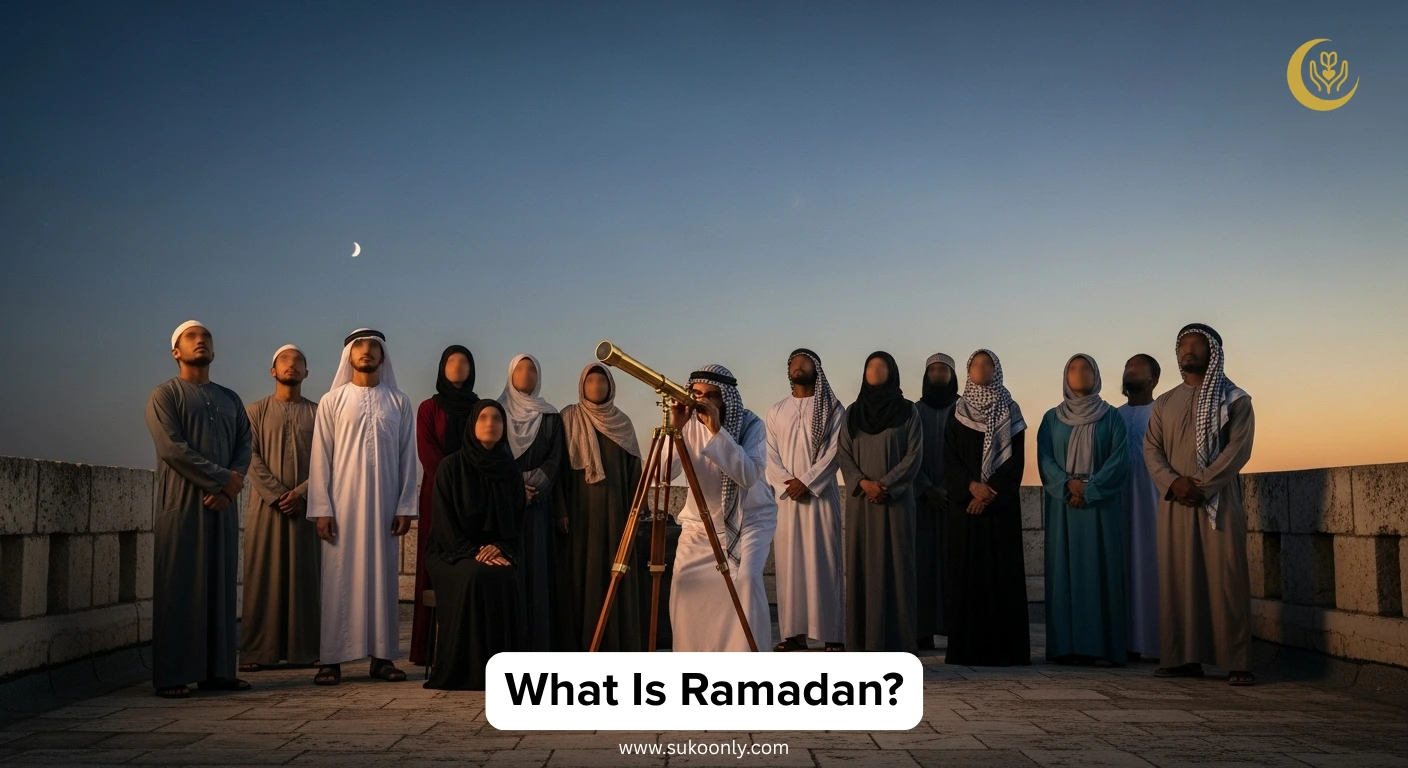
Ramadan is the ninth month of the Islamic lunar calendar and one of the Five Pillars of Islam. During Ramadan, Muslims worldwide fast from dawn to sunset as an act of worship, spiritual discipline, and obedience to Allah. Fasting in Ramadan, known as sawm, is obligatory for all healthy adult Muslims and represents a core practice of Islamic faith.
Ramadan is the month in which the Qur’an was revealed to the Prophet Muhammad, establishing its central importance in Islamic belief. Because of this, Ramadan is marked by increased prayer (salah), recitation of the Qur’an, charity (zakat), and personal reflection.
The word “Ramadan” comes from the Arabic root R-M-Ḍ (ر-م-ض), meaning “scorching heat,” symbolizing spiritual purification and moral discipline. During Ramadan, Muslims work on getting closer to Allah by praying and controlling their behavior.
Ramadan lasts 29 or 30 days, depending on the lunar cycle. The beginning of Ramadan is determined by the sighting of the crescent moon (hilal). Religious authorities or local moon-sighting committees officially declare the start of Ramadan, which can result in slight date differences between countries. The month concludes with Eid al-Fitr, the Islamic festival that marks the completion of fasting.
What is Fasting in Ramadan?
Fasting in Ramadan is a core act of worship in Islam, where Muslims abstain from food, drink, and sinful behavior from dawn (Fajr) until sunset (Maghrib). It’s not just about hunger or thirst—it’s a complete form of spiritual discipline that deepens the connection with Allah. While fasting, Muslims strive to control anger, speech, and actions—with the greater goal of building lasting taqwa (Allah-consciousness) that continues beyond Ramadan and outside fasting hours.
Ramadan is more than a ritual—it’s a spiritual transformation. As scholars often say:
-
- Rajab is for planting seeds,
- Sha’ban (not Shawwal) is for watering, and
- Ramadan is when the leaves bloom.
This symbolic cycle reminds Muslims to begin preparing early so that by Ramadan, the heart is fully ready to absorb the blessings.
Fasting is not limited to praying five times and reading the Qur’an—though those are essential. It’s about aligning both deen (faith) and duniya (worldly life). You continue to work, study, and live your life, but with heightened awareness of your intentions, actions, and words.
For example, avoiding a lie—even if it reaches your tongue—simply to please Allah holds greater weight in Ramadan. A good deed done during this month is multiplied many times over—even 10x or more—according to various Islamic traditions.
If you haven’t started preparing in Rajab or Sha’ban, it’s never too late. Start now. Wake up for Fajr, read even a few pages of the Qur’an after each prayer, and do zikr (remembrance of Allah) during Dhuhr. Even if you’re a slow reader or struggle with Arabic, remember: intention matters more than perfection.
The Prophet Muhammad (ﷺ) himself was taught by the Angel Jibreel (AS)—he didn’t know how to read before revelation. So if you’re just beginning or feel you’re not “good enough,” you’re still walking the prophetic path. Your effort is seen, rewarded, and cherished.
Duas in Ramadan

Dua (supplication) holds special power during Ramadan, especially while fasting and during key times like before iftar, after obligatory prayers, and in the last 10 nights. The Prophet Muhammad (ﷺ) said, “The supplication of the fasting person is not rejected” (Tirmidhi). This makes Ramadan one of the best times to call upon Allah sincerely for forgiveness, guidance, and blessings.
Here are a few essential duas to recite during Ramadan:
وَبِصَوْمِ غَدٍ نَّوَيْتُ مِنْ شَهْرِ رَمَضَانَ Wa bisawmi ghadin nawaiytu min shahri Ramadan “I intend to fast tomorrow for the month of Ramadan.” اللَّهُمَّ إِنِّي لَكَ صُمْتُ، وَبِكَ آمَنتُ، وَعَلَيْكَ تَوَكَّلْتُ، وَعَلَىٰ رِزْقِكَ أَفْطَرْتُ Allahumma inni laka sumtu, wa bika aamantu, wa ‘alayka tawakkaltu, wa ‘ala rizq-ika-aftartu “O Allah! I fasted for You, and I believe in You, and I put my trust in You, and with Your sustenance I break my fast.” اللَّهُمَّ إِنَّكَ عَفُوٌّ تُحِبُّ الْعَفْوَ فَاعْفُ عَنِّي Allahumma innaka ‘afuwwun tuhibbul ‘afwa fa’fu ‘anni “O Allah, You are Most Forgiving, and You love forgiveness; so forgive me.” 1. Dua for Beginning the Fast (Suhoor)
2. Dua for Breaking the Fast (Iftar)
3. Dua for the Last 10 Nights (Laylat al-Qadr)
When to Make Duas in Ramadan?
-
- Before iftar (just before breaking the fast)
- During suhoor (the pre-dawn meal)
- Between adhan and iqamah
- After every salah
- During Laylat al-Qadr (especially in the last 10 nights)
Ramadan is the best time to open your heart and speak directly to Allah. Whether you’re fluent in Arabic or make dua in your own language, sincerity matters most. Even a short, heartfelt dua is accepted and multiplied during this blessed month.
Prayers & Night Worship in Ramadan
During Ramadan, prayers and night worship are intensified, making this month a time of deep spiritual connection. Along with the five daily prayers (salah), Muslims engage in extra acts of worship—most notably Taraweeh and Qiyam-ul-Lail (late night prayer).
1. Taraweeh Prayer
-
- Taraweeh is a special nightly prayer offered after ‘Isha throughout Ramadan.
- It is performed in even numbers, often 8 or 20 rak‘ahs, depending on the practice in your mosque or community.
- It is highly recommended (sunnah mu’akkadah) and was practiced by the Prophet Muhammad (ﷺ).
- The Qur’an is often recited in full over the course of the month during these prayers.
Example: Many mosques complete one juz (part) of the Qur’an each night during Taraweeh, allowing worshippers to hear the entire Qur’an by the end of Ramadan.
2. Qiyam-ul-Lail (Night Prayer)
-
- These are voluntary late-night prayers, sometimes performed in the last third of the night.
- During the last 10 nights of Ramadan, they become especially significant due to Laylat al-Qadr (the Night of Decree).
- Worshippers often stay up praying, reciting the Qur’an, and making duas in solitude.
Note: The Prophet (ﷺ) would increase his night worship in the last 10 nights, sometimes spending the entire night in prayer and urging his family to do the same (Bukhari, Muslim).
Rewards of Night Worship in Ramadan
-
- Night prayers cleanse the heart and draw the believer closer to Allah.
- Every letter of the Qur’an recited earns 10 good deeds or more—and in Ramadan, this is multiplied further.
- The Prophet (ﷺ) said, “Whoever stands (in prayer) during Ramadan out of faith and seeking reward, his past sins will be forgiven.” (Bukhari, Muslim)
Night worship in Ramadan is not about perfection—it’s about consistency, sincerity, and effort. Whether you pray in congregation or alone at home, use this time to reconnect with Allah in a meaningful way.
The Qur’an in Ramadan

Ramadan is known as the Month of the Qur’an because it was during this month that the first verses of the Qur’an were revealed to the Prophet Muhammad (ﷺ) through Angel Jibreel (Gabriel). Allah says in Surah Al-Baqarah (2:185):
“The month of Ramadan [is that] in which was revealed the Qur’an, a guidance for the people…”
1. Importance of Qur’an Recitation in Ramadan
-
- Muslims are encouraged to increase Qur’an recitation during Ramadan as a form of worship and reflection.
- Reciting even a single letter of the Qur’an earns a reward—and that reward is multiplied during Ramadan.
- Many aim to complete a full khatam (entire reading of the Qur’an) by reading one juz (part) per day.
Example: If you read 4–5 pages after each of the 5 daily prayers, you can complete the Qur’an within 30 days.
2. Reflection (Tadabbur) and Understanding
-
- It’s not only about reading, but also understanding and applying the Qur’an’s guidance in daily life.
- Reflecting on the meanings, even if in translation, brings spiritual depth to your worship.
- You can set a personal goal to read the tafsir (explanation) of one surah per week.
3. Listening to the Qur’an
-
- If you’re unable to read fluently, listening to recitation—especially during Taraweeh or through audio—is also rewarding.
- Intention matters. Effort counts, even if your reading is slow.
Encouragement: The Prophet (ﷺ) said, “The one who is proficient in the Qur’an will be with the noble angels… and the one who reads it with difficulty, will have a double reward.” (Bukhari, Muslim)
Tips for Building a Qur’an Routine in Ramadan
-
- Schedule specific times: after Fajr, Dhuhr, and before Iftar.
- Pair recitation with dua and dhikr to enhance focus.
- Use a Qur’an app with audio and translation if reading Arabic is difficult.
Whether you read one page or one juz, stay consistent and sincere. Ramadan is the ideal time to reconnect with the Qur’an—not only through words, but through understanding and action.
Laylatul Qadr

Laylatul Qadr (The Night of Decree or Power) is the most sacred night in the Islamic calendar. It falls within the last 10 nights of Ramadan, most likely on an odd night—the 21st, 23rd, 25th, 27th, or 29th. According to the Qur’an, it is “better than a thousand months” (Surah Al-Qadr 97:3), meaning worship on this one night carries the reward of over 83 years.
1. Why Laylatul Qadr Is Special?
-
- It marks the night when the Qur’an was first revealed to Prophet Muhammad (ﷺ).
- Angels, including Jibreel (AS), descend to earth by Allah’s command.
- Allah’s mercy, forgiveness, and blessings are abundant and widespread.
“The angels and the Spirit descend therein by permission of their Lord for every matter. Peace it is until the emergence of dawn.” (Qur’an 97:4–5)
2. Signs of Laylatul Qadr
While the exact night is hidden, signs may include:
-
- A calm and peaceful night
- Moderate temperature (not too hot or cold)
- A unique sense of tranquility in the air
- The sun rising the next morning without sharp rays
Note: These signs are subtle and not guaranteed—so the best approach is to worship consistently during all last 10 nights.
3. Best Acts of Worship on Laylatul Qadr
-
- Qiyam (Night Prayer): Spend time in long, heartfelt prayer.
- Dua: The most famous dua for this night is:
اللَّهُمَّ إِنَّكَ عَفُوٌّ تُحِبُّ الْعَفْوَ فَاعْفُ عَنِّي Allahumma innaka ‘afuwwun tuhibbul ‘afwa fa’fu ‘anni “O Allah, You are Forgiving and love forgiveness, so forgive me.”
-
- Qur’an Recitation: Read or listen with reflection.
- Dhikr: Repeat phrases like SubhanAllah, Alhamdulillah, Allahu Akbar, and La ilaha illallah.
- Charity: Give even a small amount each night to maximize reward.
How to Prepare for Laylatul Qadr?
-
- Make a dua list in advance.
- Reduce distractions (phone, social media, unnecessary chores).
- Sleep early so you can worship more during the night.
- Involve your family, especially in simple acts like dua and Qur’an listening.
Don’t wait for the 27th night—seek Laylatul Qadr in all of the last 10 nights, especially the odd ones. A single sincere act could change your destiny for a lifetime.
Daily Life During Ramadan

Daily life during Ramadan revolves around balancing spiritual devotion with everyday responsibilities. Muslims continue with work, school, and family life while adjusting routines to focus on worship, self-control, and intentional living.
1. Typical Daily Schedule
-
- Suhoor (pre-dawn meal): A light, energizing meal before Fajr prayer.
- Fajr Prayer: Performed right after suhoor; many stay up afterward for Qur’an or dhikr.
- Daytime: Work, school, or chores continue—but with an effort to avoid gossip, anger, or wasting time.
- Dhuhr & Asr Prayers: Short pauses to reconnect through prayer.
- Evening (Iftar): Fast is broken at sunset (Maghrib) with dates and water, followed by a light meal.
- Isha & Taraweeh: Night prayers and extended Qur’an recitation.
- Rest: Sleep is often broken into parts—some at night, some in the afternoon.
Tip: Many find success by shifting heavy tasks to the morning when energy is higher and using late afternoons for rest and reflection.
2. Balancing Worship & Daily Duties
-
- Islam encourages a balance between deen (religion) and duniya (worldly life).
- You’re not required to stop working—but you are encouraged to stay mindful, speak kindly, and maintain sincerity in both prayer and action.
- Even daily chores can become acts of worship if done with good intention.
Example: A mother preparing iftar for her family is earning reward equal to someone giving charity, if she does it with the right niyyah (intention).
3. Spiritual Discipline Throughout the Day
-
- Control of the tongue is essential: no lying, gossip, or backbiting.
- Guard the eyes and thoughts: avoid distractions, inappropriate content, or idle talk.
- Stay consistent with Qur’an recitation, dua, and dhikr, even in small amounts.
Practical Tips for a Spiritually Productive Day
-
- Wake up early for suhoor and Fajr to set the tone.
- Keep a pocket Qur’an or app with you for short readings.
- Use a daily Ramadan tracker to monitor prayers, fasting, and Qur’an goals.
- Avoid energy crashes by eating smart (dates, water, fruits, light meals).
- Remember: intention turns routine into reward.
Ramadan is not about doing everything perfectly—it’s about doing your best every day. Whether you’re at work, caring for children, or studying, each part of your day can bring reward when aligned with sincerity and remembrance of Allah.
Emotional & Spiritual Well-Being in Ramadan

Ramadan isn’t just a time for physical fasting—it’s also a chance to renew your emotional and spiritual health. This sacred month creates space to pause, reflect, and reconnect with your purpose, helping you find peace in both your heart and mind.
1. Spiritual Clarity Through Worship
-
- Prayer, Qur’an, and dua help anchor the day, creating structure and spiritual calm.
- Worship brings clarity—especially when you pause to reflect on your intentions and renew your relationship with Allah.
- You may feel more emotionally grounded when your daily life includes regular time for stillness and connection.
Tip: After each prayer, spend just 1–2 minutes making heartfelt dua or doing dhikr. These short moments can bring long-lasting peace.
2. Managing Emotional Highs and Lows
-
- Fasting can trigger mood swings—especially in the first few days. Fatigue, hunger, or caffeine withdrawal may affect emotions.
- Use these moments as a chance to practice sabr (patience) and recognize them as part of the spiritual training of Ramadan.
- Try simple techniques: deep breathing, short naps, hydration at suhoor and iftar, and setting boundaries around screen time or social drama.
Example: If you feel irritable or overwhelmed, silently reciting “La hawla wa la quwwata illa billah” can help ground you emotionally and spiritually.
3. Letting Go of Guilt and Perfectionism
-
- Not every day will be perfect—and that’s okay. If you miss a prayer, struggle to focus, or feel disconnected, return gently without self-blame.
- Allah rewards effort, not perfection. What matters most is your sincerity and your willingness to keep trying.
- Comparing your Ramadan to others—especially online—can lead to spiritual burnout. Focus on your personal journey.
4. Build a Simple Spiritual Self-Care Routine
-
- Create quiet time after Fajr or before Maghrib to reflect, write duas, or journal gratitude.
- Choose a personal theme for the month (e.g., patience, forgiveness, or gratitude) and build small habits around it.
- Keep a note of one thing daily that you’re thankful for or one ayah that moved you.
Ramadan is a rare opportunity to care for your inner self—beyond the routines and obligations. When you protect your emotional balance and seek Allah with sincerity, the month becomes not just a ritual, but a reset for the soul.
Fasting & Core Duas
- Dua for Laylatul Qadr
- Dua for Fasting
- Dua for Forgiveness
- Dua for Repentance
- Dua for Patience
- Duas for Sadness Relief
- Dua for Anxiety
- Dua for Rizq
Qur’an Power Surahs for Ramadan
- Al-Baqarah
- Al-Mulk
- Ya-Seen
- Ar-Rahman
- Al-Waqiah
- Ad-Dukhan
Common Questions About Ramadan
Ramadan begins with the sighting of the new moon marking the start of the 9th month in the Islamic lunar calendar. The exact start date may vary by country based on moon sighting. In 2026, Ramadan is expected to begin around February 17, subject to local confirmation. Yes. Fasting during Ramadan is obligatory for all healthy, adult Muslims. Exceptions include those who are ill, traveling, menstruating, pregnant, nursing, elderly, or otherwise unable due to valid reasons. Key things that invalidate the fast include: Unintentional actions (e.g., eating by mistake) do not break the fast. Fasting is not obligatory for children until they reach puberty. However, many parents encourage children to fast partially or for shorter periods to help them practice and understand its significance. Laylatul Qadr (The Night of Decree) is the holiest night of the year, believed to fall within the last 10 nights of Ramadan, likely on an odd night. Worship on this night is said to be better than a thousand months (Qur’an 97:3). Yes. The duas of a fasting person are especially accepted, particularly before breaking the fast (iftar). The Prophet Muhammad (ﷺ) said, “The supplication of the fasting person is not rejected.” (Tirmidhi) Yes, you can brush your teeth while fasting, but be careful not to swallow water or toothpaste. Use a dry brush or brush early to stay cautious. For suhoor, eat foods that provide energy and hydration—like oats, eggs, fruit, and water. For iftar, break the fast with dates and water, followed by a balanced meal including protein, carbs, and healthy fats. Taking medicine orally during fasting hours breaks the fast. If your health requires medication, consult a scholar or doctor about alternatives like adjusting the timing or using non-oral forms (if allowed). Not always. Some communities follow local moon sightings, while others follow global sightings or fixed calendars. This may lead to different start and end dates across countries or even within the same region.

Mohammed Basheer is the founder of Sukoonly.com, an Islamic blog focused on duas, prophetic healing, and Qur’anic wisdom. He writes with sincerity and spiritual depth for seekers around the world.