
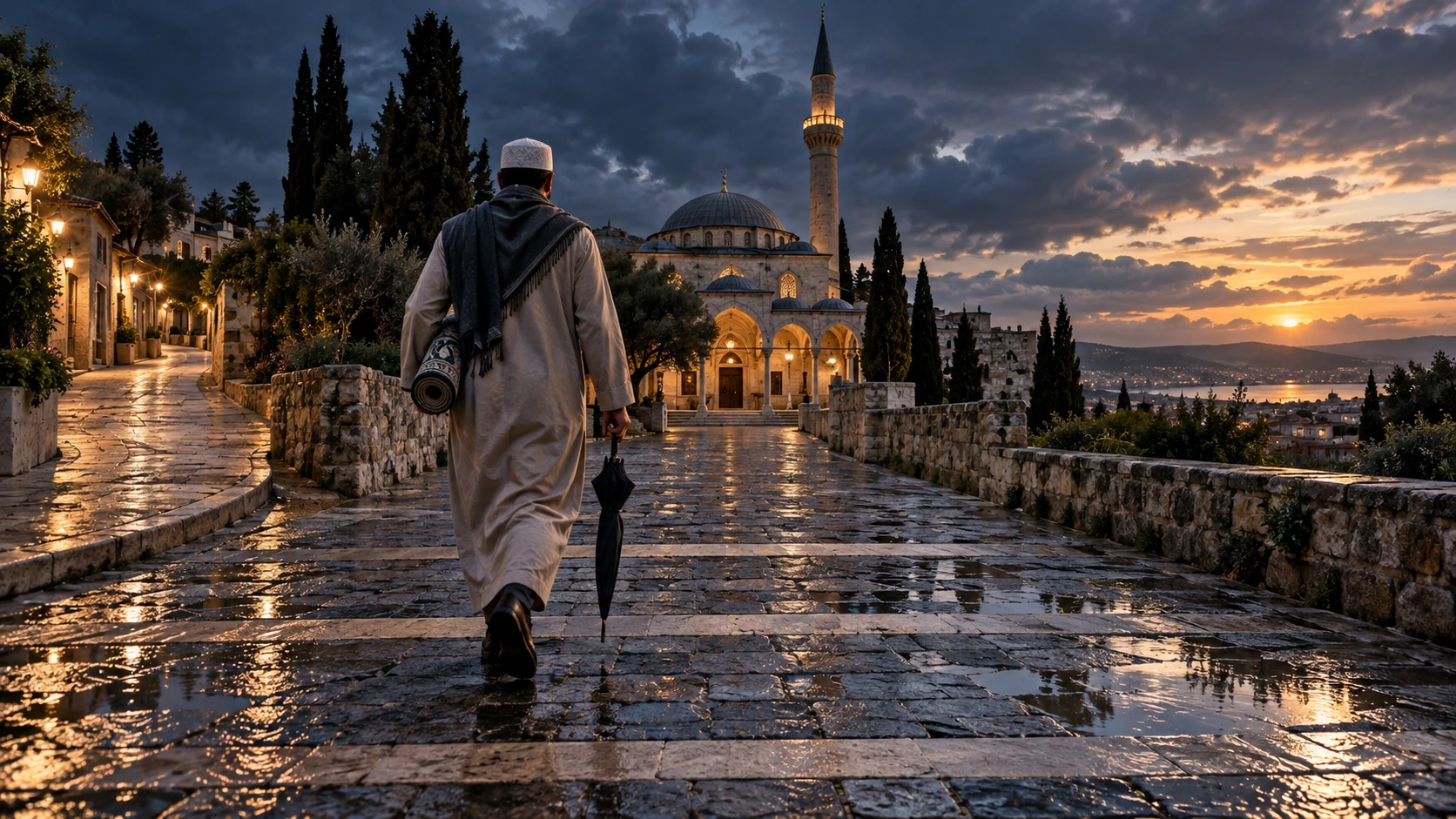
Sabr is one of the most frequently mentioned virtues in the Quran — mentioned explicitly over 90 times across different contexts. Yet most people who know the word translate it simply as “patience,” a translation that captures perhaps half of what the Arabic term actually carries. The result is that sabr is understood as passive endurance — waiting without complaint. The Islamic scholarly tradition defines it as something far more active, far more demanding, and far more rewarding.
This article defines sabr with the precision it deserves: its Arabic root, its three distinct types identified by scholars, the Quranic and prophetic evidence for its reward, and how it connects to the broader Islamic concepts of tawakkul, tawbah, and dua.
What Does Sabr Mean? — The Arabic Root
Sabr (صَبْر) comes from the Arabic root ṣabara (صَبَرَ), which carries three intertwined meanings:
- To restrain — specifically, to hold the self back from something. Sabr in Arabic is literally self-restraint: the soul wants to react, complain, flee, or succumb — and sabr is the act of holding it.
- To endure — to continue functioning under pressure without breakdown
- To remain constant — to maintain a position or state with steadfastness over time
In pre-Islamic Arabic poetry, ṣabr was used to describe a warrior who stood firm in battle rather than retreating. The Islamic use of the word preserved this active, muscular quality — sabr is not the absence of struggle; it is the presence of a restraining force within the struggle.
Ibn al-Qayyim al-Jawziyyah, in Uddat al-Sabirin wa Dhakhirat al-Shakirin (his full treatise on sabr), defines it as: “The restraint of the soul from panic and agitation, the restraint of the tongue from complaint, and the restraint of the limbs from actions that are forbidden in that state.”
The 3 Types of Sabr — The Classical Scholarly Framework
Islamic scholars — most systematically Ibn al-Qayyim and Ibn Rajab al-Hanbali — classify sabr into three distinct types based on what the person is exercising patience with respect to. All three are obligatory for every Muslim in their respective domains. Understanding the distinction changes how a Muslim understands the concept of spiritual endurance:
Type 1 — Sabr ʿalā al-Ṭāʿah — Patience in Performing Acts of Worship
This is sabr exercised in the act of obeying Allah ﷻ — maintaining the five daily prayers, fasting, reciting Quran, giving zakah, performing hajj, making dhikr — when the soul resists, when tiredness is present, when competing priorities pull at the person’s time.
The Quran commands this type explicitly:
وَأْمُرْ أَهْلَكَ بِالصَّلَاةِ وَاصْطَبِرْ عَلَيْهَا
Wa’mur ahlaka biṣ-ṣalāti waṣṭabir ‘alayhā
“And enjoin prayer upon your family and be steadfast in it.” — Quran 20:132
The word used here — iṣṭabir — is the Form X intensive of sabr, meaning “be extremely patient, be thoroughly steadfast.” The Quran does not say merely “pray” — it says “be persistently patient in maintaining the prayer.” This is because the soul’s inclination is often toward comfort and avoidance; sabr in worship is the act of overriding that inclination consistently, day after day, year after year.
This type of sabr increases in reward the more demanding the act of worship is. The Prophet ﷺ said: “The reward of deeds depends upon the intentions and every person will get the reward according to what he intends.” — Bukhari 1. The effort of sabr exercised to maintain worship — especially when difficult — multiplies the reward of the worship itself.
Type 2 — Sabr ʿan al-Maʿṣiyah — Patience in Avoiding Prohibited Things
This is sabr exercised in holding the self back from what is forbidden — resisting the pull toward haram speech, actions, relationships, earnings, or entertainment. In many ways, this is the type of sabr that requires the most sustained muscular effort, because the prohibited things often appear attractive in the moment.
The Quran describes the model of this sabr in the account of Prophet Yusuf (عليه السلام), who exercised it under extreme personal pressure:
إِنَّهُ مَن يَتَّقِ وَيَصْبِرْ فَإِنَّ اللَّهَ لَا يُضِيعُ أَجْرَ الْمُحْسِنِينَ
Innahu man yattaqi wa yaṣbir fa’innallāha lā yuḍī’u ajral-muḥsinīn
“Indeed, whoever fears Allah and is patient — then indeed, Allah does not allow to be lost the reward of those who do good.” — Quran 12:90
The Prophet ﷺ described the spiritual rank of the person who exercises sabr in avoiding temptation:
“Seven people will be shaded by Allah under His shade on the Day when there is no shade except His… [including] a man who was invited by a woman of beauty and position but said: ‘I fear Allah.'” — Bukhari 660, Muslim 1031
The specific mention of “a woman of beauty and position” in the hadith indicates that this sabr was exercised against a powerful pull — not an easy refusal. The reward of divine shade on the Day of Judgement is proportional to the difficulty of the sabr exercised.
Type 3 — Sabr ʿalā al-Muṣībah — Patience in the Face of Affliction
This is the type most people think of when they hear “patience” — enduring calamity, loss, illness, death of loved ones, financial ruin, persecution. It is the sabr of restraining the soul from panic, restraining the tongue from complaints against Allah ﷻ, and restraining the body from expressions of grief that cross into impermissible territory (striking oneself, tearing clothing, etc.).
The Quran provides the complete theological framework for this type:
وَلَنَبْلُوَنَّكُم بِشَيْءٍ مِّنَ الْخَوْفِ وَالْجُوعِ وَنَقْصٍ مِّنَ الْأَمْوَالِ وَالْأَنفُسِ وَالثَّمَرَاتِ ۗ وَبَشِّرِ الصَّابِرِينَ الَّذِينَ إِذَا أَصَابَتْهُم مُّصِيبَةٌ قَالُوا إِنَّا لِلَّهِ وَإِنَّا إِلَيْهِ رَاجِعُونَ
Wa lanabluwannakum bishay’in minal-khawfi wal-jū’i wa naqṣin minal-amwāli wal-anfusi waththamarāt. Wa bashshiriṣ-ṣābirīn. Alladhīna idhā aṣābathum muṣībatun qālū innā lillāhi wa innā ilayhi rāji’ūn
“And We will surely test you with something of fear and hunger and a loss of wealth and lives and fruits — but give good tidings to the patient. Who, when disaster strikes them, say: ‘Indeed, to Allah we belong, and indeed, to Him we shall return.'” — Quran 2:155-156
Notice the structure: affliction is promised as a certainty (“We will surely test you“) — not a possibility. The response — Innā lillāhi wa innā ilayhi rāji’ūn — is not a mourning phrase but a theological statement: “We belong to Allah; therefore what He takes was His to begin with. And we return to Him; therefore the destination is certain.” The sabr of calamity is not the absence of grief — it is the presence of this theological clarity alongside the grief.
The Prophet ﷺ clarified that sabr in affliction does not require the absence of emotional response:
“The eye cries and the heart grieves, but we do not say except what pleases our Lord. And we are, O Ibrahim, grieved by your departure.” — Bukhari 1303 (said by the Prophet ﷺ at the death of his son Ibrahim)
Tears are not a breach of sabr. The tongue is held; the heart is held; the limbs are held — but the eyes cry. The Prophet ﷺ himself established by example that genuine grief and genuine sabr coexist.
The Reward of Sabr — “Without Account”
The reward promised for sabr in the Quran is unique among all Islamic virtues in a significant way:
إِنَّمَا يُوَفَّى الصَّابِرُونَ أَجْرَهُم بِغَيْرِ حِسَابٍ
Innamā yuwaffas-ṣābirūna ajrahum bighayri ḥisāb
“Indeed, the patient will be given their reward without account.” — Quran 39:10
Bighayri ḥisāb — “without account” — is among the most astonishing phrases in the Quran regarding reward. Every other deed in Islamic theology is accounted — weighed, measured, and rewarded in proportion to its weight. Bighayri ḥisāb means the reward of sabr operates outside this accounting system — it is simply given without being counted or measured. Ibn al-Qayyim notes that this is because the value of sabr cannot be computed: it underlies every virtue, every act of obedience, every avoidance of sin, and every response to calamity.
Additional Quranic statements on the reward of sabr:
- The company of Allah: “And be patient — indeed, Allah is with those who are patient.” — Quran 8:46
- Love of Allah: “And Allah loves the steadfast.” — Quran 3:146
- Guidance: “And We made them leaders guiding by Our command when they were patient and certain of Our signs.” — Quran 32:24
- A special greeting in Jannah: “Peace be upon you for what you patiently endured. And excellent is the final home.” — Quran 13:24
Sabr Is Not Passive — The Active Dimension
The most damaging misunderstanding of sabr is that it means doing nothing. Islamic scholarship definitively rejects this:
- Sabr in affliction does not mean accepting injustice. Seeking legal remedy for wrongdoing, speaking against oppression, and working actively to change harmful circumstances are all permitted and sometimes obligatory. Sabr is about the internal state — not complaining against Allah ﷻ, not losing faith, not breaking into impermissible acts of despair — while actively using all permissible means to address the situation.
- Sabr and dua are complements. The Quran commands: “And seek help through sabr and salah.” (Quran 2:45). Making dua during hardship, asking Allah ﷻ for relief, taking medicine, seeking counsel, working toward solutions — all of these are compatible with sabr, not opposites to it.
- Sabr is sustained effort, not resignation. The Prophet ﷺ continued to work, plan, and act despite facing opposition, grief, and hardship for 23 years. His example demonstrates that sabr is the internal spiritual orientation that makes sustained effort sustainable — not the cessation of effort.
Sabr and Shukr — The Two Responses to All States
Ibn al-Qayyim identifies a beautiful comprehensive principle in Madarij al-Salikin: the Muslim’s entire life can be characterized by two states — ease and hardship — and the two correct responses to them are shukr (gratitude) and sabr respectively. He writes: “The whole of the deen is contained in these two: sabr in difficulty and shukr in ease.”
The Prophet ﷺ confirmed this with a remarkable statement:
“How wonderful is the affair of the believer! All his affairs are good for him — and this is for no one except the believer. If ease comes to him, he gives thanks and that is good for him. If hardship comes to him, he shows sabr and that is good for him.” — Muslim 2999
This hadith establishes that the believer who has internalized both sabr and shukr has achieved a state where every circumstance is spiritually beneficial — not because the circumstances themselves are always pleasant, but because the response to them always generates reward.
Sabr and Dua — Seeking Help Through Both
One of the most practical Quranic prescriptions combines sabr and salah (which includes dua) as the dual weapon against difficulty:
وَاسْتَعِينُوا بِالصَّبْرِ وَالصَّلَاةِ ۚ وَإِنَّهَا لَكَبِيرَةٌ إِلَّا عَلَى الْخَاشِعِينَ
Wasta’īnū biṣ-ṣabri waṣ-ṣalāh. Wa innahā lakabīratun illā ‘alal-khāshi’īn
“And seek help through patience and prayer. Indeed, it is difficult except for the humbly submissive [to Allah].” — Quran 2:45
The verse acknowledges that sabr is difficult — lakabīrah, meaning great/heavy — and that only those with khushu’ (internal humility and presence before Allah) find it accessible. This is the honest acknowledgment in the Quran itself that sabr is not easy. The pathway to it is prayer and dua — the connection to Allah ﷻ that sustains the capacity for sabr. When sabr becomes difficult, the prescription is not to try harder but to return to salah and dua first.
The etiquettes of dua include specifically making dua in the state of hardship — because the orientation of need and humility that comes with genuine affliction is one of the conditions for acceptance of dua.
Prophetic Examples of Sabr
Prophet Ayyub (عليه السلام) — Sabr in Prolonged Illness
Ayyub (عليه السلام) endured years of severe illness and loss. The Quran does not give us detailed complaint from him — it gives us his dua (Quran 21:83), which contains no demand, only acknowledgment. His sabr was active: he maintained his relationship with Allah ﷻ, he continued to turn to Him, and he did not attribute his suffering to injustice or abandon his worship. When Allah ﷻ relieved him, He praised his sabr explicitly: “Indeed We found him patient — an excellent servant. Indeed, he was one repeatedly turning back [to Us].” — Quran 38:44
Prophet Ibrahim (عليه السلام) — Sabr Against Every Test
Ibrahim (عليه السلام) was tested with leaving his homeland, with fire, with leaving his wife and infant son in an unirrigated valley, and with the command to sacrifice his son. At every test, sabr was exercised — not by passive waiting but by deliberate, active compliance with Allah’s command combined with complete internal submission. The Quran characterizes him as: “Indeed, Ibrahim was a leader [ummah], devoutly obedient to Allah, inclining toward truth, and he was not of those who associate others with Allah.” — Quran 16:120
FAQs — Sabr in Islam
Is it permissible to cry during sabr?
Yes — as established by the Prophet ﷺ at the death of his son Ibrahim. Crying is a natural human response. Sabr does not require emotional suppression; it requires that the tongue not speak against Allah’s decree and that the limbs not act in impermissible ways (striking oneself, tearing clothing). The grief of the heart and the tears of the eyes are not a violation of sabr.
Is saying “why did this happen to me?” a breach of sabr?
Internal questioning of circumstance — trying to understand or process grief — is not a breach of sabr. What breaches sabr is the theological statement that Allah was unjust or wrong in His decree, or the behavioral response of abandoning worship and trust in Allah. The Prophet ﷺ distinguished between the “wailing of grief” (impermissible) and “the weeping of mercy” (permitted). Scholars similarly distinguish between processing pain and objecting to divine decree.
Can a person ask Allah to remove hardship, or is that against sabr?
Asking Allah ﷻ to remove hardship is not only permitted — it is encouraged. Making dua for relief from sadness and hardship is from the Sunnah itself. Prophet Ayyub made dua for relief. Prophet Yunus made dua from within the whale. Asking for relief is different from complaining against Allah’s decree; the first is directed toward Allah as a petition, the second is a statement about His justice. Sabr and dua for relief coexist and complement each other.
Which type of sabr is the most rewarded?
Ibn al-Qayyim holds that Sabr ʿan al-Maʿṣiyah (avoiding haram) is the most difficult for most people because it requires actively resisting an internal pull, often repeatedly, under circumstances where the forbidden thing is attractive. Some scholars argue Sabr ʿalā al-Ṭāʿah (maintaining worship) is most comprehensive because it underpins the entire structure of Islamic practice. All three are obligatory; all three generate the “reward without account” of Quran 39:10.

Mohammed Basheer is the founder of Sukoonly.com, an Islamic blog focused on duas, prophetic healing, and Qur’anic wisdom. He writes with sincerity and spiritual depth for seekers around the world.