

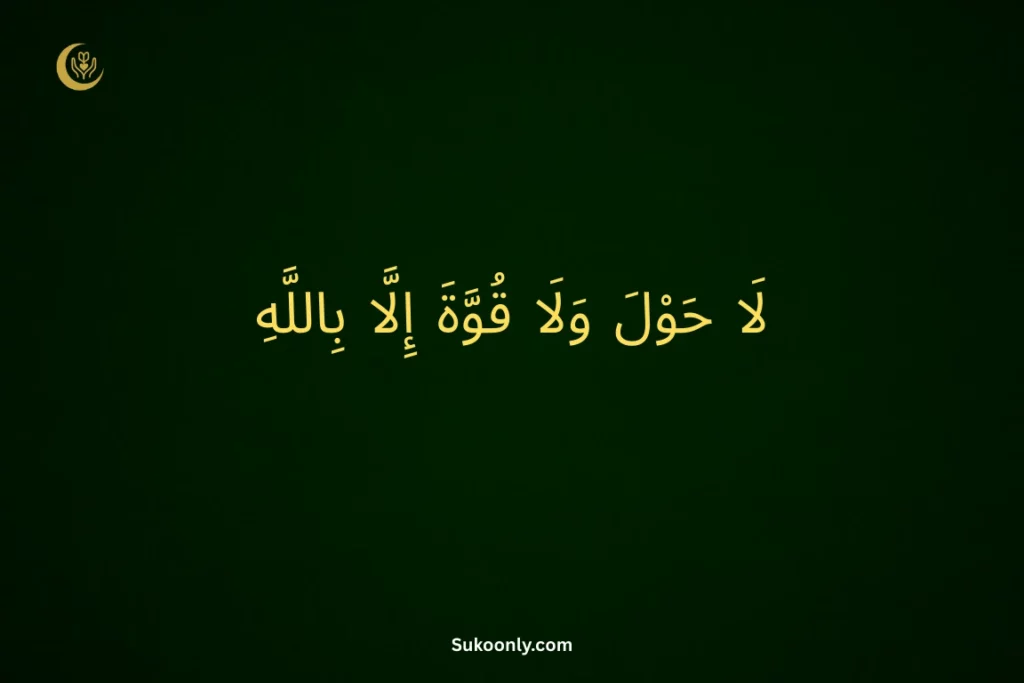
“La hawla wala quwwata illa billah” (لَا حَوْلَ وَلَا قُوَّةَ إِلَّا بِاللَّهِ) is the dhikr Muslims recite when they feel overwhelmed, powerless, or in need of strength beyond their own capacity. The phrase means “There is no power and no might except with Allah,” and it appears throughout authentic Hadith collections, including Sahih Bukhari, where the Prophet ﷺ described it as “a treasure from beneath the Throne.”
This dhikr serves as a spiritual realignment. It reminds the believer that human effort has limits, but Allah’s ﷻ power does not. When life feels heavy—when fear settles, when hardship hits, or when a person steps into an uncertain moment—this phrase becomes an anchor that grounds the heart in tawakkul (reliance on Allah).
In Islamic practice, La hawla wala quwwata illa billah is not a statement of defeat. It is a conscious act of shifting what is too heavy for the human soul toward the One who carries all affairs. It gives emotional stability, spiritual surrender, and the inner calm to continue, even when strength feels empty.
La Hawla Wala Quwwata Illa Billah – Arabic, Transliteration, and Meaning
لَا حَوْلَ وَلَا قُوَّةَ إِلَّا بِاللَّهِ Transliteration: Lā ḥawla wa lā quwwata illā billāh Meaning: “There is no power and no might except with Allah.” This short phrase holds incredible meaning. The word ḥawl refers to the ability to move, change, or shift — whether it’s our situation, emotions, or even mindset. Quwwah means strength — the inner energy we need to keep going, hold on, or face what’s ahead. Together, they remind us that none of this — not even the smallest action — can happen unless Allah ﷻ allows it. He is Al-Qayyum, the One who holds everything up, including us. Saying La hawla wala quwwata illa billah is more than words. It’s admitting we don’t have control — and that’s okay — because Allah does. It’s a way of placing our struggles, efforts, and hopes back where they belong: with the One who never gets tired, never lets go, and never fails.
When to Say La Hawla Wala Quwwata Illa Billah?
In a hadith from Sahih Muslim, the Prophet ﷺ called this phrase “a gate of Paradise.” He also said it’s one of those remembrances that brings great reward — yet it’s so light and easy on the tongue. Scholars say it’s a way of asking for Allah’s help without even needing to explain what’s wrong. Just saying it opens the door to divine support. You can whisper it: The more you say it, the more natural it becomes. It turns into a quiet habit of the heart — a way of turning back to Allah, again and again, every time you realize… you were never meant to do it all on your own.
La Hawla Wala Quwwata Illa Billah – Virtues & Rewards from Authentic Hadith
La hawla wala quwwata illa billah isn’t just a phrase we say — it’s a remembrance that Allah ﷻ treasures. In Sahih Bukhari, the Prophet ﷺ called it “a treasure from beneath the Throne” — showing how special it is in the eyes of our Creator. It’s more than words. It’s a way of admitting that all strength, all change, and all control belong only to Allah.
In Sahih Muslim, it’s described as one of the “gates of Paradise.” Other hadith tell us this phrase is among those most beloved to Allah — easy to say, but so heavy on the scale when we meet Him on the Day of Judgment.
What makes it so powerful is how small it sounds, but how much it carries. It reflects our trust (tawakkul), our servitude (ubudiyyah), and our deep belief in Allah’s power (qudrah). When we say it with meaning, it realigns our heart — reminding us Who is truly in charge, and Whose help we always need.
La Hawla vs Similar Phrases
Compare that to: But La hawla is different. It’s what you say when you’re not even sure where to begin. It’s a whisper from the soul that says: “Ya Allah, I have no strength — carry me.” Each phrase is powerful in its own way. But knowing when to say them — and what your heart is really feeling — turns simple words into deep, healing remembrance.
FAQs — La Hawla Wala Quwwata Illa Billah
Yes — it is authentically narrated as part of the Tashahhud and also appears in prescribed adhkar after salah.
According to Sahih Muslim and other hadith collections, La hawla wala quwwata illa billah is one of the phrases included in extended Tashahhud recitations. Additionally, it is part of the post-salah remembrances taught by the Prophet ﷺ. Saying it after the five daily prayers is a Sunnah practice, especially when combined with other phrases like Subhanallah, Alhamdulillah, and Allahu Akbar. It serves as a reminder that our prayer, action, and spiritual strength all depend on Allah alone.
Both are powerful, but they address different states of the soul.
La hawla wala quwwata illa billah expresses a sense of helplessness and the need for divine empowerment, while Astaghfirullah is a plea for forgiveness and cleansing of sins. If you're overwhelmed due to your own mistakes or shortcomings, Astaghfirullah is the right dhikr. But if you're emotionally or spiritually exhausted and just feel like you can't do it on your own, then La hawla is the cry of the soul. One is seeking pardon, the other is seeking strength.

Mohammed Basheer Orsala is the founder of Sukoonly.com - an Islamic resource dedicated to verified Quranic duas and Sunnah-based supplications. A self-taught Islamic researcher, he has studied classical texts and authenticated hadith collections including the works of Imam al-Nawawi, Shaykh al-Albani, Ibn Hajar al-Asqalani, and Ibn al-Qayyim. He writes to make verified Prophetic supplications accessible to English-speaking Muslims worldwide.