
Most Muslims know the two pillars of the deen that are regularly discussed: Islam (the external acts of submission) and Iman (belief and its branches). Far fewer know that the hadith considered the most comprehensive summary of the entire religion — the Hadith of Jibreel — identifies a third pillar above both: Ihsan. This article defines that third pillar with the precision the tradition demands.
What Does Ihsan Mean? — The Arabic Root
Ihsan (إحسان) comes from the Arabic root ḥasuna (حَسُنَ), meaning “to be good, beautiful, or excellent.” The Form IV (Af’ala) verb aḥsana (أحسن) means “to do something with excellence, to do it beautifully, to perfect it.” Ihsan is thus not merely doing good — it is doing everything with the consciousness of excellence that comes from awareness of Allah ﷻ.
The Quran uses the root ḥ-s-n over 190 times across different contexts — more frequently than sabr (90+ times) and nearly as frequently as salah. It is one of the most pervasive value-concepts in the entire Quran, which indicates its centrality to the Islamic ethical and spiritual system.
The Hadith of Jibreel — The Foundation
The most critical text for understanding Ihsan is the Hadith of Jibreel (عليه السلام), considered by scholars the most comprehensive single hadith in the Islamic tradition — often called “the mother of the Sunnah” (umm al-sunnah):
One day the Prophet ﷺ was sitting with the Companions when a man came with extremely white clothing and extremely black hair, with no sign of travel on him, and no one among them knew him. He sat before the Prophet ﷺ and said: “O Muhammad, tell me about Islam.” The Prophet ﷺ said: “Islam is to testify that there is no god but Allah and that Muhammad is the Messenger of Allah, to establish the prayer, to give zakah, to fast Ramadan, and to make Hajj to the House if you are able.” The man said: “You have spoken the truth.” [The Companions were surprised that he asked and then confirmed.] The man said: “Tell me about Iman.” The Prophet ﷺ said: “It is to believe in Allah, His angels, His books, His messengers, the Last Day, and to believe in divine decree — both its good and its evil.” The man said: “You have spoken the truth. Now tell me about Ihsan.” The Prophet ﷺ said: “It is to worship Allah as though you see Him — for though you do not see Him, He indeed sees you.” The man said: “You have spoken the truth…” [The Prophet ﷺ later told the Companions]: “That was Jibreel — he came to teach you your deen.” — Muslim 8, Bukhari 50
The definition the Prophet ﷺ gave for Ihsan is precise and carries theological weight in every word: “An ta’budallāha ka’annaka tarāhu, fa’in lam takun tarāhu fa’innahu yarāk” — “To worship Allah as though you see Him — for though you do not see Him, He indeed sees you.”
Unpacking the Definition — Two Levels of Ihsan
The Prophet ﷺ’s definition contains two clauses connected by “for though…” — and scholars identify this as a description of two ascending levels of Ihsan:
Level 1 — Mushāhadah: Worshipping as Though You See Allah
The higher level — maqam al-mushāhadah (the station of witnessing) — is to worship Allah ﷻ with such complete consciousness of His presence that the act of worship is saturated with that awareness. The word “see” here is not literal vision; it refers to the state in which awareness of Allah ﷻ is so vivid and present that it functions as if He were visibly before the worshipper.
Ibn al-Qayyim describes this level: “The heart is filled with awareness of Allah to the degree that worship becomes an expression of joy and love, performed with complete attention and presence — because the person is worshipping the One he is aware of, not going through motions in a state of absence.”
This is the station of the greatest Companions and the Prophets. Scholars describe it as rare and not continuously sustained even by the most devout — but its aspiration shapes the quality of every act of worship.
Level 2 — Murāqabah: Worshipping with the Awareness of Being Seen
The lower (but still required) level — maqam al-murāqabah (the station of watchfulness) — is reflected in the second clause: “though you do not see Him, He sees you.” This is the constant awareness that Allah ﷻ observes every act, every intention, every private thought. Nothing is hidden from Him.
Al-Muraqabah is the minimum threshold of Ihsan — the constant consciousness that turns mechanical acts of worship into genuine communication with Allah ﷻ, and prevents a person from doing in private what they would not do in public (since Allah’s observation is more certain than any human’s). If Level 1 (mushāhadah) is not attainable at every moment, Level 2 (murāqabah) is always possible and always obligatory.
Ihsan Is Not Only in Worship — The Comprehensive Scope
Ihsan in the Quran and Sunnah extends beyond ritual worship to every domain of human action. The Prophet ﷺ stated this explicitly:
“Indeed, Allah has prescribed Ihsan in everything. So if you kill, do so with Ihsan. And if you slaughter [an animal], do so with Ihsan — let each of you sharpen his blade and relieve his animal [of suffering].” — Muslim 1955
This hadith is remarkable in its scope: the Prophet ﷺ chose the most jarring possible example — killing — to make the point that Ihsan applies even there. If the most difficult and extreme act requires Ihsan (doing it with precision, minimizing suffering, not being gratuitously harsh), then everything else in a Muslim’s life is implicitly also subject to the standard of Ihsan: their work, their parenting, their relationships, their social interactions, their business dealings.
Ihsan in daily life means:
- In relationships — treating people with the excellence you would want to receive; the Quran commands ihsan toward parents (Quran 2:83), relatives, orphans, neighbors, and all people
- In work — doing the task with the quality it deserves, knowing Allah ﷻ observes the quality of effort, not just the output
- In speech — saying only what is excellent, avoiding the unnecessary, the harmful, and the false
- In private — maintaining the same standard in private as in public, because murāqabah means the awareness that the divine observer is more constant than any human observer
Ihsan in the Quran — The Command and the Promise
إِنَّ اللَّهَ يَأْمُرُ بِالْعَدْلِ وَالْإِحْسَانِ
Innallāha ya’muru bil-‘adli wal-iḥsān
“Indeed, Allah commands justice and ihsan.” — Quran 16:90
This verse pairs justice (‘adl) and Ihsan as the two ethical pillars Allah ﷻ commands. ‘Adl is giving people what they are owed; Ihsan is giving them more than they are owed — with excellence, generosity, and care. The scholars note that justice is the minimum; Ihsan is the aspiration. A society built on justice alone is functional; a society built on Ihsan is beautiful.
هَلْ جَزَاءُ الْإِحْسَانِ إِلَّا الْإِحْسَانُ
Hal jazā’ul-iḥsāni illal-iḥsān
“Is the reward of Ihsan anything but Ihsan?” — Quran 55:60
This verse is one of the most linguistically perfect in the Quran — the word Ihsan appears twice, framing a rhetorical question that answers itself. The reward Allah ﷻ gives for Ihsan is itself Ihsan — meaning the response is always of the same quality or higher than the act. A person who treats others with excellence, worships with excellence, lives with excellence — receives divine excellence in return.
إِنَّ اللَّهَ مَعَ الَّذِينَ اتَّقَوا وَّالَّذِينَ هُم مُّحْسِنُونَ
Innallāha ma’alladhīnattaqaw walladhīna hum muḥsinūn
“Indeed, Allah is with those who fear Him and those who are doers of Ihsan.” — Quran 16:128
The divine companionship (ma’iyyah) of Allah ﷻ — His specific, supportive presence with a person — is paired in this verse with two qualities: taqwa (God-consciousness, fear) and Ihsan (excellence). The muḥsinūn (people of Ihsan) carry divine company in their endeavors.
Ihsan, Tawakkul, and Dua — The Spiritual Connection
Ihsan does not stand alone in the Islamic spiritual framework — it is the quality that elevates every other act of worship:
- Ihsan in dua — making dua with full presence of heart, using the etiquettes of dua, choosing the correct times, and expressing genuine need — is Ihsan of supplication. It transforms a mechanical formula into a living conversation.
- Ihsan in tawbah — returning to Allah with genuine nadam, complete cessation, and sincere resolve (not a performance of tawbah) — is Ihsan of repentance. It transforms a pro-forma statement of istighfar into an actual act of return.
- Ihsan in sabr — exercising patience not merely by gritting teeth but by maintaining trust in Allah’s wisdom and decrees — is Ihsan of endurance. It transforms avoidance of complaint into an active spiritual orientation.
- Ihsan in tawakkul — not just saying “I trust in Allah” but actually releasing outcomes to Him after doing everything within one’s capacity — is Ihsan of reliance. It transforms resignation into active spiritual surrender.
Ihsan is thus the quality standard that applies to every other spiritual concept in Islam. It is not a separate practice — it is the level of excellence to which every practice should aspire.
How to Cultivate Ihsan — Practical Steps
1. Begin Every Act with Bismillah and Intention
The conscious utterance of “Bismillah ar-Rahman ar-Rahim” before any act is an act of murāqabah — acknowledging Allah’s presence and invoking His name before beginning. It shifts the act from secular to sacred, from unconscious to deliberate. Making sincere niyyah (intention) for the sake of Allah before every action is the first step of Ihsan in that action.
2. Maintain Presence in Salah
The salah is the most structured opportunity for cultivating Ihsan. Khushu’ (humility and presence in prayer) is the specific application of mushāhadah/murāqabah within the prayer. The Prophet ﷺ described the difference between the prayer of one who has khushu’ and one who doesn’t as the difference between a letter that reaches the recipient and a letter that doesn’t. The pursuit of khushu’ in salah — knowing what you are reciting, understanding its meaning, slowing down — is the most daily training ground for Ihsan.
3. Practice Murāqabah as a Daily Habit
Scholars recommend a practical murāqabah practice: before beginning any significant act or conversation, pause and recall that Allah ﷻ observes. This is not anxiety-inducing awareness — it is the freeing awareness that the most important observer is always present, and therefore the most important standard to meet is always His. It removes the tyranny of other people’s opinions and replaces it with the steadiness of Allah’s sight.
4. Pursue Excellence in Everything, Not Just Worship
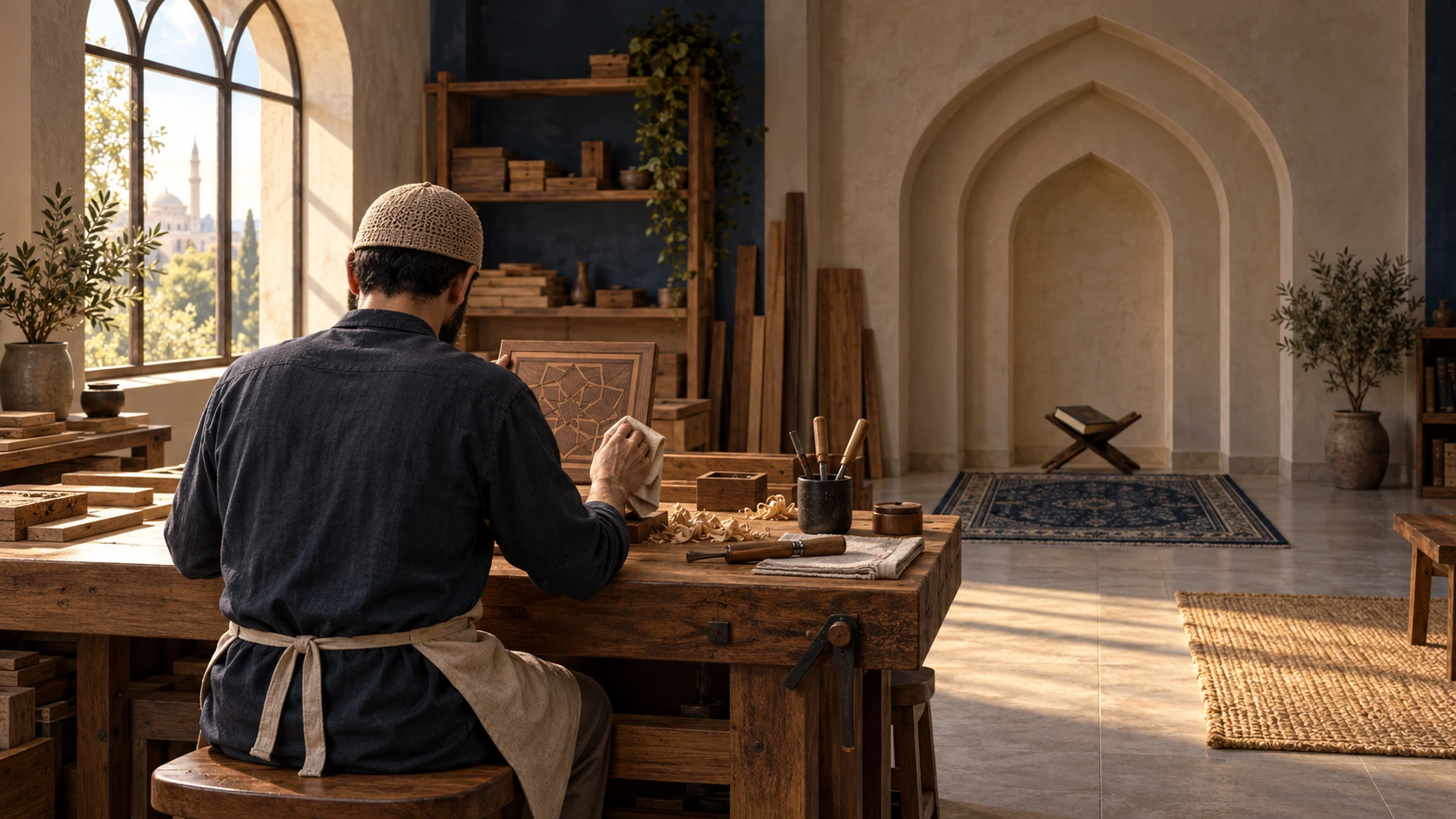
Based on the hadith of Muslim 1955, Ihsan is a standard applied to everything. The carpenter who does Ihsan in their craft, the doctor who does Ihsan in their medicine, the parent who does Ihsan in their parenting — all are fulfilling a Prophetic command and generating reward for it. This is one of the most transformative implications of Ihsan: there is no secular activity exempt from its standard, and therefore no secular activity exempt from divine reward when done with Ihsan.
FAQs — What Is Ihsan
Is Ihsan the same as Taqwa?
They are closely related but distinct. Taqwa is God-consciousness that expresses itself primarily through caution — avoiding what Allah has forbidden and maintaining what He has commanded. Ihsan is God-consciousness that expresses itself through excellence — doing what is required and more, with beauty and perfection. Taqwa is the floor; Ihsan is the aspiration above the floor. A person of taqwa keeps the minimum; a muhsin (person of Ihsan) does more than the minimum and does it beautifully. The Quran 16:128 pairs them together because both are needed: taqwa keeps a person from sin; Ihsan elevates a person toward excellence.
Can a regular Muslim achieve Ihsan, or is it only for scholars and saints?
The hadith of Jibreel was given to the general assembly of Companions — not just the elite. Ihsan is an aspiration available to every Muslim regardless of knowledge level. The minimum threshold — murāqabah (awareness of being seen by Allah ﷻ) — is a mental orientation that any Muslim can cultivate. The higher levels of mushāhadah develop over time through consistent practice. Ihsan is not a station the few achieve and the many observe; it is the quality standard toward which every Muslim is commanded to strive in every act.
How does Ihsan relate to the concept of bidʿah (innovation)?
Ihsan operates within the defining structure of the Sunnah, not outside it. Doing a worship act with Ihsan means doing it as the Prophet ﷺ did it — but with full presence and consciousness. Adding to the Sunnah in the name of “doing it with excellence” is not Ihsan; it is bid’ah. The muhsin does what the Prophet ﷺ taught, with the quality of consciousness and love that the Prophet ﷺ embodied. Form follows Sunnah; quality follows Ihsan.

Mohammed Basheer is the founder of Sukoonly.com, an Islamic blog focused on duas, prophetic healing, and Qur’anic wisdom. He writes with sincerity and spiritual depth for seekers around the world.