

Tawaf is one of the most sacred rituals in Islam, performed by walking around the Kaaba in Makkah seven times counter-clockwise as an act of worship (ʿibadah) and devotion to Allah ﷻ. It is a central rite of both Umrah and Hajj tawaf, firmly rooted in the Qur’an and the Sunnah of the Prophet Muhammad ﷺ.
The tawaf meaning or tawaaf meaning extends far beyond the physical act. It symbolizes submission, remembrance (dhikr), humility, and love for Allah. At the same time, Kaaba tawaf reflects the unity of the Muslim Ummah, circling the House of Allah just as the angels circle His Throne.
The tawaf definition highlights that this act is not merely ritual but a profound spiritual journey. Through Tawaf, believers follow the legacy of Prophet Ibrahim (عليه السلام), who built the Kaaba, and the Sunnah of Prophet Muhammad ﷺ, who completed and perfected its rites.
In this article, we will explore what is tawaf in Islam—its meaning, symbolism, and spiritual significance, as well as its role in the pilgrimage of Hajj and Umrah.
Purpose and Spiritual Significance of Tawaf
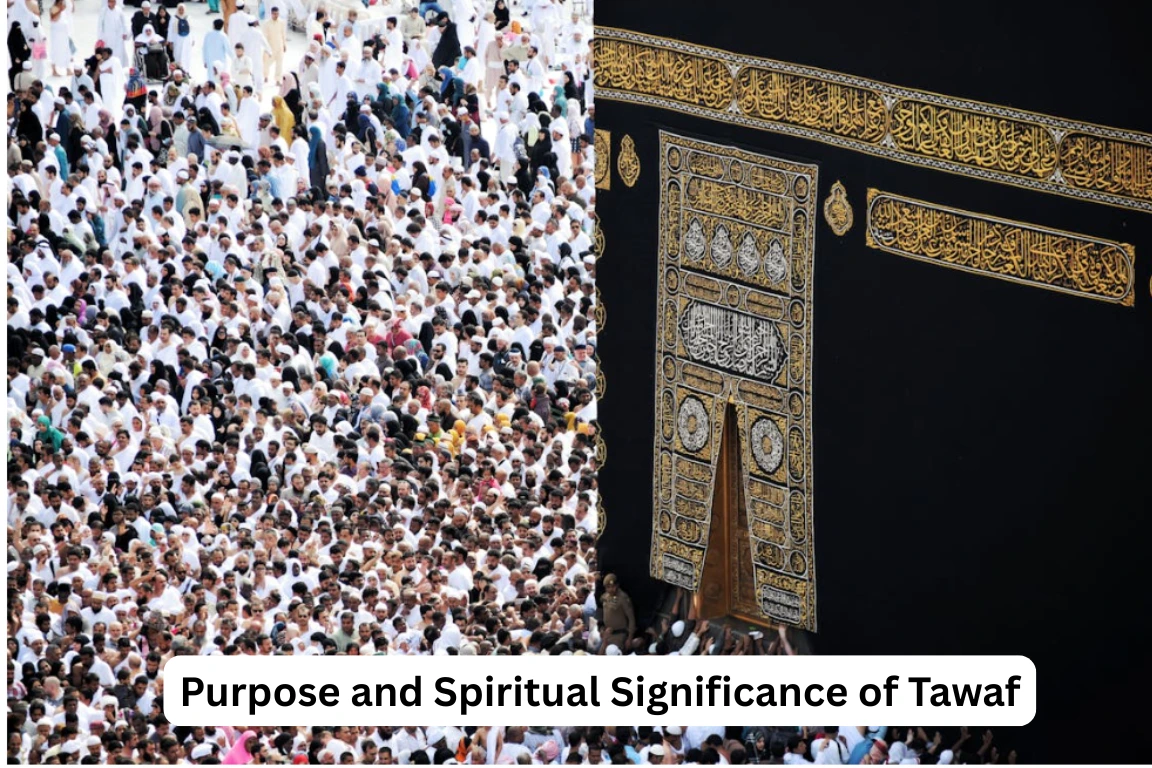
The purpose of Tawaf is not just walking around the Kaaba—it is a profound act of worship (ʿibadah), remembrance (dhikr), and the affirmation of Allah’s Oneness (tawḥīd).
- By making Tawaf, Muslims renew their covenant with Allah ﷻ and affirm their unity as one Ummah, a community of believers joined by faith beyond race, language, or culture.
- Spiritually, Tawaf reflects the devotion of the angels who circle the Divine Throne (ʿArsh), reminding every believer that life itself revolves around obedience to Allah.
- Each round of Tawaf carries humility, surrender, and reverence—turning simple steps into worship that softens the heart and draws a servant closer to the Lord of the Worlds.
Types of Tawaf in Hajj and Umrah

There are several types of Tawaf in Hajj and Umrah, each connected to a stage of the sacred journey.
- Tawaf al-Qudum (Arrival Tawaf) is performed when pilgrims enter Makkah, symbolizing their honored entry into the Sacred Mosque.
- Tawaf al-Ifadah (Tawaf of Release) is a core pillar (rukn) of Hajj, completed after standing at ʿArafat—without it, the pilgrimage is not valid.
- Tawaf al-Wadaʿ (Farewell Tawaf) is the final circumambulation before leaving Makkah, serving as a heartfelt farewell to the Kaaba.
- Tawaf al-ʿUmrah is the essential rite of Umrah, while Tawaf al-Tatawwuʿ (Voluntary Tawaf) can be performed at any time for added spiritual reward.
Each type of Tawaf reflects devotion in its own way—whether at the beginning, during the core rites, in bidding farewell, or as an extra act of worship.
How Tawaf is Performed — Steps and Rules

Tawaf is performed by walking around the Kaaba seven times in a counter-clockwise direction, starting and finishing at the Black Stone (Ḥajar al-Aswad). The pilgrim begins with niyyah (intention), and men observe iḍṭibāʿ by keeping the right shoulder uncovered during Tawaf al-ʿUmrah or Tawaf al-Qudum. At the start of each round, pilgrims face the Black Stone, raise their hands, and recite the takbīr or other duas. The Kaaba remains on the left side throughout, while the believer’s heart and tongue are engaged in dhikr and supplication.
A valid Tawaf requires ṭahārah (ritual purity), so the pilgrim must be in wuḍūʾ.
- Once the seven circuits are completed, two rakʿahs are prayed behind Maqām Ibrāhīm, if possible, followed by drinking from the blessed Zamzam water.
- The entire rite should be carried out with patience, humility, and reverence, as Tawaf is not only a physical walk but also a deeply spiritual act that draws the servant closer to Allah.
Duas and Remembrance During Tawaf

During Tawaf, pilgrims are encouraged to keep their tongues busy with dhikr (remembrance of Allah) and heartfelt duʿa (supplications). At the start of each round, it is Sunnah to face the Black Stone (Ḥajar al-Aswad), raise the hands, and say “Allāhu Akbar.” There is no fixed dua for every circuit, but many beautiful invocations are drawn from the Qur’an and the Sunnah.
The most authentic supplication between the Yemeni Corner (Rukn al-Yamānī) and the Black Stone is:
“Rabbana ātinā fi’d-dunyā ḥasanah, wa fi’l-ākhirati ḥasanah, wa qinā ʿadhāb an-nār.”
(Our Lord, grant us good in this world and good in the Hereafter, and protect us from the punishment of the Fire.)
Beyond this, pilgrims may recite tasbīḥ (Subḥān Allāh), taḥmīd (Al-ḥamdu lillāh), takbīr (Allāhu Akbar), verses of the Qur’an, or make personal duas from the heart. The essence of Tawaf is to keep the tongue alive in remembrance and the heart humbled in love for Allah ﷻ throughout the seven rounds.
FAQs — Tawaf Explained
Muslims complete seven rounds of Tawaf because this was the practice of Prophet Muhammad ﷺ, following the tradition of Prophet Ibrahim (عليه السلام) and Prophet Ismail (عليه السلام). The number seven in Islam reflects completion and divine order, as seen in the Qur’an’s mention of the seven heavens and seven earths. No. Tawaf is only valid with wuḍūʾ (ablution) and ṭahārah (ritual purity). Just like ṣalāh (prayer), it must be performed in a state of cleanliness before Allah. No. Women cannot perform Tawaf during menstruation (ḥayḍ). They should wait until they regain ritual purity, as taught by the Prophet ﷺ. The main types are: Tawaf al-Qudum (Arrival), Tawaf al-Ifadah (Main Pillar of Hajj), Tawaf al-Wadaʿ (Farewell), Tawaf al-ʿUmrah, and Tawaf al-Tatawwuʿ (Voluntary). Each type belongs to a different stage of the pilgrimage journey. There is no fixed dua for every round. However, the Prophet ﷺ recommended reciting this Qur’anic supplication between the Yemeni Corner (Rukn al-Yamānī) and the Black Stone (Ḥajar al-Aswad): “Rabbana ātinā fi’d-dunyā ḥasanah, wa fi’l-ākhirati ḥasanah, wa qinā ʿadhāb an-nār.”
(Our Lord, grant us good in this world, good in the Hereafter, and protect us from the punishment of the Fire.)

Fathima Kausar K is a writer at Sukoonly.com, where she focuses on sharing authentic duas, Qur’anic supplications, and spiritually uplifting content that helps readers find peace, clarity, and closeness to Allah.
Her writing is rooted in the belief that duʿāʾ is not just a set of words, but a sincere conversation with Allah — especially during moments of sadness, uncertainty, gratitude, or quiet reflection. Through her articles, she aims to make authentic Islamic supplications easier to understand, meaningful to recite, and practical for everyday life.
Fathima carefully studies classical Islamic sources, authentic narrations, and well-known scholarly explanations, and presents them in a simple, gentle, and relatable way. Her focus is always on clarity, authenticity, and emotional connection rather than complexity or technical language.
Through Sukoonly, she hopes to create a peaceful space where readers can slow down, reconnect with their faith, and find comfort through remembrance, duas, and trust in Allah.