

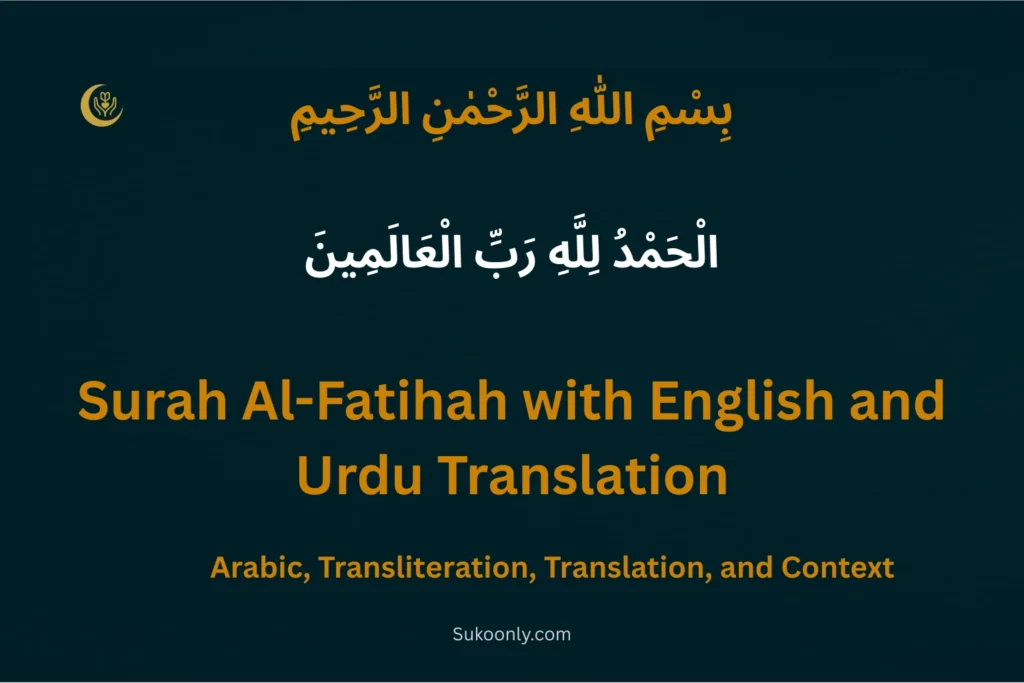
Surah Al-Fatihah is the opening chapter of the Qur’an, revealed in Makkah, and recited by Muslims in every unit of prayer. Its name, Al-Fatihah, means “The Opening” because it begins both the Qur’an itself and the servant’s dialogue with Allah ﷻ.
The chapter is made up of seven short verses that reflect the heart of Islam: praising Allah’s perfection, acknowledging His endless mercy, affirming His authority on the Day of Judgment, dedicating worship to Him alone, and asking for guidance to stay firm on the straight path. Because of its depth and repetition in worship, scholars have honored it with titles such as “Umm al-Kitab” (Mother of the Book) and “As-Sabʿ al-Mathānī” (The Seven Oft-Repeated Verses).
The Prophet Muhammad ﷺ emphasized its centrality, saying: “There is no prayer for the one who does not recite the Opening of the Book.” (Bukhari, Muslim). For this reason, Surah Al-Fatihah is the most frequently recited passage in the world.
This Surah is more than recitation — it is a direct conversation with the Creator. It begins with praise, moves to recognition of divine sovereignty, and concludes with a heartfelt plea: to walk the straight path, not the path of those who went astray or earned Allah’s anger.
Surah Al-Fatihah in Arabic Text
Below is the complete Arabic text of Surah Al-Fatihah, presented with full vowel markings (tashkeel) for clear and accurate recitation:
Arabic:بِسْمِ اللَّهِ الرَّحْمَٰنِ الرَّحِيمِ
الْحَمْدُ لِلَّهِ رَبِّ الْعَالَمِينَ
الرَّحْمَٰنِ الرَّحِيمِ
مَالِكِ يَوْمِ الدِّينِ
إِيَّاكَ نَعْبُدُ وَإِيَّاكَ نَسْتَعِينُ
اهْدِنَا الصِّرَاطَ الْمُسْتَقِيمَ
صِرَاطَ الَّذِينَ أَنْعَمْتَ عَلَيْهِمْ غَيْرِ الْمَغْضُوبِ عَلَيْهِمْ وَلَا الضَّالِّينَTransliteration:
Bismillāhir-Raḥmānir-Raḥīm
Al-ḥamdu lillāhi rabbil-‘ālamīn
Ar-Raḥmānir-Raḥīm
Māliki yawmid-dīn
Iyyāka na‘budu wa-iyyāka nasta‘īn
Ihdināṣ-ṣirāṭal-mustaqīm
Ṣirāṭal-ladhīna an‘amta ‘alayhim ghayril-maghḍūbi ‘alayhim walāḍ-ḍāllīnTranslation:
“In the name of Allah, the Entirely Merciful, the Especially Merciful.
All praise is due to Allah, Lord of the worlds —
The Entirely Merciful, the Especially Merciful,
Master of the Day of Judgment.
It is You we worship, and You we ask for help.
Guide us to the straight path —
The path of those upon whom You have bestowed favor, not of those who have evoked [Your] anger, nor of those who are astray.”
Surah Al-Fatihah with Urdu Translation
Here is the authentic Urdu translation of Surah Al-Fatihah, taken from Kanz-ul-Iman, a trusted and widely followed Urdu rendering of the Qur’an:
شروع اللہ کے نام سے جو بڑا مہربان نہایت رحم والا ہے۔
سب تعریفیں اللہ ہی کے لئے ہیں جو سب جہانوں کا پالنے والا ہے۔
بڑا مہربان، نہایت رحم والا۔
بدلے کے دن کا مالک۔
ہم تیری ہی عبادت کرتے ہیں اور تجھی سے مدد چاہتے ہیں۔
ہمیں سیدھا راستہ دکھا۔
ان لوگوں کا راستہ جن پر تو نے انعام فرمایا، نہ کہ ان کا جن پر غضب کیا گیا اور نہ گمراہوں کا۔
Meaning and Tafsir of Surah Al-Fatihah
Surah Al-Fatihah is often called the heart of the Qur’an because it beautifully captures the essence of our relationship with Allah ﷻ in just a few short verses. It opens with praise, reminding us that Allah is the Lord of all worlds — not distant, but full of mercy, love, and care for every part of His creation.
Then, it gently shifts our attention to a powerful truth: that Allah is the Master of the Day of Judgment. He is the One who will call every soul to account, yet He does so with justice and mercy.
From there, the Surah becomes deeply personal. “You alone we worship, and You alone we ask for help.” These words aren’t just statements — they’re a declaration of devotion. They teach us to turn to Allah with sincerity, to rely on Him alone, and to recognize that all strength and guidance comes from Him.
The Surah ends with a heartfelt dua: asking Allah to keep us firm on the straight path — the way of those who earned His favor — and to protect us from going down the roads of misguidance or earning His displeasure.
In just seven verses, Surah Al-Fatihah weaves together praise, belief, worship, and supplication. It’s not only a Surah we recite — it’s a daily reminder of who we are, who our Lord is, and the path we seek to walk with His help.
Why is Surah Al-Fatihah Recited in Every Prayer?
Surah Al-Fatihah is recited in every single unit of Salah because it is the soul of the prayer — the moment where the heart turns directly to Allah ﷻ. It’s the only Surah that has been made obligatory in each rakʿah, showing us just how central it is to our connection with our Lord.
The Prophet Muhammad ﷺ said, “There is no prayer for the one who does not recite the Opening of the Book.” (Bukhari, Muslim). Without it, the prayer is incomplete — because without it, the conversation between the servant and the Creator hasn’t truly begun.
In just a few verses, Surah Al-Fatihah brings together the core of our worship:
-
It begins with sincere praise for Allah, the Lord of all creation.
-
It acknowledges His mercy and His absolute authority over everything — especially on the Day of Judgment.
-
It then moves to the heart’s deepest plea: asking Allah to guide us, keep us firm, and protect us from misguidance.
Each time we stand to pray, repeating these verses is not a ritual — it’s a renewal. It reminds us that we are always in need of Allah’s help, always seeking His light. Surah Al-Fatihah keeps our prayers alive with meaning, grounding us in faith, humility, and hope every single time we recite it.
FAQs about Surah Al-Fatihah
Surah Al-Fatihah is called Umm al-Kitab — the “Mother of the Book” — because it holds within it the core message of the entire Qur’an. In just seven verses, it teaches us to praise Allah, recognize His mercy, reflect on the Day of Judgment, commit to worshipping Him alone, and ask for guidance to stay on the straight path. This Surah is the foundation of our prayers and our faith. That’s why scholars gave it this honored title — because it opens the Qur’an, and it opens the heart of the believer to the journey of Islam. Yes, Surah Al-Fatihah is known as a source of healing — both for the heart and the body. The Prophet Muhammad ﷺ approved of its use as ruqyah (spiritual remedy), and his Companions would recite it for those who were ill or in pain. In one authentic hadith, it was recited over someone who had been stung, and by Allah’s permission, they were cured. This Surah brings healing through faith, through remembrance of Allah, and through sincere trust in His mercy. When recited with a heart full of reliance and dua, it becomes a source of comfort and relief. Surah Al-Fatihah was revealed in Makkah, which makes it a Makki Surah. Its message reflects the early days of Islam — calling people to the Oneness of Allah, teaching the foundations of worship, and strengthening the believer’s trust in their Lord. While a few reports mention it being revealed in Madinah as well, scholars explain that it may have been revealed more than once. Still, the majority agree that its primary revelation was in Makkah. Surah Al-Fatihah is recited in every rakʿah of prayer — and that alone tells us how important and rewarding it is. Every letter of the Qur’an carries reward, and since this Surah is repeated so often, it becomes one of the most recited and rewarded chapters in a Muslim’s life. The Prophet ﷺ even described it as a personal conversation between the believer and Allah ﷻ. In a beautiful Hadith Qudsi, Allah responds to each verse when we recite it — accepting our praise, our worship, and our dua. So the real reward of Surah Al-Fatihah isn’t just in the words — it’s in the closeness to Allah that those words bring, over and over again. Yes, you can recite Surah Al-Fatihah and ask Allah to gift its reward to someone who has passed away. This is known as isāl al-thawāb — passing on the reward — and it’s a practice supported by many scholars. Just as we give charity and make dua for our loved ones who have returned to Allah, we can also recite Qur’an with a sincere heart and ask Allah to send them the reward. It’s a beautiful way to continue honoring and benefiting those we love, even after they’ve left this world.

Mohammed Basheer Orsala is the founder of Sukoonly.com - an Islamic resource dedicated to verified Quranic duas and Sunnah-based supplications. A self-taught Islamic researcher, he has studied classical texts and authenticated hadith collections including the works of Imam al-Nawawi, Shaykh al-Albani, Ibn Hajar al-Asqalani, and Ibn al-Qayyim. He writes to make verified Prophetic supplications accessible to English-speaking Muslims worldwide.