
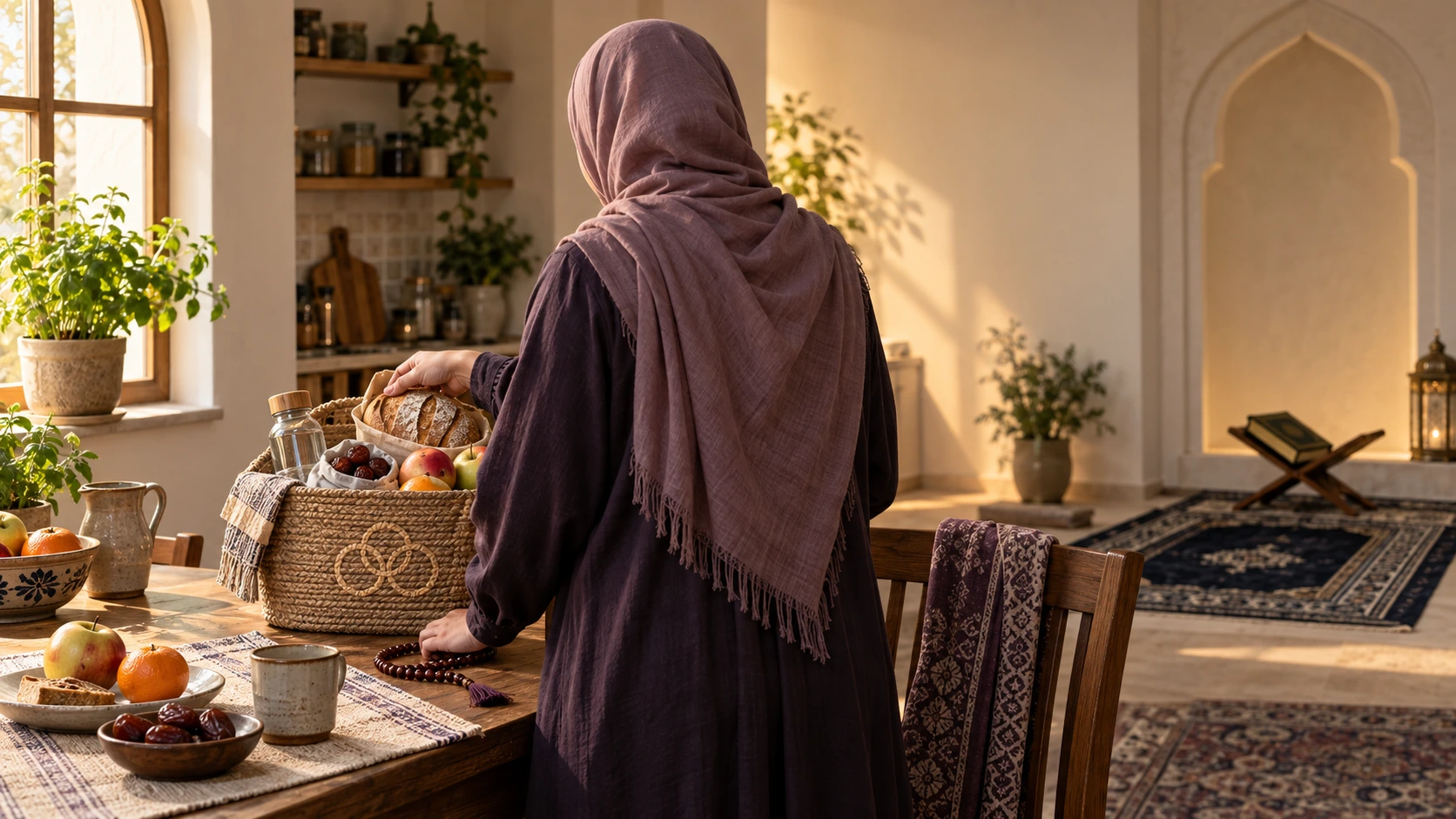
Shukr is the Islamic response to ease — but the tradition defines it in a way that will surprise anyone who understands it simply as “saying thank you.” Shukr in the Quranic framework is an active, comprehensive state of the heart, tongue, and limbs that responds to Allah’s blessings with acknowledgment, expression, and use in obedience. And unlike most virtues, it comes with a divine promise that is uniquely unconditional: more.
What Does Shukr Mean? — The Arabic Root
Shukr (شُكْر) comes from the Arabic root shakara (شَكَرَ), originally meaning “to recognize a favor and acknowledge its source.” In pre-Islamic Arabic, shakūr described an animal that showed visible signs of good health and vitality in response to adequate nourishment — the external expression of inner flourishing as a recognition of what was received.
Islamic theology adopted and elevated this root: Shukr is the recognition of Allah ﷻ as the source of every blessing, expressed through acknowledgment in the heart, words on the tongue, and actions of the limbs. All three dimensions are required for complete Shukr.
Notably, Allah ﷻ Himself carries the name Al-Shakūr (الشَّكُور) — The Grateful, The One Who Appreciates — meaning He acknowledges and abundantly rewards even the smallest acts of gratitude and obedience from His servants. The name occurs four times in the Quran. Its presence as a divine name establishes Shukr as a value Allah ﷻ Himself embodies toward His servants, not merely what He commands of them toward Him.
The Divine Promise — Shukr Guarantees Increase
The Quran contains what may be the most direct cause-and-effect promise in the entire text:
لَئِن شَكَرْتُمْ لَأَزِيدَنَّكُمْ ۖ وَلَئِن كَفَرْتُمْ إِنَّ عَذَابِي لَشَدِيدٌ
La’in shakartum la’azīdannakum wa la’in kafartum inna ‘adhābī lashadīd
“If you are grateful, I will surely increase you. But if you are ungrateful — indeed, My punishment is severe.” — Quran 14:7
The linguistic structure of this verse is emphatic in both clauses. La’in (lam + in) and la’azīdannakum (lam tawkid + azidannakum with nun al-tawkid) are double emphatic constructions — among the most forceful affirmations possible in Arabic. Allah ﷻ is not suggesting or recommending gratitude. He is making a sworn double-emphatic promise: gratitude will be met with increase. This is unconditional and universal.
Scholars note that the increase promised is not restricted to the type of blessing originally present. Shukr for health may result in increase of wealth. Shukr for wealth may result in increase of knowledge. The increase is in whatever dimension Allah ﷻ determines is most beneficial — not necessarily in the same category as the original blessing.
The 3 Dimensions of Shukr — Heart, Tongue, and Limbs
The scholars of Islamic spirituality — most comprehensively Ibn al-Qayyim in Madarij al-Salikin and Uddat al-Sabirin wa Dhakhirat al-Shakirin — define complete Shukr as encompassing three inseparable dimensions:
Dimension 1 — Shukr of the Heart (Qalb)
The heart’s Shukr is recognition — knowing that a blessing came from Allah ﷻ, not from oneself or another person. This is the foundational dimension, because without it the tongue’s words and the limbs’ actions are hollow. Heart-Shukr also includes maḥabbah (love) toward Allah ﷻ in response to His generosity — the natural emotion that arises when a giver is recognized and appreciated.
The opposite of heart-Shukr is ghaflah (heedlessness) — receiving blessings without awareness of their source. The Quran describes entire nations who received blessings and attributed them to their own skill or the natural order, never turning their recognition toward Allah ﷻ. This is the root of ingratitude that the second clause of Quran 14:7 warns against.
Dimension 2 — Shukr of the Tongue (Lisān)
The tongue’s Shukr is verbal acknowledgment — saying Alḥamdulillāh (all praise belongs to Allah), attributing blessings to Allah when speaking to others, not attributing blessings to good luck, personal skill, or other people’s generosity in a way that erases Allah’s role.
The Prophet ﷺ taught specific verbal expressions of Shukr for specific blessings:
- Upon receiving any pleasing news or blessing: Alḥamdulillāh alladhī bini’matihi tatimmus-ṣāliḥāt (“Praise be to Allah by whose grace good things are completed”) — Ibn Majah 3803
- Upon waking: Alḥamdulillāhilladhī aḥyānā ba’da mā amātanā wa ilayhin-nushūr — Bukhari 6312
- After eating: Alḥamdulillāhilladhī aṭ’amanī hādhā wa razaqanīhi min ghayri ḥawlin minnī wa lā quwwah — Abu Dawud 4023, graded Hasan
The Alḥamdulillāh in these duas is not casual — it is a specific theological claim: al-ḥamd (all praise, with the definite article indicating totality) belongs lillāh (to Allah exclusively). It is Shukr and Ikhlas combined in a single phrase.
Dimension 3 — Shukr of the Limbs (Jawāriḥ)
The limbs’ Shukr is using the blessing in obedience to Allah ﷻ — the most demanding and most comprehensive dimension. Health used in worship and service is Shukr of the body. Wealth used in charity and halal provision is Shukr of the wealth. Knowledge used to benefit others and teach is Shukr of the knowledge. Time used in acts that Allah ﷻ loves is Shukr of the time.
The Prophet Dawud (عليه السلام) received a direct divine command regarding this dimension:
اعْمَلُوا آلَ دَاوُودَ شُكْرًا ۚ وَقَلِيلٌ مِّنْ عِبَادِيَ الشَّكُورُ
I’malū āla Dāwūda shukrā wa qalīlun min ‘ibādiyash-shakūr
“Work, O family of Dawud, in gratitude — and few of My servants are truly grateful.” — Quran 34:13
The command “work in gratitude” (i’malū shukrā) establishes that Shukr is expressed through action — not merely through feeling or statement. The remark “few of My servants are truly grateful” does not mean that Shukr is impossible; it means that the complete three-dimensional Shukr (heart + tongue + limbs) is rare, and reaching it is a high spiritual achievement.
Shukr and Sabr — The Complete Islamic Response to All States
Ibn al-Qayyim identifies Shukr and Sabr as the two states that comprehensively cover the entirety of a Muslim’s life:
- In ease: Shukr — recognizing the blessing, expressing gratitude, using the blessing in obedience
- In difficulty: Sabr — restraining the soul from panic, restraining the tongue from complaint, maintaining trust in Allah
The Prophet ﷺ’s hadith in Muslim 2999 confirms this: “How wonderful is the affair of the believer — all of his affairs are good. If ease comes to him, he gives Shukr, and that is good for him. If hardship comes to him, he exercises Sabr, and that is good for him.”
A person who has internalized both Shukr and Sabr has achieved what scholars call riḍā (contentment, pleasure with Allah’s decree) — the spiritual state in which every circumstance is received with the appropriate Islamic response, and none generates spiritual loss.
Shukr and Dua — The Gratitude That Opens Blessing
The etiquettes of dua prescribe beginning every supplication with praise of Allah ﷻ (ḥamd) — which is the verbal expression of Shukr. This is not merely protocol; it is the correct spiritual orientation from which to ask. The person who begins their dua by acknowledging what they have already received from Allah ﷻ is in the spiritually correct posture to ask for more.
The Hadith of Ahmad 11133 — the foundation of understanding why dua is always responded to — itself ends with the Companions saying they wanted to make more duas, and the Prophet ﷺ confirming “Allah is more [generous].” This generosity of Allah ﷻ is itself a subject for Shukr — and recognizing it motivates more dua, which generates more response, which generates more Shukr. The cycle is self-reinforcing.
Shukr and Tawbah — Gratitude as the Entry Point for Return
There is a profound connection between Shukr and Tawbah that is rarely articulated: the person who genuinely recognizes the blessings they have received from Allah ﷻ is more equipped to feel genuine nadam (regret) for having sinned against the Giver of those blessings. Shukr deepens the relational awareness of Allah ﷻ — and that relational awareness makes Tawbah more sincere, because the servant is not just fulfilling a ritual obligation but returning to a Benefactor they genuinely recognize.
This is why many scholars advise counting one’s blessings specifically before making tawbah — not as a transaction (“You gave me X, so I’ll repent”) but as a spiritual orientation exercise that brings the reality of Allah’s generosity into the heart, making the contrast with sin more vivid and the desire to return more genuine.
Practical Forms of Shukr in Daily Life
- Say Alhamdulillah deliberately — not as a cultural reflex but as a conscious theological statement each time a blessing is received or recognized. The Prophet ﷺ said: “Alhamdulillah fills the scales.” — Muslim 223
- Perform two rak’ahs of Shukr prayer — upon receiving a significant blessing. This is an established Sunnah: the Prophet ﷺ prayed when he received good news — Abu Dawud 2774, graded Hasan
- Give sadaqah upon receiving blessings — the limbs’ Shukr expressed financially. Using a portion of a blessing to benefit others is among the most concrete expressions of recognition that the blessing came from Allah ﷻ and belongs to His creation
- Make a habit of morning and evening adhkar — the morning and evening remembrances from the Sunnah are structured Shukr: they acknowledge Allah’s blessings at the bookends of each day. See the full collection of daily duas and adhkar
- Reflect on blessings before sleep — Ibn al-Qayyim and other scholars describe a nightly habit of counting three blessings received that day as a Shukr discipline. It trains the heart’s recognition capacity — the foundation of all three dimensions of Shukr
FAQs — What Is Shukr
Is Shukr only for obvious, large blessings?
No — Shukr applies to every blessing, including those considered “small” or ordinary. The Prophet ﷺ taught gratitude for waking up, for having food, for good health, for the ability to pray — all things most people take for granted. In fact, the scholars note that the person who practices Shukr for small blessings grows in the capacity to recognize larger ones. The Quran’s promise of “increase” in Quran 14:7 applies to gratitude for any blessing, not just the significant ones.
Can you thank a person and also make Shukr to Allah for the same thing?
Yes — and both are required. The Prophet ﷺ said: “Whoever does not thank people has not thanked Allah.” — Abu Dawud 4811, graded Sahih by al-Albani. Thanking the human instrument through whom Allah ﷻ sent a blessing is part of the Shukr toward Allah ﷻ Himself. The two are not in competition; they are both expressions of recognizing the chain of blessing that flows from Allah ﷻ through people to the recipient.
Can Shukr be made for difficult things that turned out to be beneficial?
Yes — and this is one of the most advanced forms of Shukr. The Quran (2:216) establishes that sometimes what appears to be a hardship is actually a blessing. A person who was forced into a job change that led to a better life, or who experienced an illness that redirected their priorities, or who faced a loss that deepened their relationship with Allah ﷻ — is in a position to make Shukr for what initially felt like a blow. This retrospective Shukr is a sign of spiritual maturity and connects to the Sabr exercised during the hardship itself.
What is the difference between Shukr and Hamd?
Hamd (الحمد) is praise of Allah for His inherent attributes — His perfection, His majesty, His beauty — regardless of whether one has received a specific blessing. Shukr is specifically gratitude in response to a received blessing. Hamd is broader: you can praise Allah ﷻ even in a state of total deprivation, because His attributes are praiseworthy independent of what He gives. Shukr requires a specific blessing as its object. The phrase Alḥamdulillāh carries both: it is both Hamd (praise) and, in the context of daily life among blessings, Shukr simultaneously.
This article is part of the Islamic Concepts series. Read the related articles: What Is Tawbah? | What Is Sabr? | What Is Ihsan? | What Is Ikhlas? | What Is Tawakkul?

Mohammed Basheer is the founder of Sukoonly.com, an Islamic blog focused on duas, prophetic healing, and Qur’anic wisdom. He writes with sincerity and spiritual depth for seekers around the world.