
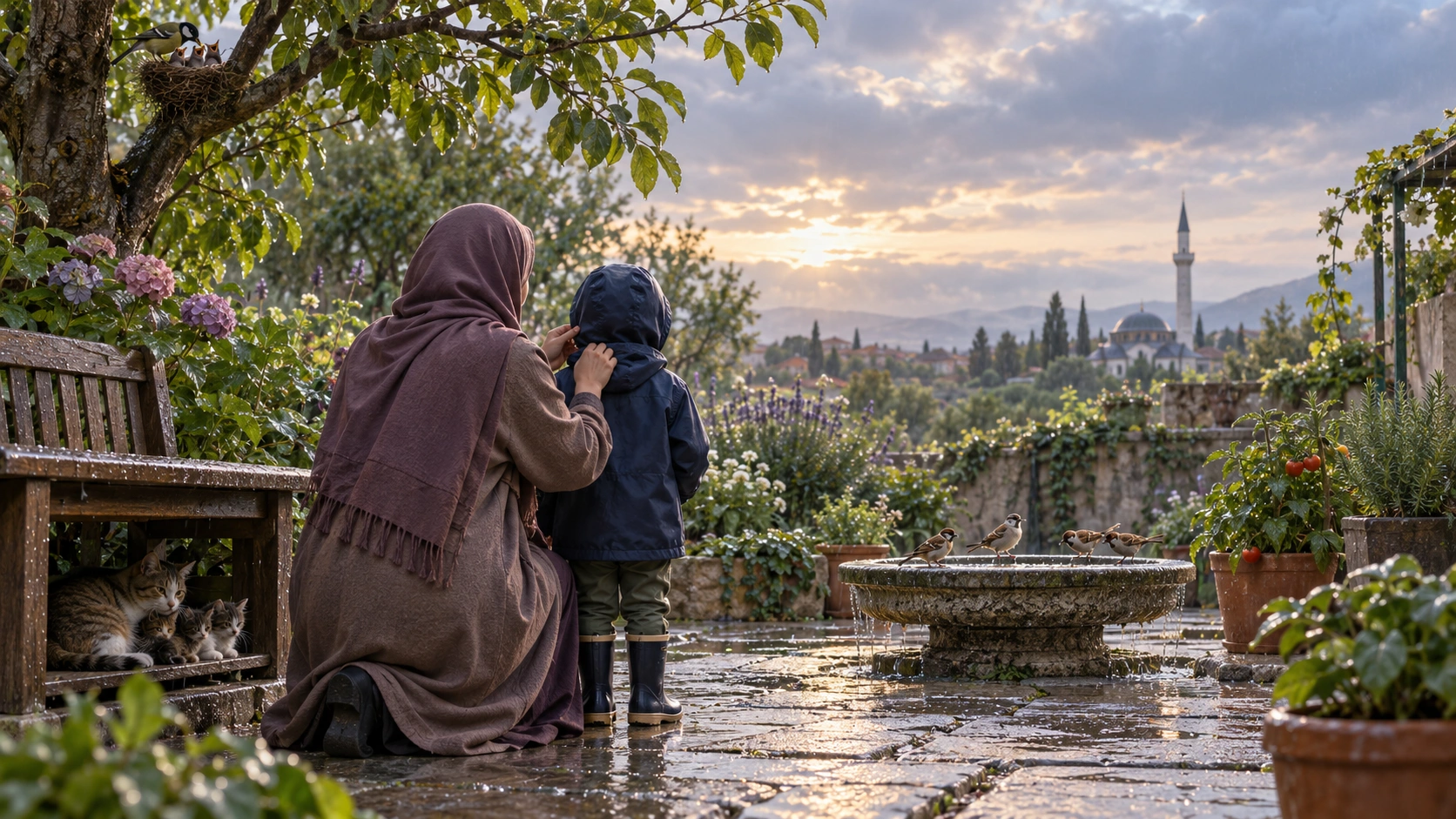
Ar-Rahman appears in the very first line of the Quran — before any other divine name, before any commandment, before any narrative. A Muslim repeats it seventeen times daily in their obligatory prayers, in the Basmala alone. Yet most who recite it have never engaged with what the name actually means, what distinguishes it from Ar-Rahim (which always follows it), and why the Quran chose it as the Name to open with. This article provides that engagement.
What Does Ar-Rahman Mean? — The Arabic Root
Ar-Rahman (الرَّحْمٰن) comes from the Arabic root r-ḥ-m (ر-ح-م), from which the primary noun is raḥmah (رَحْمَة) — often translated as mercy, compassion, or loving tenderness. But raḥmah in Arabic carries a specific quality not fully captured by “mercy” in English: it is mercy that yearns toward its object. Scholars trace the root to raḥim (رَحِم) — the womb — because the womb is the most instinctive and unconditional expression of tenderness in human experience. A mother does not choose to care for what she carries; the compassion is structural, preceding all action.
Allah ﷻ Himself invokes this etymology in a hadith of profound theological weight:
“Allah said: I am Ar-Rahman. I created the raḥim (womb) and derived its name from My own name. Whoever maintains it, I will maintain connection with them. Whoever severs it, I will sever connection with them.” — Bukhari 5988, Tirmidhi 1907
Allah ﷻ Himself named the womb after Ar-Rahman — establishing that the most instinctive, unconditional tenderness in creation is a derived expression of His own attribute. If the mercy of a mother toward her child is overwhelming in human experience, the Quran situates it as a single drop of the mercy Allah ﷻ carries under this name.
Ar-Rahman vs Ar-Rahim — The Critical Distinction
The two Names always appear together — Ar-Rahman, Ar-Rahim — which leads many to treat them as near-synonyms. Scholars of ‘ilm al-asmā’ wa al-ṣifāt (the science of Allah’s names and attributes) identify a precise distinction:
- Ar-Rahman (الرَّحْمٰن) — On the fa’ʿlān pattern, indicating an attribute that is overwhelming in magnitude, comprehensive in scope. Ar-Rahman describes the totality of Allah’s mercy as an attribute — vast, encompassing, and the source from which all specific mercies flow. It is the mercy that covers believer and disbeliever alike in this world, that sustains all creation without discrimination.
- Ar-Rahim (الرَّحِيم) — On the faʿīl pattern, indicating an attribute that is continuously active and repeatedly exercised. Ar-Rahim describes the mercy that Allah ﷻ specifically directs toward the believers in the Hereafter — a particular mercy that is the result of specific relationship and response to iman and tawbah.
Ibn al-Qayyim crystallizes this in Madarij al-Salikin: “Ar-Rahman is the attribute; Ar-Rahim is the action. Ar-Rahman describes what Allah is; Ar-Rahim describes what Allah perpetually does toward the believers.”
The Quran supports this distinction explicitly in Surah Al-Ahzab:
وَكَانَ بِالْمُؤْمِنِينَ رَحِيمًا
“And He is ever, to the believers, Raheem.” — Quran 33:43
Note: the Quran says Raheem (perpetually merciful, directed toward believers) — not Rahman — in this context. Ar-Rahman is never used with a restricted object in the Quran; it is always universal. Ar-Rahim is specifically directed toward the believers in multiple contexts.
Ar-Rahman Is a Proper Name — Exclusive to Allah
Among all 99 Names of Allah, Ar-Rahman has a unique status: it functions as a proper name (ism ʿalam) for Allah ﷻ, not merely a descriptive attribute. The Quran demonstrates this by using Ar-Rahman as a standalone name — completely interchangeable with “Allah” — in a way that no other name is used:
قُلِ ادْعُوا اللَّهَ أَوِ ادْعُوا الرَّحْمٰنَ ۖ أَيًّا مَّا تَدْعُوا فَلَهُ الْأَسْمَاءُ الْحُسْنَىٰ
Qulid’ullāha awid’uur-Raḥmān, ayyam-mā tad’ū falahul-asmā’ul-ḥusnā
“Say: Call upon Allah or call upon Ar-Rahman — whichever you call, to Him belong the most beautiful names.” — Quran 17:110
The verse places “Allah” and “Ar-Rahman” as fully interchangeable in dua. This is theologically significant: you can call upon “Ar-Rahman” in the same way you call upon “Allah.” No other name among the 99 is used this way in the Quran. Scholars conclude: Ar-Rahman, like Allah, is a proper name that cannot be applied to anyone other than Allah ﷻ, and it encompasses all His other attributes under it.
Unlike “Al-Rahim” (which can technically be used for a very merciful human — the Prophet ﷺ is called raḥīmun in Quran 9:128), “Ar-Rahman” is exclusive to Allah ﷻ. No human, angel, or created being can be called “Ar-Rahman.”
Ar-Rahman in the Quran — Key Occurrences and Contexts
The name Ar-Rahman appears 57 times in the Quran. Its distribution across the Quran is itself informative:
The Basmala — Every Surah’s Foundation
بِسْمِ اللَّهِ الرَّحْمٰنِ الرَّحِيمِ
Bismillāhir-Raḥmānir-Raḥīm
“In the name of Allah, Ar-Rahman, Ar-Rahim.”
The Basmala appears at the start of 113 of the 114 surahs of the Quran. Muslims recite it before eating, before beginning any significant act, and as a constant invocation. It places Ar-Rahman as the first divine attribute announced — before any specific divine action or command. The structure teaches: before knowing what Allah ﷻ commands, know the character of the One commanding. He is Ar-Rahman — incomprehensible mercy — and Ar-Rahim — perpetually merciful to the believers.
Surah Ar-Rahman — The Surah Named After This Name
The 55th surah of the Quran bears the name Ar-Rahman and opens with it immediately — no preamble, no transitional phrase, just the name:
الرَّحْمٰنُ عَلَّمَ الْقُرْآنَ
“Ar-Rahman. He taught the Quran.” — Quran 55:1-2
The surah then enumerates Allah’s blessings — the creation of the human being, the sun and moon, the trees and skies, the two seas — and punctuates each with the recurring rhetorical question: Fa’ayyi ālā’i Rabbikumā tukadhdhibān — “So which of the favors of your Lord will you deny?” The surah frames all of creation as an expression of Ar-Rahman’s attribute. Every blessing in existence — not just the explicitly spiritual ones — is Ar-Rahman made visible.
Ar-Rahman and the Throne
الرَّحْمٰنُ عَلَى الْعَرْشِ اسْتَوَىٰ
Ar-Raḥmānu ‘alal-‘arshi-stawā
“Ar-Rahman, over the Throne, established Himself.” — Quran 20:5
Of all Allah’s 99 Names, it is Ar-Rahman that the Quran associates with istiwa’ ‘ala al-‘arsh (establishment over the Throne — the highest possible position of authority and lordship). Not Al-Malik (The King), not Al-Jabbar (The Compeller), not Al-Qahhar (The Subduer). Ar-Rahman. The scholars of tafsir draw a profound principle from this: the supreme authority in the universe is held under the attribute of mercy. Power and dominion, in Islam, are exercised by the One whose defining characteristic is compassion.
The Scope of Ar-Rahman’s Mercy — Quantified
The Prophet ﷺ gave a hadith that allows believers to comprehend — partially — the scale of what Ar-Rahman means:
“Allah has one hundred mercies. He has sent down one of them among jinn and humans, animals and insects — by it they show tenderness to each other, and by it the wild animal is gentle with its offspring. And Allah has kept back ninety-nine mercies with which He will have mercy upon His servants on the Day of Resurrection.” — Bukhari 6000, Muslim 2752
Everything a person has experienced of tenderness, compassion, love — from a mother, from a friend, from a stranger who helped in crisis, from an animal toward its young — all of it combined represents one out of one hundred of Allah’s mercy. The remaining ninety-nine are reserved specifically for the Day of Judgement. The scale of Ar-Rahman is functionally incomprehensible — it cannot be extrapolated from human experience because human experience only touches a fraction of a percent of it.
Ar-Rahman and Tawbah — The Mercy That Opens the Door
The name Ar-Rahman is the theological foundation of tawbah. The Quran’s most direct address to sinners is framed under Ar-Rahman’s mercy:
قُلْ يَا عِبَادِيَ الَّذِينَ أَسْرَفُوا عَلَىٰ أَنفُسِهِمْ لَا تَقْنَطُوا مِن رَّحْمَةِ اللَّهِ ۚ إِنَّ اللَّهَ يَغْفِرُ الذُّنُوبَ جَمِيعًا ۚ إِنَّهُ هُوَ الْغَفُورُ الرَّحِيمُ
“Say: O My servants who have transgressed against themselves — do not despair of the mercy of Allah (raḥmatillāh). Indeed, Allah forgives all sins. Indeed, it is He who is Al-Ghafur, Ar-Rahim.” — Quran 39:53
The word raḥmatillāh (mercy of Allah) in this verse draws on the same root as Ar-Rahman. The prohibition — “do not despair” (lā taqnaṭū) — is absolute. Despairing of Ar-Rahman’s mercy contradicts the established theological reality of who Allah ﷻ is. A person who despairs is not just feeling hopeless — they are, in effect, disagreeing with the Quran’s description of Allah ﷻ as Ar-Rahman.
Invoking Ar-Rahman in Dua — How to Call Upon This Name
The Quran (17:110) explicitly establishes that calling upon “Ar-Rahman” in dua is fully equivalent to calling upon “Allah.” This means Ar-Rahman is among the most direct divine names to invoke in personal supplication. Scholarly recommendations for invoking Ar-Rahman include:
- For seeking forgiveness: Yā Raḥmān, irḥamnī — “O Ar-Rahman, have mercy on me”
- For seeking relief from hardship: Yā Raḥmān, yā Raḥīm, irḥamnā biraḥmatika — “O Ar-Rahman, O Ar-Rahim, encompass us in Your mercy”
- The dua of those who fear Allah’s punishment: Rabbanā āmannā faghfirlana warḥamna wa anta khayrul-rāḥimīn — Quran 23:109 — “Our Lord, we have believed — so forgive us and have mercy upon us, for You are the best of the merciful.”
See the complete collection of duas for forgiveness and mercy for Prophetically taught supplications that invoke this name.
The Believer’s Relationship with Ar-Rahman
Knowing Allah ﷻ by the name Ar-Rahman changes how a believer relates to Him in three specific ways:
1 — It makes tawbah psychologically possible
The most common barrier to repentance is the belief that “my sins are too many” or “Allah won’t forgive me.” This belief is possible only if one forgets Ar-Rahman. The scale of the 99 mercies hadith makes the mathematics of forgiveness clear: no accumulation of human sin approaches the boundary of Ar-Rahman’s capacity for forgiveness. The door is not merely open — it is structurally incapable of being closed by the volume of a person’s sins.
2 — It reframes suffering
When difficulty arrives, the knowledge of Ar-Rahman prevents the instinctive interpretation: “Allah is punishing me.” The Prophet ﷺ said: “The greatest reward comes with the greatest trial. When Allah loves a people He tests them. Whoever accepts it, earns His pleasure, and whoever objects, earns His wrath.” — Tirmidhi 2396. The One who tests through Ar-Rahman’s attribute is not withholding mercy — He is expressing it in the form that produces the greatest long-term good. Sabr under trial becomes spiritually sustainable when it is grounded in the knowledge of Ar-Rahman.
3 — It grounds gratitude
The shukr (gratitude) of a person who knows Ar-Rahman is qualitatively different from the gratitude of someone who simply notices specific blessings. Every benefit — the breath between these words, the cognitive function to read them, the warmth of whatever space you are in — is an expression of Ar-Rahman. Ihsan in worship becomes more natural when the worshipper knows the Name of the One being worshipped with this depth.
FAQs — Ar-Rahman
Why does the Quran open with Ar-Rahman rather than Al-Khaliq (The Creator) or Al-Malik (The King)?
The placement of Ar-Rahman is deliberate and was noted by the earliest scholars of tafsir. Opening with Al-Khaliq would establish Allah’s relationship to creation as one of power. Opening with Al-Malik would establish it as one of authority and dominion. Opening with Ar-Rahman establishes it as one of mercy — which is the foundational lens through which all of the Quran’s subsequent content should be understood. The commands are from Ar-Rahman; the prohibitions protect from what Ar-Rahman knows will harm. The news of the Hereafter comes from Ar-Rahman — which means even its difficult elements carry mercy within them.
Does Ar-Rahman’s mercy extend to non-Muslims?
Yes — the worldly mercy of Ar-Rahman encompasses all creation without exception. The Prophet ﷺ said: “Show mercy to those on earth, and the One above the heavens will show mercy to you.” — Tirmidhi 1924, graded Sahih. The hadith of 100 mercies — with one distributed across all jinn, humans, animals, and insects — confirms Ar-Rahman’s worldly mercy is undiscriminating. The Quran describes the disbelievers of Makkah as also recipients of Allah’s blessings (Quran 56:63-73). The specific mercy of Ar-Rahim — in the Hereafter — is the mercy reserved for the believers.
Can I name my child Abd Ar-Rahman?
Yes — and it is among the names the Prophet ﷺ identified as the most beloved to Allah ﷻ: “The most beloved names to Allah are Abdullah and Abd Ar-Rahman.” — Muslim 2132. The name Abd Ar-Rahman means “servant of Ar-Rahman.” Several major Companions bore this name, most notably Abd Ar-Rahman ibn Awf (one of the ten promised Paradise), Abd Ar-Rahman ibn Abi Bakr, and Abd Ar-Rahman ibn Umar.
Explore the complete list of all 99 Names: 99 Names of Allah — Arabic, Transliteration, and Meaning. Related: What Is Tawbah? | What Is Sabr? | Duas for Forgiveness

Mohammed Basheer is the founder of Sukoonly.com, an Islamic blog focused on duas, prophetic healing, and Qur’anic wisdom. He writes with sincerity and spiritual depth for seekers around the world.