
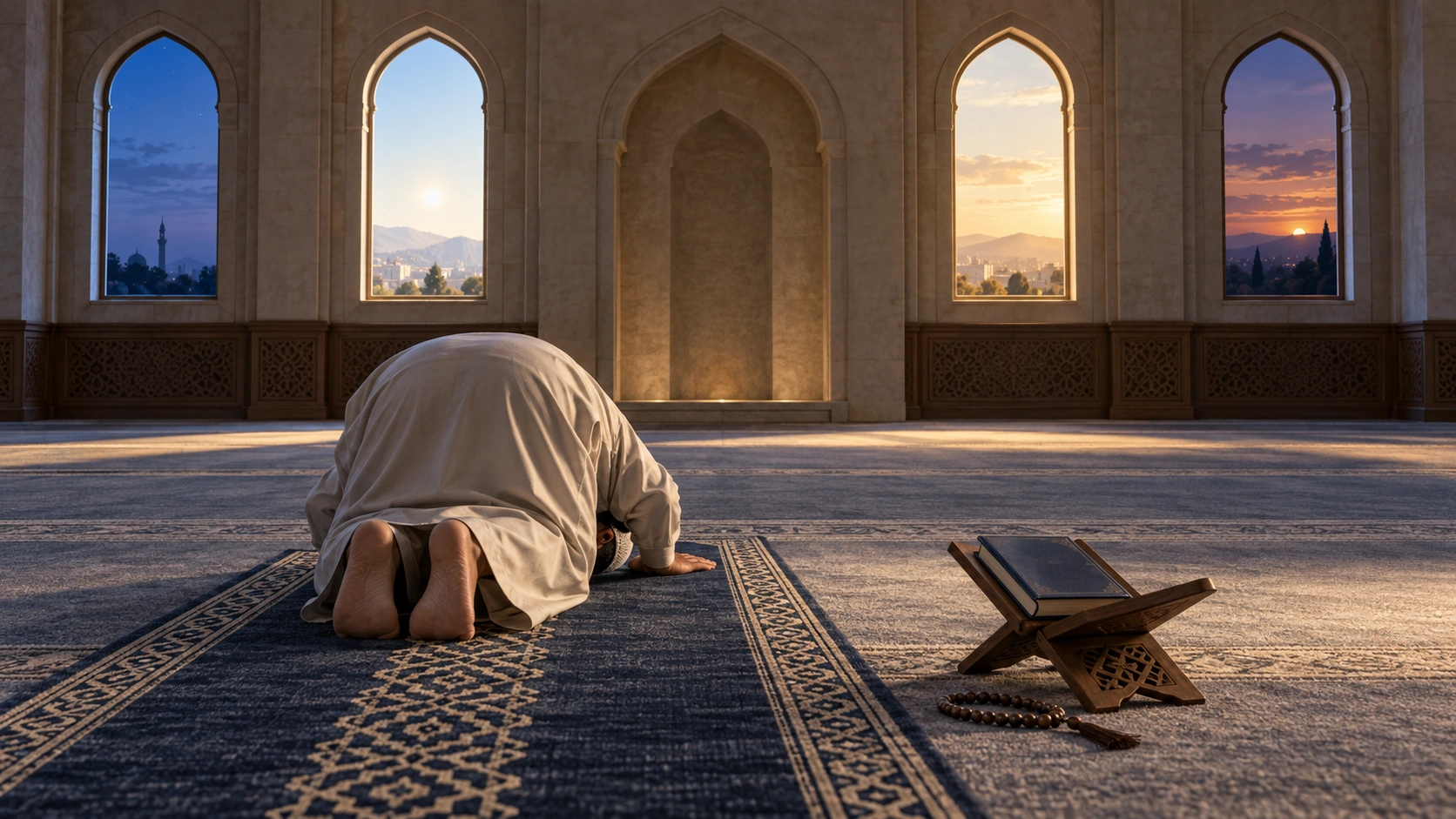
Salah is the second pillar of Islam and the single act of worship that a Muslim performs more than any other — five times every day, approximately 1,825 times every year, across an entire lifetime. Yet for many Muslims, the word carries weight without depth — it is known as obligatory without being truly understood. This article provides that depth: what salah is, why it is the central pillar of Islamic worship, what it consists of, and why the Prophet ﷺ said it was the first thing that will be examined on the Day of Resurrection.
What Is Salah? — The Arabic Root and Definition
Salah (صَلَاة), also spelled salat, comes from the Arabic root ṣ-l-w (ص-ل-و). Classical Arabic lexicographers give the primary meaning of the root as “connection, bond, closeness.” In pre-Islamic usage, ṣalā also referred to the part of a horse’s back closest to the tail — the connection point of the body. In theological usage, salah is the connection established between the servant and Allah ﷻ through a structured act of worship.
The formal jurisprudential definition of salah: “Specific words and actions that begin with the takbir [saying Allahu Akbar] and conclude with the taslim [saying As-salamu alaykum], performed with specific conditions.”
What makes salah distinct from other forms of worship is its structure: it is not merely internal prayer (dua) or remembrance (dhikr), though it contains both. It is a complete physical, verbal, and spiritual act — standing, bowing, prostrating — that simultaneously engages the body, the tongue, and the heart in a directed relationship with Allah ﷻ.
The Five Daily Prayers — Names, Times, and Rakat
The five obligatory daily prayers are established by the Quran and defined in their specific form by the Sunnah:
| Prayer | Arabic | Time | Fard Rakat |
|---|---|---|---|
| Fajr | الفجر | Dawn until sunrise | 2 |
| Dhuhr | الظهر | After midday until Asr | 4 |
| Asr | العصر | Mid-afternoon until sunset | 4 |
| Maghrib | المغرب | Just after sunset until Isha | 3 |
| Isha | العشاء | Nightfall until Fajr | 4 |
For the complete breakdown including all Sunnah and nafl prayers, see the Namaz Rakat Chart with times for all prayers.
The Quranic Command for Salah
Salah is commanded in the Quran more explicitly and repeatedly than any other act of worship. Unlike zakah, fasting, or hajj — which are commanded prominently but not repeatedly — salah is commanded, urged, and praised across dozens of verses:
وَأَقِيمُوا الصَّلَاةَ وَآتُوا الزَّكَاةَ
Wa aqīmuṣ-ṣalāta wa ātuz-zakāh
“And establish prayer and give zakah.” — Quran 2:43 (and over 80 similar commands)
The Quran’s command consistently uses aqīmū — from aqāma, meaning “to establish, to erect, to maintain upright.” The instruction is not merely to “do” salah or “perform” it — it is to establish it: to make it a standing, upright, permanent structure in one’s life. The word implies consistency, correctness, and completeness — not salah done occasionally or haphazardly, but salah that stands firm in the architecture of daily life.
إِنَّ الصَّلَاةَ كَانَتْ عَلَى الْمُؤْمِنِينَ كِتَابًا مَّوْقُوتًا
Innaṣ-ṣalāta kānat ‘alal-mu’minīna kitābam-mawqūtā
“Indeed, prayer has been decreed upon the believers at specified times.” — Quran 4:103
Kitābam-mawqūtā — “a written obligation at specified times.” Both elements are emphatic: it is written (an absolute obligation, not discretionary) and at specified times (not at any time of one’s choosing). The time structure of salah is part of its obligation — praying all five at a single convenient time does not fulfill the obligation.
How Salah Was Made Obligatory — The Night of Isra and Mi’raj
Every other pillar of Islam was revealed through the Angel Jibreel (عليه السلام) descending to the earth with the command. Salah alone was given differently — the Prophet ﷺ was taken up through the heavens to receive the command directly from Allah ﷻ during the Isra and Mi’raj (the Night Journey and Ascension). The original command was fifty prayers per day. The Prophet ﷺ, on the advice of Prophet Musa (عليه السلام), returned to Allah ﷻ multiple times asking for reduction until it was fixed at five — with the reward of fifty:
“They are five prayers, and they are [rewarded as] fifty. My word does not change.” — Bukhari 3887, Muslim 163
The method of delivery — the Prophet ﷺ ascending rather than the command descending — is universally noted by scholars as indicating salah’s supreme rank among all acts of worship. It was too important to be delivered through ordinary channels.
The First Question on the Day of Resurrection
“The first of his deeds for which a man will be called to account on the Day of Resurrection will be his prayers. If his prayer is sound, he will have prospered and succeeded. If it is defective, he will have failed and lost. If something is lacking from his obligatory prayers, the Lord says: ‘Look and see if My servant has any voluntary prayers that can make up what is lacking from his obligatory prayers.’ Then all his deeds will be treated similarly.” — Tirmidhi 413, Abu Dawud 864, graded Sahih by al-Albani
The structure of this hadith establishes two things: salah is the first examination, and its outcome determines the overall trajectory of a person’s account. “Prospered and succeeded” vs “failed and lost” — the language is total, not partial. The salah is the pillar upon which the rest of the account rests. A person who maintained salah is approaching the account from a position of establishment; a person who neglected it approaches from a position of deficit.
What Salah Consists Of — The Essential Elements
The Conditions (Shurut) — Before Salah Begins
- Taharah (ritual purity) — wudu (ablution) or ghusl (full bath) where required
- Clean clothing and place — free from najasah (ritual impurity)
- Facing the Qiblah — the direction of the Ka’bah in Makkah
- Correct time — within the specified window for each prayer
- Niyyah (intention) — the internal resolve to perform the specific prayer
- Covering the ‘awrah — the parts of the body that must be covered during salah
The Pillars (Arkan) — Within Salah
- Takbirat al-Ihram — opening with “Allahu Akbar,” hands raised
- Qiyam — standing (obligatory for those able)
- Recitation of Al-Fatiha — in every rakat
- Ruku’ — bowing with the back parallel to the ground
- I’tidal — rising fully from ruku’
- Sujud — two prostrations per rakat, on seven bones
- Julus — sitting between the two sujuds
- Final Tashahhud — sitting and reciting the Tashahhud
- Taslim — concluding with “As-salamu alaykum wa rahmatullah” to both sides
- Tartib and Muwalat — performing each element in the correct order without undue gap
For the complete step-by-step guide with all recitations and movements, see How to Perform Salah — Complete Step-by-Step Guide.
What Salah Does — The Spiritual and Psychological Effects
Salah Prevents Wrongdoing
إِنَّ الصَّلَاةَ تَنْهَىٰ عَنِ الْفَحْشَاءِ وَالْمُنكَرِ
Innaṣ-ṣalāta tanhā ‘anil-faḥshā’i wal-munkar
“Indeed, prayer prohibits immorality and wrongdoing.” — Quran 29:45
The Quran states this as a present-tense fact, not a goal or aspiration. A salah established correctly — with the awareness and presence that the act requires — actively operates against the inclination toward sin. Scholars explain: salah involves standing before Allah ﷻ five times daily in an act of complete submission and consciousness; the person who genuinely does this finds it increasingly inconsistent to then turn immediately to what displeases Allah. Ihsan in salah — the awareness of being seen by Allah (murāqabah) — directly feeds into taqwa in daily life.
Salah Expiates Minor Sins
“The five daily prayers, and Jumu’ah to Jumu’ah, are expiation for whatever [minor sins] occur between them — as long as the major sins are avoided.” — Muslim 233
Each salah does not merely “count” as an act of worship — it actively expiates the minor sins accumulated since the previous salah. The practical implication: a person who establishes the five prayers is continuously cleansing their spiritual ledger at five-times-daily intervals. The accumulation of minor sins that characterizes daily life is continuously addressed. This is one of the most merciful divine provisions for the ordinary believer who cannot maintain perfect conduct.
Salah as the Closest Point to Allah
“The closest a servant is to his Lord is when he is in sujud (prostration) — so make much dua in it.” — Muslim 482
Sujud — the prostration, the moment of placing the forehead on the ground before Allah ﷻ — is identified by the Prophet ﷺ as the closest moment of divine proximity available to a human being in this world. This is the moment the Quran (Quran 96:19) commands: wasjud waqtarib — “prostrate and draw near.” Every salah contains multiple sujuds; the believer who understands this has access to multiple moments of maximum closeness to Allah ﷻ every single day. Making dua in sujud is therefore among the most powerful times for supplication.
Salah Establishes Dhikr at Its Highest Form
وَأَقِمِ الصَّلَاةَ لِذِكْرِي
“And establish prayer for My remembrance.” — Quran 20:14
Salah is the supreme form of dhikr — remembrance of Allah ﷻ. The Quran identifies this as the ultimate purpose of the prayer: lidhikrī — for My remembrance. Every element of salah is structured dhikr: the takbir, the Fatiha, the tasbih in ruku’ and sujud, the tashahhud, the salawat on the Prophet ﷺ — all are prescribed remembrances of Allah ﷻ, structured within a physical act of submission.
Salah in Congregation — The Multiplied Reward
“Prayer in congregation is superior to praying alone by twenty-seven degrees.” — Bukhari 645, Muslim 649
The congregational prayer — performed in the masjid with at least one other person behind an imam — multiplies the reward of the individual prayer by 27. For men, the Prophet ﷺ emphasized its importance to the degree that some scholars hold it to be obligatory (fard ‘ain or fard kifayah, with scholarly disagreement). The social dimension of salah in congregation maintains community bonds, establishes visible Islamic presence, and creates the five-times-daily gathering of Muslims around the worship of Allah ﷻ.
The adhan and iqamah that call Muslims to congregation are themselves acts of great merit — the Prophet ﷺ said the mu’adhdhin will have the longest necks on the Day of Resurrection (i.e., the highest station).
The Salah Series — What to Read Next
- How to Perform Salah — Step-by-Step with All Recitations
- Khushu in Salah — How to Achieve True Presence in Prayer
- Missed Prayers in Islam — Ruling and What to Do
- Qada Prayer — How to Make Up Missed Salah
- Namaz Rakat Chart — All Prayers, Times, and Counts
FAQs — What Is Salah
At what age does salah become obligatory?
Salah becomes obligatory upon reaching puberty (bulugh). However, parents are instructed to teach children salah from age 7 and to enforce it from age 10 — with scholars holding this to be obligatory upon the parents, not merely recommended. The Prophet ﷺ said: “Order your children to pray when they are seven years old, and discipline them for not doing so when they are ten.” — Abu Dawud 495, graded Hasan Sahih by al-Albani
Is salah valid without wudu?
No — taharah (ritual purity) is a condition (shart) for salah’s validity, not merely a recommendation. A salah performed without wudu (or ghusl where required) is not valid and does not count. The Prophet ﷺ said: “Allah does not accept the salah of one who is in a state of hadath (ritual impurity) until he makes wudu.” — Bukhari 135, Muslim 225
Can salah be performed in any language?
The obligatory recitations within salah — Al-Fatiha, other Quranic recitation, and the specific tasbihs — must be in Arabic. There is scholarly consensus on this. The dua made within sujud or between the two prostrations can be in any language, according to the majority of scholars, as long as it is in addition to the prescribed recitations rather than replacing them.
What is the ruling on a person who deliberately abandons salah?
The deliberate abandonment of salah is among the most seriously warned-against actions in the Sunnah. The Prophet ﷺ said: “Between a man and shirk and kufr is the abandonment of salah.” — Muslim 82. Scholars have significant discussion on whether this means actual disbelief or a major sin short of disbelief; the Hanbali and some Shafi’i positions hold the deliberate abandoner of salah without denial of its obligation to be in a very grave state. All scholars agree it is a major sin (kabira) and among the most urgent situations for tawbah.

Mohammed Basheer is the founder of Sukoonly.com, an Islamic blog focused on duas, prophetic healing, and Qur’anic wisdom. He writes with sincerity and spiritual depth for seekers around the world.