

The death of Prophet Muhammad ﷺ marks one of the most important moments in Islamic history. As the final Messenger of Allah and the Seal of the Prophets, his passing in Madinah in 11 AH (632 CE) concluded the earthly life of the Prophet who delivered the Qur’an and established the foundations of Islam. The question “How did Prophet Muhammad die?” is answered in authentic Islamic sources that document his final illness, his last advice to the Muslim community, and the circumstances of his passing.
According to rigorously authenticated Hadith narrations, Prophet Muhammad ﷺ experienced several days of severe fever and physical weakness before returning to Allah. He passed away in the home of his wife Aisha (RA), in Madinah, on a Monday in the month of Rabiʿ al-Awwal. His death affirmed a central Islamic belief: prophets are human beings chosen by Allah who fulfill their mission and then experience death like all of humanity. Studying these events through reliable narrations preserves historical accuracy while clarifying Islamic theology.
When Did Prophet Muhammad ﷺ Die?
Prophet Muhammad ﷺ passed away on Monday, 12 Rabiʿ al-Awwal, 11 AH, according to the majority of classical Seerah scholars. This date corresponds approximately to June 632 CE in the Gregorian calendar. His death occurred in Madinah, eleven years after the Hijrah (migration) from Makkah. Prophet Muhammad ﷺ was 63 years old at the time of his passing. He lived 53 years in Makkah before migration and 10 years in Madinah, where he established the first Islamic state and completed the delivery of the Qur’an. Authentic hadith narrations report that he was born on a Monday, that the first revelation began on a Monday, and that he died on a Monday. This recurring day is frequently noted in classical Islamic scholarship and reflects the consistency of transmitted reports regarding the key milestones of his life.
Where Did Prophet Muhammad ﷺ Die?
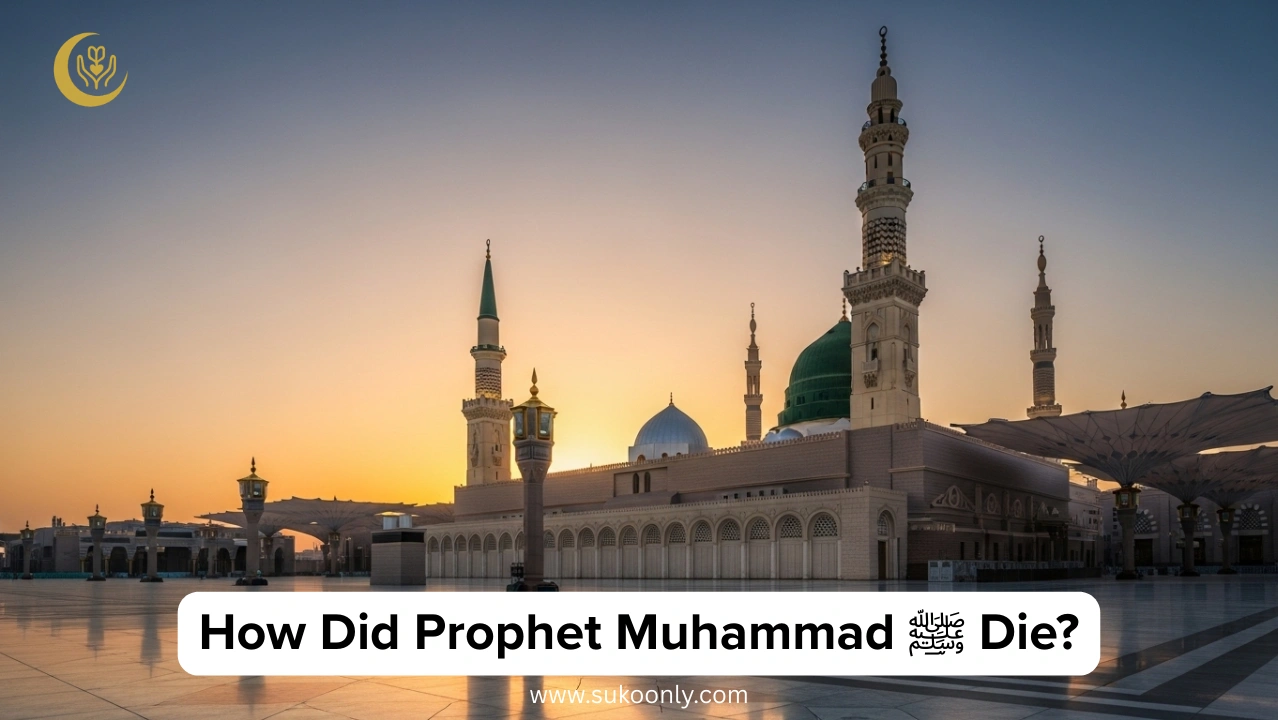
Prophet Muhammad ﷺ passed away in Madinah (Al-Madinah Al-Munawwarah), the city to which he migrated after the Hijrah. During his final illness, he was staying in the home of his wife Aisha (RA). Authentic hadith narrations state that he died in her chamber. After his passing, the Companions consulted regarding his burial. Abu Bakr (RA) narrated that the Prophet ﷺ said: “No prophet is buried except in the place where he dies.” Based on this narration, the Companions buried Prophet Muhammad ﷺ in the same chamber where he passed away. That chamber was later incorporated into Masjid an-Nabawi during subsequent expansions of the mosque. Today, his grave remains within the Prophet’s Mosque, beneath the area commonly known as the Green Dome. 
What Illness Did Prophet Muhammad ﷺ Suffer Before His Death?

In the days before his passing, Prophet Muhammad ﷺ experienced a severe illness that lasted approximately 12 to 13 days, according to authentic narrations. His sickness began shortly after he visited the martyrs of Uhud and addressed the people of Madinah.
He suffered from a high fever, intense headaches, and physical weakness. Aisha (RA) reported that his fever was extremely severe and that she had not seen anyone experience such intensity, as recorded in Sahih al-Bukhari. Despite the severity of his illness, Prophet Muhammad ﷺ continued leading the congregational prayers during the early days of his sickness.
As his condition worsened, he instructed Abu Bakr (RA) to lead the prayers in Masjid an-Nabawi. Both Sahih al-Bukhari and Sahih Muslim document this instruction. During his final days, he remained in the home of Aisha (RA) until his passing.
Authentic Islamic sources describe his illness as a severe fever accompanied by weakness. They do not provide a specific medical diagnosis, and classical scholars therefore refrain from assigning one. The reports focus on the documented symptoms and the Prophet’s guidance during his final days rather than medical speculation.
Was Prophet Muhammad ﷺ Poisoned?
Authentic narrations describe a poisoning incident during the Battle of Khaybar in 7 AH. After the Muslim victory, a Jewish woman presented roasted meat that had been laced with poison. According to reports recorded in Sahih al-Bukhari and Sahih Muslim, Prophet Muhammad ﷺ tasted the meat but did not consume much after being informed that it was poisoned. One of his Companions, Bishr ibn al-Bara (RA), ate from it and later died from its effects. Prophet Muhammad ﷺ survived the immediate consequences of the poisoning. However, during his final illness in Madinah, authentic narrations in Sahih al-Bukhari report that he mentioned continuing to feel pain from the food eaten at Khaybar and described the sensation as though his aorta was being cut. The majority of classical scholars state that Prophet Muhammad ﷺ passed away after a severe fever-based illness in 11 AH, as documented in multiple hadith reports. Some scholars hold the view that the earlier poisoning may have contributed to his final sickness, while others treat the two events as separate occurrences. There is no authentic narration stating that he died immediately from the poisoning at Khaybar. Reliable sources clearly describe a distinct period of illness in Madinah several years later before his passing. 
What Were the Prophet Muhammad ﷺ Final Words?
In the final moments before his passing, Prophet Muhammad ﷺ spoke words reflecting devotion to Allah and concern for his community. Authentic reports from Aisha (RA) state that he was resting against her during his final illness in Madinah. As his voice weakened, he uttered brief but significant phrases.
Among the statements preserved in Sahih al-Bukhari is that he repeatedly said: “ar-Rafīq al-Aʿlā” (الرَّفِيقُ الأَعْلَى), meaning “the Highest Companion.” Authentic hadith explain that prophets are given a choice at the time of death, and scholars understand this phrase as his choice to return to Allah.
Reliable narrations also record that during his final days, Prophet Muhammad ﷺ emphasized the importance of Salah (prayer) and reminded the community about fulfilling the rights of those under their care. These instructions are documented in multiple hadith collections and reflect his continued guidance even during severe illness.
Because several authentic reports describe words spoken close to his passing, scholars clarify that references to his “final words” include both the phrase ar-Rafīq al-Aʿlā and his repeated instructions regarding prayer. Together, they summarize his final message: devotion to Allah and responsibility toward the community.
How Did the Companions React to the Death of Prophet Muhammad ﷺ?
The death of Prophet Muhammad ﷺ caused immense grief and shock in Madinah. When the news spread, many Companions struggled to accept the reality of his passing. Umar ibn al-Khattab (RA) stood before the people and declared that the Prophet ﷺ had not died. He stated that he had gone to meet his Lord, similar to how Moses (AS) had gone before returning, and warned that anyone claiming the Prophet ﷺ had died would face consequences. His reaction reflected deep shock and love rather than denial of belief. Meanwhile, Abu Bakr (RA) entered the chamber where Prophet Muhammad ﷺ lay. He uncovered his face, kissed him, and confirmed that he had indeed passed away. Abu Bakr (RA) then addressed the people and recited the verse: “Muhammad is not but a messenger; messengers have passed on before him. If he dies or is killed, will you turn back on your heels?” — Qur’an 3:144 (Surah Aal-Imran) This verse reminded the community that Prophet Muhammad ﷺ was the Messenger of Allah and that earlier prophets had also died. Authentic reports state that when Abu Bakr (RA) recited this verse, the Companions accepted the reality of his death. The moment restored stability to the community and marked the transition from prophetic leadership to the era of the caliphate. 
What Does the Qur’an Say About the Death of Prophet Muhammad ﷺ?
The Qur’an affirms that Prophet Muhammad ﷺ was a human messenger and that death applies to all people, including prophets. Multiple verses address his mortality directly and clarify that his passing does not change the truth of his message. In Surah Aal-Imran (3:144), Allah says: “Muhammad is not but a messenger; messengers have passed on before him. If he dies or is killed, will you turn back on your heels?” — Qur’an 3:144 This verse establishes two principles: Prophet Muhammad ﷺ is a messenger. Earlier messengers also passed away. It acknowledges the reality of his eventual death and commands believers to remain steadfast in faith. In Surah Az-Zumar (39:30), Allah says: “Indeed, you will die, and indeed, they will die.” — Qur’an 39:30 This verse addresses Prophet Muhammad ﷺ directly and confirms that he would experience death like all human beings.
Together, these passages affirm that Prophet Muhammad ﷺ, like previous prophets, was mortal. His death fulfilled divine decree and did not diminish the preservation of the Qur’an or the continuity of Islam. The Qur’an itself prepared the believers for this reality before his passing.
Lessons Muslims Learn from the Death of Prophet Muhammad ﷺ
The passing of Prophet Muhammad ﷺ reinforces core principles established in the Qur’an and authentic hadith.
The death of Prophet Muhammad ﷺ confirms that all human beings, including prophets, experience death. The Qur’an repeatedly states that every soul shall taste death and that only Allah is eternal. His passing affirms his humanity while preserving his status as the final Messenger. During his final illness, Prophet Muhammad ﷺ continued leading the congregational prayer in Masjid an-Nabawi as long as he was physically able. When his condition worsened, he instructed Abu Bakr (RA) to lead the prayers. This instruction demonstrates the foundational role of Salah in Islamic life and leadership continuity. When news of his death spread, Abu Bakr (RA) restored clarity by reciting Qur’an 3:144, reminding the Companions that Muhammad ﷺ was a messenger and that previous messengers had also passed away. His response illustrates the importance of returning to revelation during moments of emotional shock. The illness and passing of Prophet Muhammad ﷺ reflect the Qur’anic reality that all human beings return to Allah. His final words — ar-Rafīq al-Aʿlā (the Highest Companion) — express his readiness to meet his Lord and conclude his mission. Together, these lessons highlight faith, leadership, devotion, and reliance on divine guidance. The death of Prophet Muhammad ﷺ did not weaken Islam; rather, it demonstrated that the religion rests upon revelation, not the physical presence of any individual. 
1️⃣ Human Mortality
2️⃣ The Central Role of Salah (Prayer)
3️⃣ Stability During Crisis
4️⃣ Return to Allah
Frequently Asked Questions — The Death of Prophet Muhammad ﷺ
Authentic narrations state that Prophet Muhammad ﷺ was ill for approximately 12 to 13 days before his passing. During this period, he suffered from a severe fever, intense headaches, and physical weakness, as reported in Sahih al-Bukhari. The majority of classical scholars state that Prophet Muhammad ﷺ passed away after a severe illness characterized by high fever. Although authentic narrations mention a poisoning incident at Khaybar years earlier, there is no report stating that he died immediately from poison. Reliable sources describe a separate period of illness in Madinah before his death. Authentic reports from Aisha (RA) state that Prophet Muhammad ﷺ died in her chamber in Madinah while resting against her. Abu Bakr (RA) narrated that the Prophet ﷺ said that prophets are buried in the place where they die. Based on this narration, the Companions buried Prophet Muhammad ﷺ in the same chamber where he passed away. Prophet Muhammad ﷺ was 63 years old at the time of his death. He lived 53 years in Makkah and 10 years in Madinah after the Hijrah. He passed away on Monday, 12 Rabiʿ al-Awwal, 11 AH (632 CE), according to the majority of classical Seerah scholars. Yes. The chamber where Prophet Muhammad ﷺ was buried was later incorporated into Masjid an-Nabawi during expansions. Today, his grave remains within the mosque complex beneath the area commonly known as the Green Dome. There is no explicit recorded statement in which Prophet Muhammad ﷺ formally appointed a political successor. However, he instructed Abu Bakr (RA) to lead the congregational prayer during his illness. Some scholars later viewed this instruction as significant in the events that followed his passing.

Mohammed Basheer is the founder of Sukoonly.com, an Islamic blog focused on duas, prophetic healing, and Qur’anic wisdom. He writes with sincerity and spiritual depth for seekers around the world.