
The Sirah of Prophet Muhammad ﷺ is a chronological record of the most influential life in human history—starting with his noble lineage and birth in Makkah and concluding with his Farewell Sermon and passing in Madinah. But the Sirah is more than biography; it is a living model of moral excellence, demonstrating how the Prophet ﷺ embodied divine revelation through every stage of hardship, reform, and leadership.
From early persecution and the Hijrah to state-building in Madinah and the universal message delivered at Arafat, each phase reflects profound spiritual resilience, ethical vision, and prophetic wisdom.
This article offers a structured, phase-by-phase guide to the Sirah—highlighting major events, teachings, and individuals. It’s designed for students, educators, and anyone seeking to live more closely in line with the Sunnah. Readers are invited not just to study history but to internalize prophetic character in their own lives.
What Does “Sirah” Mean in Islam?
The word “Sirah” (السيرة) comes from the Arabic root س-ي-ر, meaning “to travel” or “to journey.” Linguistically, it refers to a person’s path or way of life. In an Islamic context, Sirah Nabawiyyah means the biography of Prophet Muhammad ﷺ—covering his mission, character, teachings, and legacy.
Unlike Hadith, which focus on specific sayings and actions verified through chains of narration, Sirah provides a continuous narrative of the Prophet’s ﷺ life. It places his decisions, challenges, and victories in social, emotional, and political context, helping Muslims understand how divine guidance was lived—not just what was said.
The earliest and most influential compiler of Sirah was Ibn Ishaq, whose work was later edited by Ibn Hisham. Their collections remain central to understanding the Prophet’s ﷺ full life journey.
Studying Sirah offers more than history—it reveals how to:
- Handle trials with patience
- Lead with justice and compassion.
- Apply Qur’anic teachings in everyday life.
For Muslims, Sirah is a moral compass, rooted in lived revelation and prophetic example.
Timeline of Prophet Muhammad’s ﷺ Life
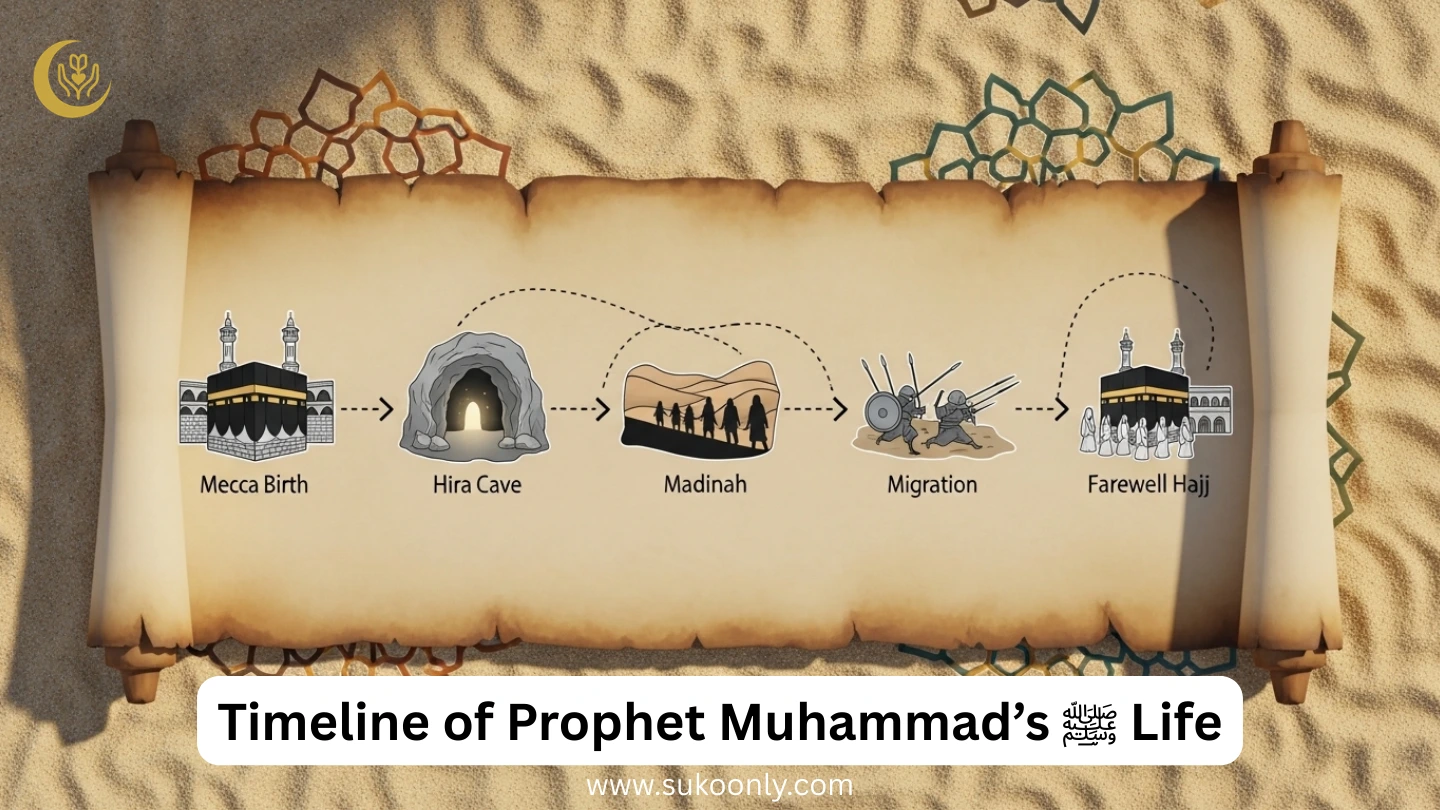
The life of Prophet Muhammad ﷺ is a series of divinely orchestrated events, beginning with his noble ancestry in Mecca and culminating in the Farewell Sermon and his passing in Madinah. This timeline traces the Prophet’s ﷺ journey from pre-birth lineage to final revelation, highlighting key events that shaped Islamic history, law, and community.
Pre-Birth Events & Ancestry of the Prophet ﷺ
Prophet Muhammad ﷺ was born into the Banu Hashim clan of Quraysh, custodians of the Kaaba. His father, Abdullah ibn Abdul Muttalib, died before his birth, making him an orphan from birth—a station that the Qur’an honors and elevates (Surah Ad-Duha). His lineage is traced to Ibrahim (AS) through Ismail (AS), connecting him to the Abrahamic legacy.
Childhood & Early Youth in Mecca
Raised by Abdul Muttalib and later Abu Talib, Muhammad ﷺ displayed unmatched truthfulness (Al-Amin) and moral character. Despite growing up in a society steeped in idolatry, he never participated in pagan practices. His early life formed the foundation for his later prophetic conduct.
The First Revelation in the Cave of Hira
At age 40, in the Cave of Hira on Mount Jabal al-Nour, the angel Jibreel (Gabriel) delivered the first verses of the Qur’an (Surah Al-‘Alaq). This moment marked the beginning of prophethood, transforming his life and the destiny of humanity.
Secret & Public Dawah in Mecca
For the first three years, the Prophet ﷺ invited family and close friends to Islam in secret. Eventually, the message went public, triggering fierce opposition from Quraysh. Despite persecution, boycotts, and humiliation, he remained firm in his mission of tawheed (monotheism).
The Year of Sorrow & Taif
In the 10th year of Prophethood, the Prophet ﷺ lost both Khadijah bint Khuwaylid (RA) and Abu Talib, his pillars of support. His journey to Taif for da’wah resulted in rejection and abuse. Yet he responded with patience, praying for their guidance, not vengeance.
The Hijrah to Madinah
In 622 CE, the Prophet ﷺ migrated to Yathrib (Madinah) by divine command. This marked the founding of the first Islamic state, where Muslims could live, worship, and govern according to Qur’anic guidance. This event begins the Hijri calendar.
Establishing the Madinan State
The Prophet ﷺ implemented the Constitution of Madinah, formalizing religious pluralism, justice, and social cohesion among Muslims, Jews, and other groups. He created a society based on equality, mutual responsibility, and rule of law.
Key Battles — Badr, Uhud, Khandaq
-
Badr (624 CE): A miraculous Muslim victory against a superior army.
-
Uhud (625 CE): A painful setback due to disobedience but a lesson in resilience.
-
Khandaq (627 CE): A defensive trench strategy that safeguarded Madinah.
Each conflict demonstrated strategic leadership and spiritual reliance.
Treaty of Hudaybiyyah
Signed in 628 CE, this peace treaty with Quraysh allowed for diplomatic da’wah and increased the Muslims’ standing. Despite unfavorable terms, it was called a “clear victory” in Surah Al-Fath, paving the way for the Conquest of Makkah.
The Farewell Hajj & Final Sermon
During his only Hajj pilgrimage, the Prophet ﷺ delivered the Farewell Sermon to over 100,000 followers. He emphasized human dignity, women’s rights, racial equality, and the finality of revelation. These principles form the ethical spine of Islamic civilization.
The Final Illness & Passing
In 632 CE, Prophet Muhammad ﷺ fell ill and passed away in the home of Aisha bint Abi Bakr (RA) at the age of 63. His final words emphasized salah (prayer) and care for the Ummah. His mission completed, his legacy continues through the Qur’an, Sunnah, and the lives he transformed.
Sirah vs Sunnah — What’s the Difference?
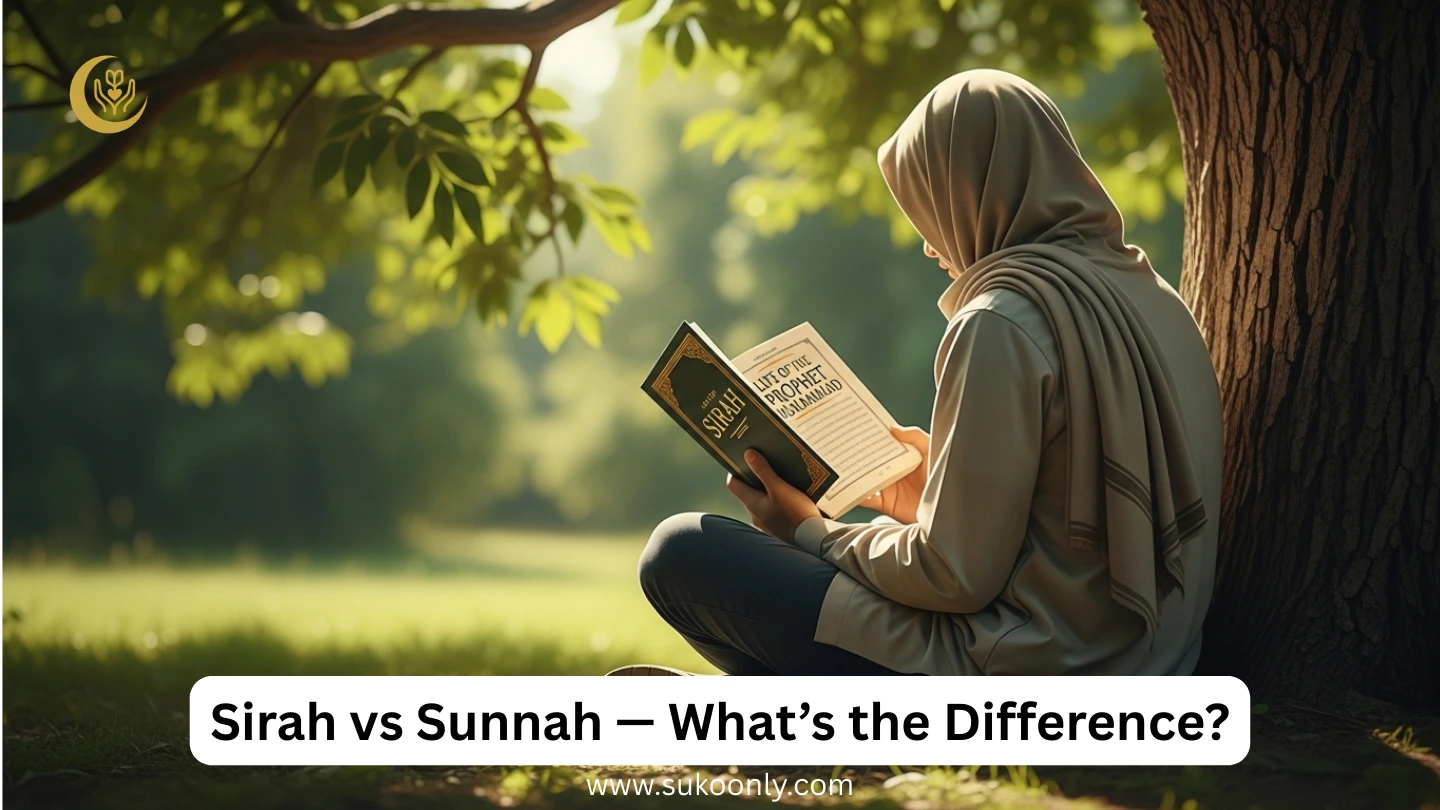
In Islamic tradition, Sirah and Sunnah are closely linked but serve distinct purposes in understanding the life and guidance of Prophet Muhammad ﷺ.
-
Sirah (biography) offers the historical narrative—detailing the Prophet’s lineage, upbringing, mission, challenges, migration (Hijrah), community building, and final sermon. It gives us context, chronology, and insight into the circumstances that shaped early Islam.
-
Sunnah is the Prophet’s way of life—his sayings, actions, approvals, and habits, recorded through verified Hadith. It forms the practical model for how Muslims should live, worship, and interact, reflecting the Qur’an in action.
While Sirah provides the story, Sunnah delivers the standard. Both are essential. One without the other risks misunderstanding or misapplying Islamic teachings.
Together, they form a complete guide to belief, practice, and spiritual insight—grounding Islamic knowledge in both principle and example.
Why Study the Sirah Today?
Studying the Sirah is not just an academic pursuit—it’s a path to personal and spiritual awakening. The trials faced by the Prophet ﷺ, from the loss of loved ones to community rejection, offer timeless lessons in patience (ṣabr), reliance on Allah (tawakkul), and unwavering hope. These aren’t abstract stories—they are reflections of real struggle and resilience that mirror our own lives.
From a leadership lens, the Sirah reveals how the Prophet ﷺ balanced mercy with justice, consultation (shūrā) with decisiveness, and compassion with unwavering moral clarity. His dealings—be it with friends, enemies, or strangers—teach emotional intelligence, ethical decision-making, and strategic foresight.
On a personal level, immersing oneself in the Sirah fosters emotional connection with the Prophet ﷺ. You begin to love him not just as a Messenger, but as a man who felt grief, showed mercy, laughed with companions, and prayed with tears in solitude. This connection rekindles faith, reshapes character, and strengthens the heart.
Whether seeking direction, emotional healing, or deeper love for the Prophet ﷺ, the Sirah offers a living blueprint. It realigns the heart with divine purpose and brings the believer closer to the one who was sent as a mercy to all worlds.
This section of Sukoonly’s Sirah hub brings you structured child pages that explore the life of the Prophet ﷺ in more detail.
-
Wives of the Prophet ﷺ – Their names, roles, and wisdom as the Mothers of the Believers
-
Children of the Prophet ﷺ – Their lives, faith, and legacy in early Islam
-
Miracles of the Prophet ﷺ – Events that affirmed Prophethood and inspired generations
-
Battles in Islam – From Badr to Khandaq, the strategy, context, and lessons
-
Letters to Kings – How the Prophet ﷺ invited world leaders to Islam with wisdom and grace
-
Appearance & Character – Shama’il insights from the companions’ vivid descriptions
-
Daily Routine – A window into the Prophet’s ﷺ daily schedule, worship, and interactions
-
Sirah Quizzes & Infographics (coming soon) – Learn interactively and test your understanding
-
FAQs About Sirah – Addressing common questions about studying the Prophet’s ﷺ life
These pages are designed to deepen your connection with the Messenger ﷺ and make learning the Sirah a spiritually enriching journey.
Frequently Asked Questions — Sirah of the Prophet ﷺ
For beginners, “In the Footsteps of the Prophet” by Tariq Ramadan and “Ar-Raheeq Al-Makhtum” (The Sealed Nectar) by Safi-ur-Rahman al-Mubarakpuri are highly recommended. The former is reflective and accessible; the latter is a well-sourced biography recognized globally. The earliest and most well-known biographer is Ibn Ishaq, whose work was later preserved and edited by Ibn Hisham. His compilation remains a foundational source for later Sirah literature.

Mohammed Basheer is the founder of Sukoonly.com, an Islamic blog focused on duas, prophetic healing, and Qur’anic wisdom. He writes with sincerity and spiritual depth for seekers around the world.