
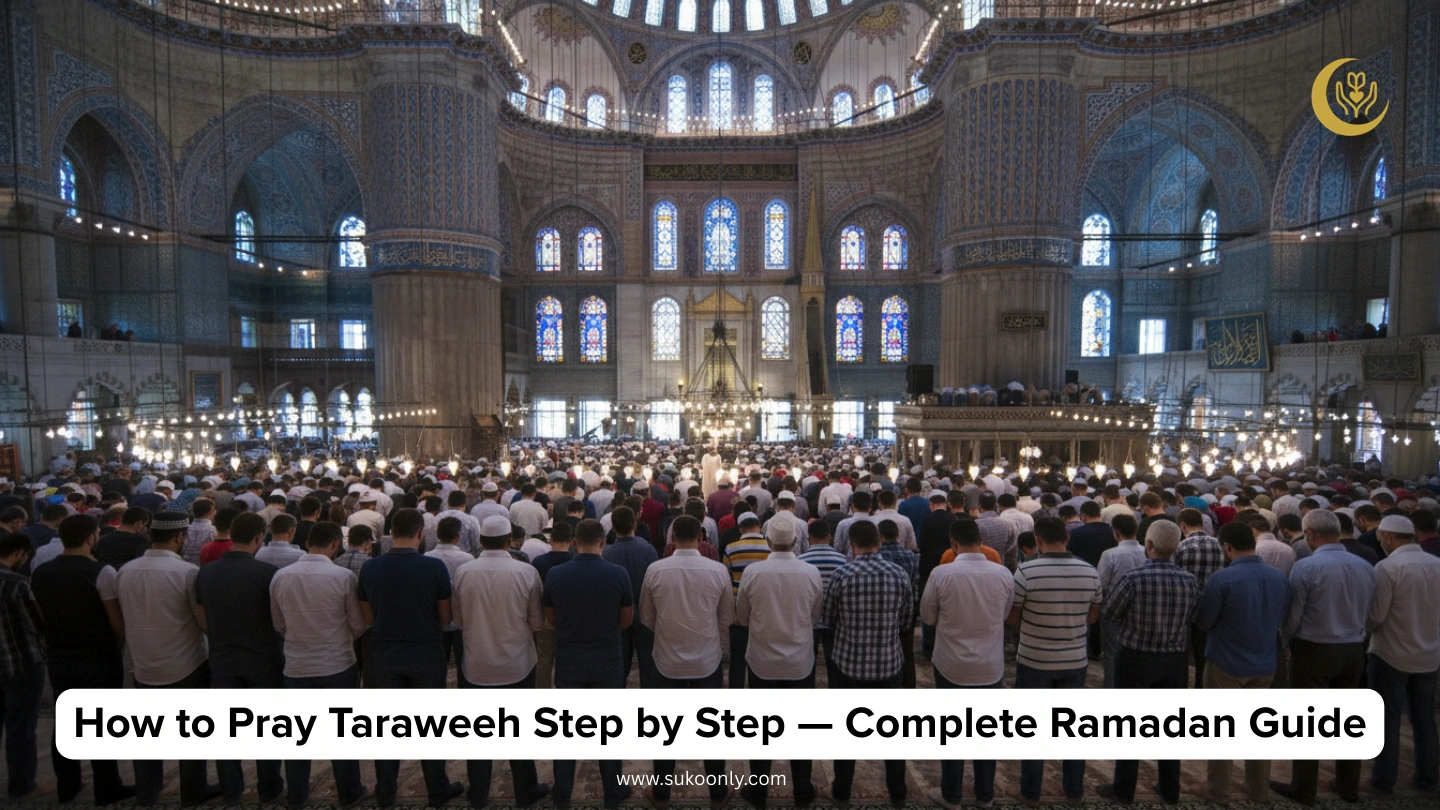

How to Pray Taraweeh is a common question during Ramadan, as Muslims seek to perform this special night prayer correctly and with understanding. Taraweeh is a voluntary prayer offered after ‘Isha during the month of Ramadan and is classified as Sunnah Mu’akkadah. It was established by Prophet Muhammad ﷺ and later organized in congregation during the caliphate of Umar ibn al-Khattab (RA).
Taraweeh is part of Qiyam al-Layl (night prayer) and provides believers the opportunity to stand before Allah ﷻ, listen to the recitation of the Qur’an, and seek forgiveness during the blessed nights of Ramadan.
The prayer is performed in sets of two rak‘ahs after ‘Isha and before Witr. It may be prayed in the mosque or at home, individually or in congregation. Classical scholars differed regarding the number of rak‘ahs, and both 8 and 20 have valid precedent within Islamic tradition. The focus of Taraweeh is sincere devotion and prolonged standing in worship rather than a specific number.
This guide provides a clear, step-by-step explanation of how to pray Taraweeh, including its timing, rak‘ah structure, congregation rulings, Witr placement, and common mistakes — so you can perform it with confidence throughout Ramadan.
What Is Taraweeh Prayer in Islam?
Taraweeh is the voluntary night prayer performed during the month of Ramadan after the ‘Isha prayer. It is classified as Sunnah Mu’akkadah (a highly emphasized Sunnah) and falls under the broader category of Qiyam al-Layl (night prayer). What distinguishes Taraweeh from other night prayers is its exclusive connection to Ramadan.
Prophet Muhammad ﷺ led Taraweeh in congregation for several nights. He later discontinued leading it publicly out of concern that it might become obligatory upon his community. This demonstrates that Taraweeh was legislated but intentionally left voluntary.
After the Prophet’s ﷺ passing, Umar ibn al-Khattab (RA) revived and organized its congregational performance in the mosque. The Muslim community has continued this practice for centuries, establishing Taraweeh as a Ramadan tradition rooted in Prophetic precedent.
The word “Taraweeh” comes from the Arabic root raaha (to rest). It refers to the short pauses traditionally taken after every four rak‘ahs. Historically, long portions of the Qur’an were recited during Taraweeh, and these pauses allowed worshippers to rest during extended standing.
Taraweeh is not obligatory (fard). It is a highly rewarded Sunnah prayer. The Prophet ﷺ said:
“Whoever stands (in prayer) during Ramadan with faith and seeking reward will have their past sins forgiven.” (Authentic hadith recorded in Sahih collections)
Scholars connect this narration to the night prayers of Ramadan, including Taraweeh.
Taraweeh differs from Tahajjud in both timing and context:
-
Tahajjud may be prayed throughout the year and typically requires sleeping before praying.
-
Taraweeh is prayed specifically during Ramadan and usually begins immediately after ‘Isha without requiring prior sleep.
Although both fall under Qiyam al-Layl, Taraweeh carries a distinct Ramadan identity and communal dimension.
Taraweeh begins on the first night of Ramadan and continues until the final night before Eid al-Fitr. Once Ramadan concludes, Taraweeh ends, while voluntary night prayer continues in the form of Tahajjud.
When Is Taraweeh Prayed? (Correct Time Explained)
Taraweeh is prayed during the nights of Ramadan after completing the obligatory ‘Isha prayer. Its time begins immediately after ‘Isha and extends until true dawn (Fajr al-Sadiq). As a night prayer under Qiyam al-Layl, Taraweeh remains valid any time between ‘Isha and the start of Fajr.
Scholars unanimously agree that Taraweeh cannot be prayed before ‘Isha and becomes invalid once Fajr begins. Although the Islamic night starts at Maghrib, Taraweeh is specifically tied to ‘Isha and must follow it.
In most mosques, Taraweeh is prayed immediately after ‘Isha in congregation, often concluding with Witr prayer. However, it is also permissible to delay Taraweeh to the later part of the night, especially for those intending to lengthen their recitation and standing in prayer. As long as it is completed before true dawn, it remains within its prescribed time.
Taraweeh begins on the first night of Ramadan and continues nightly until the final night before Eid al-Fitr. Once Fajr enters, the time for Taraweeh ends.
How Many Rak‘ahs Are in Taraweeh? (8 or 20?)
One of the most common questions about Taraweeh is how many rak‘ahs should be prayed. Both 8 rak‘ahs and 20 rak‘ahs are recognized as valid positions within Islamic scholarship. The Prophet ﷺ did not specify a fixed congregational number for Taraweeh. Scholars derive their rulings either from his personal practice of Qiyam al-Layl or from the organized Ramadan practice of the Companions.
8 Rak‘ahs Opinion (Prophetic Night Prayer Evidence)
Aisha (RA) reported that Prophet Muhammad ﷺ did not exceed eleven rak‘ahs in Ramadan or outside of it — including Witr. Based on this narration (recorded in Sahih al-Bukhari), some scholars conclude that 8 rak‘ahs of night prayer plus 3 rak‘ahs of Witr most closely reflect his regular practice.
This view emphasizes following the Prophet’s ﷺ personal night prayer structure.
20 Rak‘ahs Opinion (Companion Practice)
During the caliphate of Umar ibn al-Khattab (RA), the people were gathered behind a single Imam and prayed 20 rak‘ahs in Ramadan. This practice was accepted by the Companions and later adopted across the major schools of jurisprudence. As a result, 20 rak‘ahs became a widely established communal precedent in many regions of the Muslim world.
This view emphasizes the unified practice of the Companions during Ramadan.
Can You Pray Less?
Taraweeh is Sunnah Mu’akkadah, not obligatory. A person may pray fewer rak‘ahs if needed. The validity of Taraweeh does not depend on reaching a specific number but on performing night prayer sincerely within its prescribed time after ‘Isha.
Can You Pray More?
The Prophet ﷺ taught that night prayer is offered two by two, without setting a numerical ceiling. Based on this principle, jurists permit praying more than 8 or 20 rak‘ahs, since voluntary night prayer has no fixed upper limit.
Is 2 by 2 Required?
Yes. Taraweeh follows the general rule of night prayer: it is prayed in sets of two rak‘ahs, and it concludes with Witr.
Step-by-Step: How to Pray Taraweeh (Detailed Method)
Taraweeh is prayed after the obligatory ‘Isha prayer during Ramadan and follows the standard structure of Salah. It consists of repeated sets of two rak‘ahs, each concluded with Salam. There are no unique movements specific to Taraweeh; it follows the legislated format of voluntary night prayer established by Prophet Muhammad ﷺ.
Step 1 — Make the Intention (Niyyah)
Before beginning the first two rak‘ahs, form the intention in your heart that you are praying Taraweeh for the sake of Allah during Ramadan.
-
Niyyah is an action of the heart.
-
It does not require verbal declaration.
-
For subsequent sets, simply remain aware that you are continuing Taraweeh.
Step 2 — Pray 2 Rak‘ahs Like Regular Salah
Each two-rak‘ah unit is offered as a complete prayer and concluded with Salam.
1️⃣ Begin with Takbir (“Allahu Akbar”).
2️⃣ Recite Surah Al-Fatiha in each rak‘ah, followed by another portion of the Qur’an.
3️⃣ Perform Ruku (bowing).
4️⃣ Rise to standing.
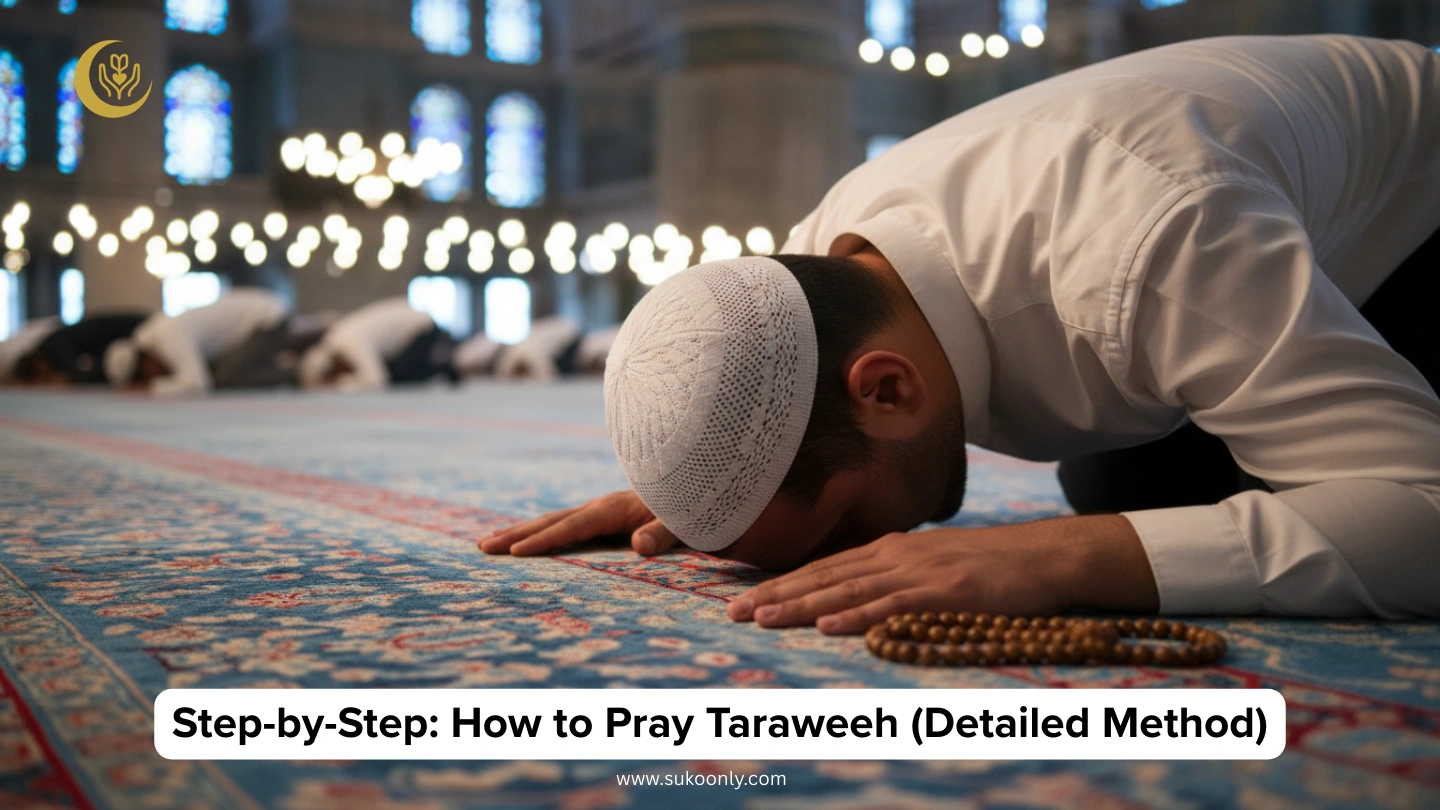
5️⃣ Perform two Sujood (prostrations) with a brief sitting between them.
6️⃣ In the second rak‘ah, after the second Sujood, sit for Tashahhud.
7️⃣ Conclude with Salam (turning right and left).
Recitation Rulings:
-
In congregation, the Imam recites aloud.
-
When praying individually, recitation may be aloud or silent.
-
There is no fixed surah required.
-
Lengthened recitation is meritorious but shorter recitation is valid.
Step 3 — Continue in Sets of Two Rak‘ahs
After Salam, stand and begin another two rak‘ahs.
The Prophet ﷺ said that night prayer is prayed two by two, which establishes this format.
Traditionally, worshippers pause briefly after every four rak‘ahs. This pause is optional and gives the prayer its name Taraweeh, derived from a word meaning “to rest.”
Continue this pattern until you reach your intended number (8, 20, or more).
If praying behind an Imam, it is recommended to remain with him until he completes the entire prayer, including Witr, to gain the reward of standing the whole night.
Step 4 — Complete With Witr Prayer
Witr is prayed after finishing Taraweeh and is distinct from it.
Witr must consist of an odd number of rak‘ahs, commonly:
-
1 rak‘ah
-
3 rak‘ahs
-
5 or more (in odd numbers)
If praying in congregation, remaining with the Imam until he completes Witr carries the reward of standing the entire night.
If praying individually, Witr may be delayed to the final portion of the night for those intending additional Qiyam al-Layl.
How to Pray Taraweeh at Home (Men & Women)
Taraweeh may be prayed at home during Ramadan. While congregational Taraweeh in the mosque is a strongly encouraged Sunnah practice established by Prophet Muhammad ﷺ and organized publicly during the caliphate of Umar ibn al-Khattab (RA), it is not required for validity. Praying Taraweeh at home fulfills the Sunnah and carries reward.

Is Congregation Required?
Congregation (jama‘ah) is not obligatory for Taraweeh. It is classified as Sunnah Mu’akkadah, not fard.
The Prophet ﷺ led Taraweeh in congregation for several nights and then discontinued leading it publicly so that it would not become compulsory upon the community.
Praying in congregation carries additional virtue, especially when remaining with the Imam until completion (including Witr). However, Taraweeh performed individually at home is fully valid and rewarded.
Can Women Pray Taraweeh at Home?
Yes. Women may pray Taraweeh at home, and it is completely valid.
Women may also attend Taraweeh in the mosque while observing proper Islamic guidelines. Many jurists state that prayer at home carries significant virtue for women, while mosque attendance remains permissible.
Can You Pray Alone?
Taraweeh may be prayed individually.
A person may also lead family members in congregation at home. The mosque is not a condition for the validity of Taraweeh.
Can You Read from the Qur’an (Phone or Mushaf)?
In voluntary prayer, many scholars permit reading from a mushaf if one has not memorized sufficient portions of the Qur’an. This allowance applies to Taraweeh prayed individually.
Many contemporary jurists also permit reading from a digital device when needed. Movements should be minimized to preserve focus and humility during prayer.
Can You Sit If Tired?
Because Taraweeh is voluntary, it may be prayed while sitting.
If someone cannot stand due to fatigue, illness, or weakness, they may sit without affecting the prayer’s validity. Even when physically able to stand, sitting in voluntary prayer remains permissible, although standing carries greater reward.
How to Pray Taraweeh in the Mosque Behind an Imam
Praying Taraweeh behind an Imam in the mosque is an established Sunnah during Ramadan. Congregational Taraweeh was led by Prophet Muhammad ﷺ and later organized publicly during the caliphate of Umar ibn al-Khattab (RA). In congregational prayer, following the Imam is essential to proper structure and reward.

Follow the Imam Fully
The Prophet ﷺ said, “The Imam is appointed to be followed.”
This establishes a clear principle in congregational Salah:
-
Bow (Ruku) when the Imam bows.
-
Prostrate (Sujood) when the Imam prostrates.
-
Do not precede the Imam in movements.
-
Do not delay excessively behind him.
Moving ahead of the Imam disrupts the order of the congregation.
During Taraweeh, the Imam recites the Qur’an aloud, and the congregation listens attentively and follows.
Do Not Leave Before the Imam Finishes Witr
The Prophet ﷺ said:
“Whoever stands with the Imam until he finishes, it will be recorded for him as if he prayed the entire night.”
Scholars explain that this refers specifically to the Ramadan night prayer, including Taraweeh and Witr.
Remaining with the Imam until he completes Witr carries the reward of standing the whole night in prayer.
What If the Imam Prays 20 and You Prefer 8?
Both 8 rak‘ahs and 20 rak‘ahs have established scholarly foundations.
If the Imam prays 20 while you personally follow the 8-rak‘ah opinion, the preferable course is to continue until completion.
Praying 20 behind the Imam does not invalidate your view, since both positions are recognized in Islamic jurisprudence. Preserving unity and attaining the reward of full-night standing takes precedence over personal numerical preference.
If someone leaves after 8 without causing disturbance, the prayer remains valid. However, completing the prayer with the congregation carries greater virtue.
What to Recite in Taraweeh?
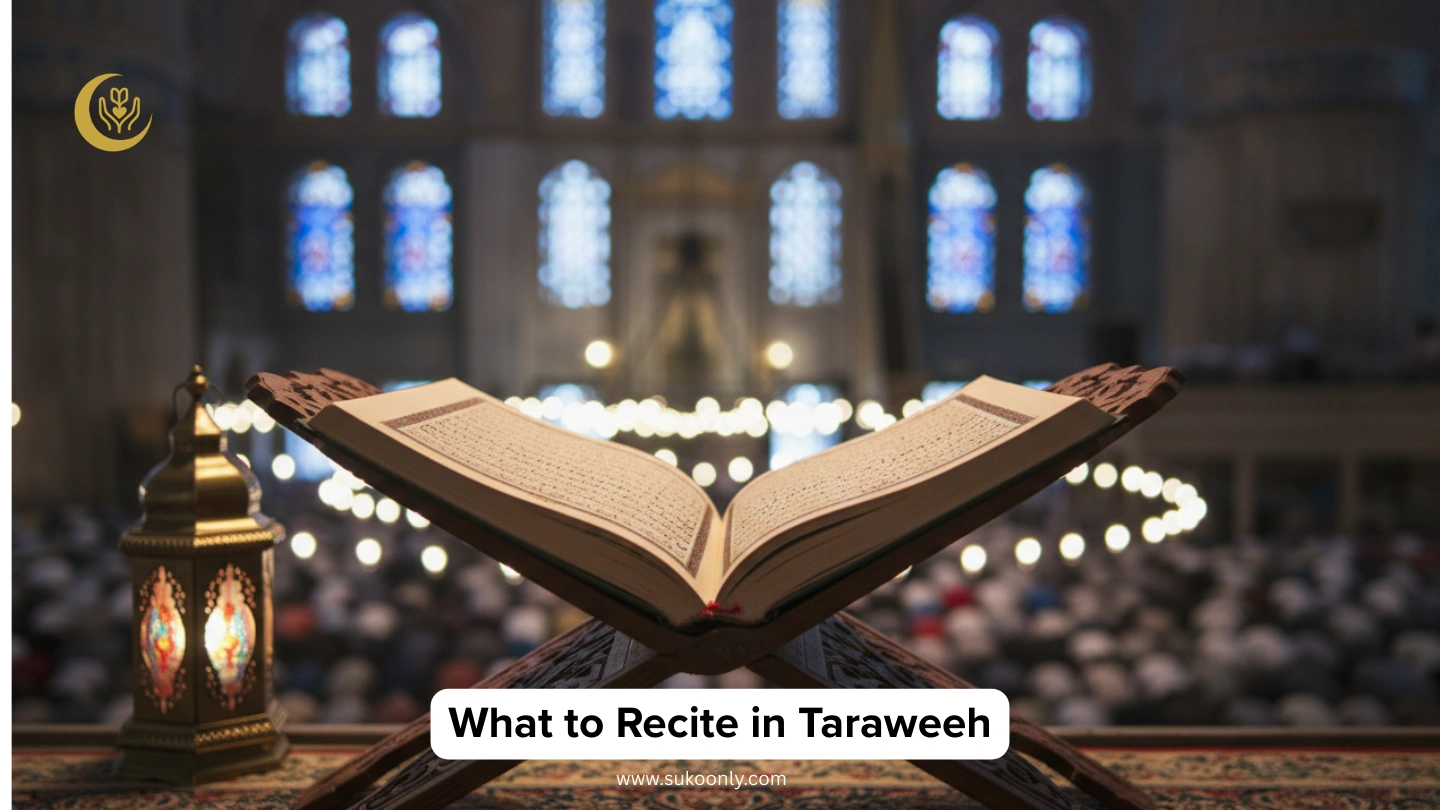
Taraweeh follows the established structure of voluntary night prayer. In every rak‘ah, Surah Al-Fatiha must be recited, followed by another portion of the Qur’an. There is no specific surah mandated for Taraweeh; any Qur’anic verses may follow Al-Fatiha.
Because Ramadan is the month in which the Qur’an was revealed, Taraweeh provides sustained engagement with its recitation across the nights of the month.
Is Long Recitation Sunnah?
Lengthening recitation in Qiyam al-Layl reflects the Prophetic Sunnah. Prophet Muhammad ﷺ stood for extended periods during night prayer. During Ramadan, the Companions listened to prolonged recitation behind their Imam.
In congregational Taraweeh:
-
The Imam recites aloud.
-
The congregation listens attentively.
-
Many mosques aim to complete the entire Qur’an (khatm) over the month.
Extended recitation increases reward but is not required for validity. The Imam should balance devotion with consideration for the congregation’s capacity.
Is Short Recitation Allowed?
Yes. Shorter surahs are fully permissible in Taraweeh.
A person praying at home or with limited memorization may recite shorter passages. The prayer remains valid so long as:
-
Surah Al-Fatiha is recited.
-
Additional Qur’anic verses follow it.
Length affects virtue, not validity.
Completing the Entire Qur’an in Ramadan
Completing the entire Qur’an (khatm) during Taraweeh is a praiseworthy and widely practiced tradition. It allows worshippers to experience the Qur’an in full across the nights of Ramadan.
However, completing the entire Qur’an is not obligatory. Taraweeh remains valid and rewarded even if the Qur’an is not completed.
Can Beginners Recite Short Surahs?
Yes. Beginners should recite what they have memorized.
There is no requirement to exceed one’s ability. Allah does not burden a soul beyond its capacity. Taraweeh is meant to cultivate gradual connection with the Qur’an through sincerity, humility, and consistent effort.
Common Mistakes in Taraweeh (Corrected)
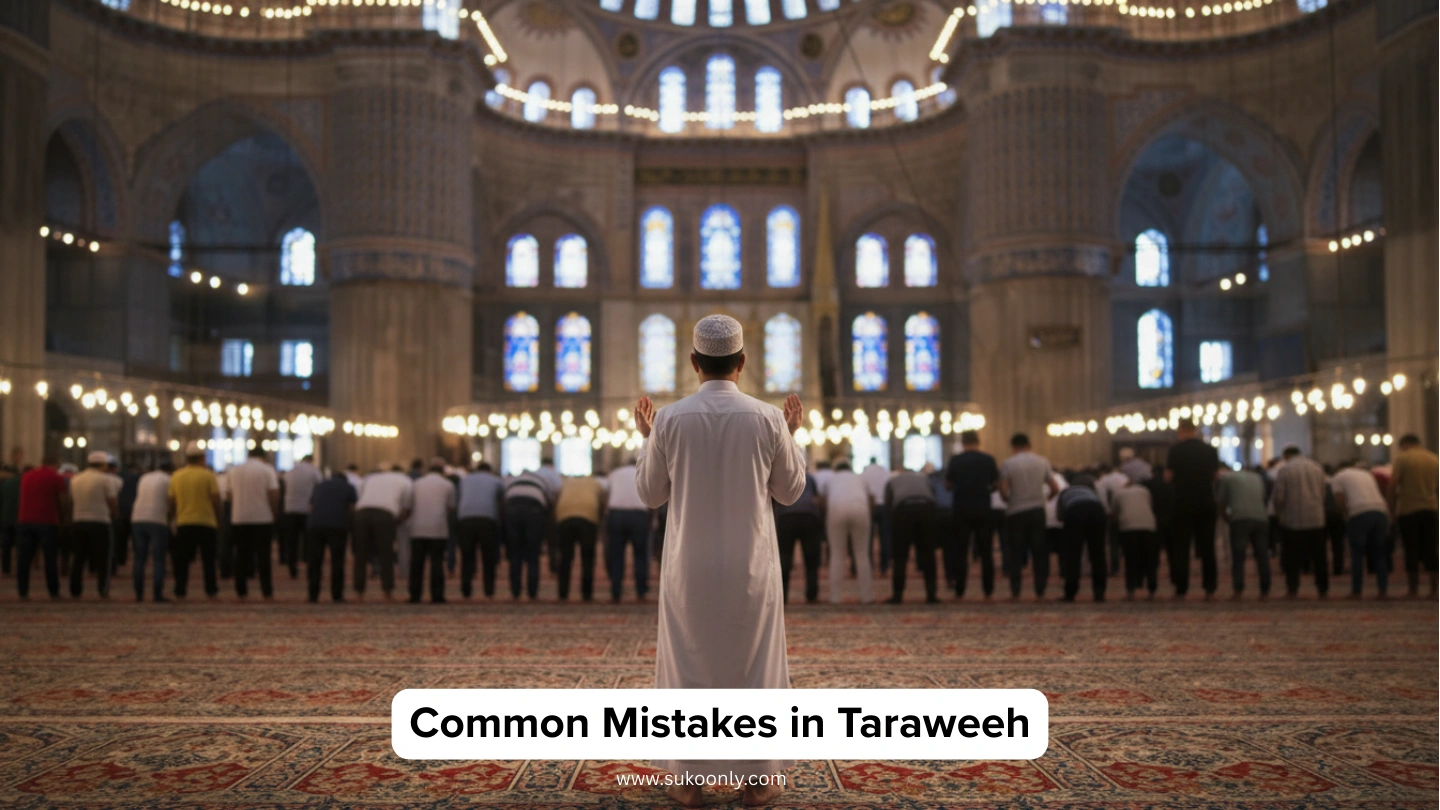
Although Taraweeh is a voluntary prayer performed during Ramadan, it must follow the essential structure and pillars of Salah. Certain mistakes can weaken its spiritual benefit or affect its validity.
- Praying Too Fast (Lack of Tumā’nīnah)
- Skipping Witr Without Intention
- Treating Taraweeh Like an Obligation
- Leaving Early Without Reason
- Arguing About 8 vs 20 Rak‘ahs
Quick Summary Table — Taraweeh Rules at a Glance
Below is a simplified overview of the core rulings related to Taraweeh during Ramadan:
| Question | Ruling |
|---|---|
| When is Taraweeh prayed? | After ‘Isha during Ramadan, before Fajr |
| How many rak‘ahs? | 8 or 20 — both valid positions |
| Is congregation required? | Recommended (Sunnah), not required |
| Can it be prayed at home? | Yes — fully valid |
| Should you stay with the Imam? | Yes — remain until he completes Witr for full reward |
| Is Taraweeh obligatory? | No — it is Sunnah Mu’akkadah |
Taraweeh is a highly emphasized voluntary night prayer in Ramadan. Its core rulings are consistent across the recognized schools of Islamic scholarship, even where minor interpretive differences exist regarding rak‘ah count.
Frequently Asked Questions — Taraweeh Prayer
Yes. Taraweeh must be prayed after ‘Isha and before Fajr. Its time extends throughout the night, including after midnight. As long as it is completed before true dawn, it remains valid. Taraweeh requires reciting Surah Al-Fatiha and an additional portion of the Qur'an in each rak‘ah. Limited memorization does not affect validity. Many scholars permit reading from a mushaf in voluntary prayer when needed. Missing Taraweeh carries no sin because it is Sunnah Mu’akkadah, not obligatory. It does not require qada (make-up prayer). Taraweeh is a form of Qiyam al-Layl prayed after ‘Isha during Ramadan. Tahajjud is night prayer offered after sleeping. Praying Taraweeh does not prevent offering additional Tahajjud later in the night. No. Praying 8 rak‘ahs of Taraweeh is valid. The difference between 8 and 20 rak‘ahs is a recognized scholarly interpretation and not a matter of sin. Yes. Taraweeh may be prayed sitting because it is voluntary. However, standing carries greater reward when physically able. When praying alone, voluntary night prayer may be recited aloud or silently. Both methods are valid. Yes. Women may attend Taraweeh in the mosque while observing proper guidelines. Praying Taraweeh at home is also valid and rewarded. Prophet Muhammad ﷺ taught: “Whoever stands in prayer during Ramadan with faith and seeking reward will have his previous sins forgiven.” Standing with the Imam until he completes the prayer — including Witr — carries the reward of praying the entire night. Taraweeh fulfills night prayer for the early portion of the night in Ramadan. Additional Tahajjud may still be offered later.

Mohammed Basheer is the founder of Sukoonly.com, an Islamic blog focused on duas, prophetic healing, and Qur’anic wisdom. He writes with sincerity and spiritual depth for seekers around the world.