

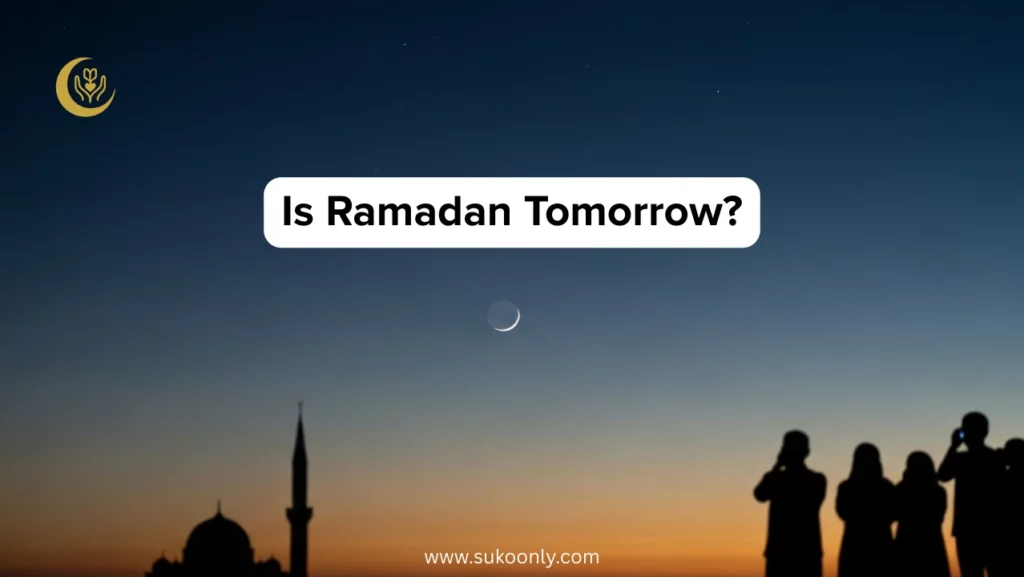
Is Ramadan tomorrow? The start of Ramadan depends on the official sighting of the hilal (crescent moon) marking the end of Sha‘ban in the Islamic lunar calendar. Ramadan does not begin automatically at midnight or based only on calendar predictions — it begins after sunset once trusted Islamic authorities confirm the moon sighting. Because the lunar month is either 29 or 30 days, the 29th night of Sha‘ban is observed carefully. If the crescent is sighted, Ramadan begins the following day. If it is not seen, Sha‘ban completes 30 days, and Ramadan starts after that. Moon visibility differs by region, so Ramadan may begin on different days in different countries. To know if Ramadan starts tomorrow in your area, follow announcements from your local mosque, national moon-sighting committee, or official religious council. (Estimated Ramadan 2026 is expected to begin on the evening of Tuesday, 17 February 2026, with the first fast observed on Wednesday, 18 February 2026. The holy month is anticipated to end on the evening of Thursday, 19 March 2026, followed by Eid al-Fitr on Friday, 20 March 2026.)
Is Ramadan Starting Tomorrow?
Ramadan 2026 is expected to begin on the evening of Thursday, February 19, 2026, with the first fast observed on Friday, February 20, 2026. The month is estimated to continue until the evening of March 20, 2026. However, these dates are not final and depend entirely on the official sighting of the hilal (crescent moon) at the end of Sha‘ban.
Ramadan does not start automatically based on calendar calculations. It begins only after sunset once authorized moon-sighting committees or recognized Islamic authorities confirm the crescent’s visibility.
If the hilal is seen on the 29th night of Sha‘ban, Ramadan begins the following day. If it is not seen, Sha‘ban completes 30 days before Ramadan starts.
Because moon visibility varies by region, Ramadan may begin on different days across countries. To know if Ramadan is starting tomorrow in your area, wait for official confirmation after Maghrib from your local mosque or national religious authority.
Why Does Ramadan Start on Different Days in Different Countries?

Ramadan begins on different days across the world because its start depends on the sighting of the hilal (crescent moon) — and the moon is not visible everywhere at the same time.
The Islamic calendar follows a lunar system. A new month begins only when the crescent moon is sighted after sunset on the 29th night of Sha‘ban. However, weather conditions, atmospheric clarity, and geographical location affect visibility. The moon may be seen in one country but not in another. Islamic scholars differ on whether Muslims should: Follow local moon sighting (each country or region confirms independently), or Follow a global sighting (if the moon is seen anywhere, all Muslims begin Ramadan). Both positions have scholarly support in Islamic jurisprudence. As a result, some countries rely on local committees, while others may follow official announcements from places such as Saudi Arabia. Ramadan is confirmed after sunset — and sunset occurs at different times worldwide. Due to time zone variation, one country may confirm the moon while another has not yet reached sunset. This natural time difference contributes to variation in Ramadan’s start date. Ramadan officially begins only after recognized religious authorities — such as national moon-sighting committees or Islamic councils — announce confirmation. Social media claims or unofficial reports do not determine the start of the month. For unity and clarity, Muslims are encouraged to follow their trusted local authority. 1. Moon Sighting Differences
2. Local vs Global Moon Sighting
3. Time Zone Differences
4. Official Religious Announcements
Moon Sighting vs Astronomical Calculation — What Do Scholars Say?
The question of whether Ramadan should begin based strictly on physical moon sighting or through astronomical calculations is one of method — not belief. Both approaches aim to determine the start of the lunar month correctly.
The majority of classical scholars hold that Ramadan begins only when the hilal (crescent moon) is physically sighted after sunset on the 29th of Sha‘ban. This position is based on prophetic instruction to fast upon seeing the moon and to complete 30 days if it is not visible. Under this view: Direct observation is required. If the moon is not seen, Sha‘ban completes 30 days. Calculations may assist but do not replace sighting. This remains the dominant position in many Muslim-majority countries. Some contemporary scholars and councils permit using astronomical calculations to determine the start of Ramadan, especially where sighting is difficult due to climate or geography. Under this view: If calculations confirm the moon is astronomically present, Ramadan may begin. Calculations can prevent false sightings. Scientific certainty can support unity and planning. This position is adopted by certain minority communities and Islamic councils, particularly in Western countries. The majority (jumhūr) of scholars prioritize physical moon sighting. A minority view allows calculations as a valid method. Both positions are rooted in scholarly reasoning and are recognized within Islamic jurisprudence. The difference lies in method, not in the obligation of fasting itself. Some scholars emphasize global unity, arguing that if the moon is sighted anywhere, all Muslims should begin Ramadan together. Others prioritize local sighting, believing each region should rely on its own confirmed observation. In practice: Many countries follow local moon sighting. Some communities follow announcements from other regions. Muslims are encouraged to follow their local recognized authority to maintain communal unity. In summary, both moon sighting and calculation approaches exist within Islamic scholarship. What matters most for individuals is following the trusted religious authority in their country or community to ensure unity and clarity. 1. The Traditional Sighting Position
2. The Calculation-Based Position
3. Majority vs Minority View
4. Unity vs Local Adherence
Frequently Asked Questions — Is Ramadan Tomorrow?
Ramadan is confirmed only after sunset (Maghrib) when an official moon-sighting announcement is made by recognized religious authorities. Until a verified confirmation is issued, Ramadan is not considered officially begun. No. Even if individuals claim to have seen the moon, Ramadan officially begins only after confirmation by a recognized Islamic authority, moon-sighting committee, or national religious body. Yes. Because moon visibility varies by location and scholars differ on local versus global sighting, some countries may begin Ramadan on different days. This variation is historically recognized within Islamic practice. Taraweeh begins on the night Ramadan starts. If Ramadan begins on Friday, Taraweeh is prayed the previous evening, after ‘Isha on Thursday. You should wait for confirmation from your recognized local Islamic authority or mosque. Fasting begins only after official confirmation to maintain clarity and community unity. Yes. Ramadan follows the Islamic lunar calendar, which consists of 29 or 30 days depending on moon sighting. Ramadan lasts either 29 or 30 days. The exact length depends on the sighting of the crescent moon marking the beginning of Shawwal. Astronomical calculations can predict when the moon is likely visible. Whether they replace physical sighting depends on the scholarly method adopted by a country or recognized Islamic authority.

Mohammed Basheer is the founder of Sukoonly.com, an Islamic blog focused on duas, prophetic healing, and Qur’anic wisdom. He writes with sincerity and spiritual depth for seekers around the world.