Muharram is not just the first month of the Islamic calendar—it is one of the most sacred and spiritually powerful times of the year.
As the new Hijri year begins, Muslims around the world are reminded that this isn’t simply a change in dates. Muharram carries deep meaning—rooted in divine command, prophetic tradition, and powerful moments from our history. It’s a time of reflection, worship, gratitude, and remembrance.
In this article, we’ll explore what makes Muharram so special—from its status as one of the four sacred months in the Qur’an, to the significance of ʿĀshūrāʼ, to the timeless lessons of courage and faith from the story of Karbala. You’ll also find answers to common questions about how to observe this month and what it means for your spiritual journey today.
What Exactly is Muharram?
Muharram marks the beginning of the Islamic year, but it’s far more than just a date on the calendar. It is one of the four sacred months that Allah ﷻ has honored in the Qur’an (9:36), and its very name—Muharram—reminds us that this is a time when fighting and wrongdoing are especially forbidden.
For a believer, Muharram is a season of reflection and devotion. It’s a time to turn our hearts toward Allah ﷻ, to fast, to pray, and to remember powerful moments from our history that still shape our faith today. The 10th of Muharram, known as ʿĀshūrāʼ, holds deep meaning. On this day, Allah ﷻ rescued Prophet Mūsā (عليه السلام) and his people from the oppression of Pharaoh. It’s also the day we remember the noble stand of Imam Husayn ibn ʿAlī (رضي الله عنه) at Karbala—his sacrifice for truth, justice, and unwavering faith.
Muharram calls us to reflect on mercy and courage, to feel both gratitude and sorrow, and to renew our commitment to walk the path of sincerity. It is a sacred invitation to deepen our relationship with Allah ﷻ and live with purpose.
Why is Muharram Called a Sacred Month in Islam?
Muharram is one of the four months that Allah ﷻ Himself has called sacred in the Qur’an (9:36), alongside Dhu al-Qaʿdah, Dhu al-Ḥijjah, and Rajab. These months were chosen by Allah ﷻ as special times—times when fighting and oppression were forbidden, even before the time of Islam. They are meant to remind our hearts that certain moments in the year are not ordinary. They are meant for peace, mercy, and turning back to our Creator.
The Prophet Muhammad ﷺ gave Muharram a special place by calling it “Shahrullah al-Muharram”—the Month of Allah. Imagine that. A month directly linked to Allah’s name. That alone tells us how honored and sacred this time truly is. The scholars teach us that in this month, good deeds are more beloved and carry more reward, while sins are more serious in their weight.
So when we enter Muharram, we’re not just stepping into a new year—we’re stepping into a gift from Allah ﷻ. It’s a chance to start fresh, to seek forgiveness, and to bring our hearts closer to Him through prayer, fasting, and sincere intentions. Muharram is a month that gently calls us to pause, reflect, and renew our connection with our Lord.
When Does Muharram Begin in the Islamic Calendar?

Muharram is the first month of the Islamic year—a new beginning for the soul. Our Islamic calendar follows the moon, not the sun, so each new month begins when the thin crescent moon, the hilāl, is sighted in the sky. That moment marks the start of Muharram, and with it, the start of a new Hijri year.
Since the lunar calendar is about 10 to 11 days shorter than the calendar most of the world follows, Muharram moves earlier each year. This is why it doesn’t land on the same date on the Gregorian calendar and why its start may vary slightly from place to place, depending on local moon sightings.
But for a believer, it’s not just about dates. Seeing that new moon is like hearing a quiet call from Allah ﷻ—an invitation to start fresh. Many Muslims welcome the new year with duʿāʼ, gratitude, and reflection. It’s a time to look back on what we’ve done, ask Allah to forgive our shortcomings, and set new intentions for the path ahead. It’s a soft beginning, filled with hope and sincerity.
What is the significance of the 10th day of Muharram (ʿĀshūrāʼ)?
The 10th of Muharram, known as ʿĀshūrāʼ, is a day that lives deep in the heart of our tradition. It’s a day that brings together powerful moments from the lives of those who came before us—moments filled with struggle, mercy, and the unwavering strength of faith.
On this day, Allah ﷻ saved Prophet Mūsā (Moses عليه السلام) and his people from the tyranny of Pharaoh. Out of gratitude, Prophet Mūsā fasted. When our beloved Prophet Muhammad ﷺ heard this, he told us that fasting on ʿĀshūrāʼ is a way to honor that moment—and he encouraged us to fast an extra day, either the 9th or the 11th of Muharram, to set our practice apart.
But ʿĀshūrāʼ carries even more weight in our hearts because it’s the day when Imam Husayn ibn ʿAlī (رضي الله عنه), the dear grandson of the Prophet ﷺ, was martyred at Karbala. He stood firm against injustice, even though it cost him his life. His courage, patience, and deep love for the truth remain a light for every generation.
So ʿĀshūrāʼ is not just about fasting—it’s a day to remember Allah’s mercy, to feel gratitude, and to reflect on the sacrifices made for this faith. It’s a time to renew our own commitment to justice, truth, and sincerity in our relationship with Allah ﷻ.
What Historical Events Happened in Muharram?

Muharram isn’t just the start of a new year—it holds within it stories that touch the soul and remind us of the enduring mercy of Allah ﷻ and the strength of those who walked the path of truth before us.
One of the most well-known events is what took place on the 10th of Muharram, the day of ʿĀshūrāʼ. On this day, Allah ﷻ saved Prophet Mūsā (Moses عليه السلام) and his people from the cruelty of Pharaoh. Out of deep gratitude, Prophet Mūsā fasted. Our beloved Prophet Muhammad ﷺ honored that moment by encouraging us to fast as well, keeping that spirit of thankfulness alive in our own time.
Some narrations also tell us that it was in this month that Prophet Ādam (عليه السلام) was forgiven after his sincere repentance, and that Prophet Nūḥ (Noah عليه السلام) and his followers found safety when the Ark came to rest after the flood. These moments remind us that no matter how heavy the storm, Allah’s mercy is always near.
But the heart of Muharram, for many, is Karbala.
It was in this month, in the year 61 AH, that Imam Husayn ibn ʿAlī (رضي الله عنه), the noble grandson of the Prophet ﷺ, stood against injustice—knowing the cost. Alongside his family and companions, he gave his life in defense of truth, leaving behind a legacy of courage, sacrifice, and unwavering faith that continues to move the hearts of believers around the world.
So Muharram is not just a month of historical moments—it is a sacred reminder of Allah’s ability to save, and of our responsibility to stand firm, with sincerity and courage, no matter the cost.
How Do Muslims Observe Muharram?

When the month of Muharram arrives, it’s more than just the start of a new calendar—it’s the opening of a sacred door. A time to pause, reflect, and take those first steps into the new year with hearts full of sincerity and a renewed connection to Allah ﷻ.
The Prophet Muhammad ﷺ taught us to fast on the 10th of Muharram, the day of ʿĀshūrāʼ, in gratitude for how Allah ﷻ saved Prophet Mūsā (عليه السلام) and his people from Pharaoh’s oppression. He also encouraged fasting a day before or after—either the 9th or the 11th—to distinguish the way Muslims show gratitude and devotion.
But Muharram isn’t only about fasting. It’s a month to increase all kinds of worship—reciting the Qur’an with meaning, turning to Allah in duʿāʼ with a soft heart, offering extra prayers, and seeking forgiveness for the past while asking for strength in the days ahead. It’s a time to give, to help those in need, and to protect our hearts from sin—because in sacred months like this, every deed is more deeply recorded.
And for many Muslims, this month also carries the deep memory of Karbala—the sacrifice of Imam Husayn ibn ʿAlī (رضي الله عنه). His courage, his love for the truth, and his willingness to give everything for Allah ﷻ remind us to stand firm in faith, no matter how difficult the road.
In all of this, Muharram becomes a month of quiet strength—a time for worship, generosity, and deep remembrance. It’s a chance to begin the year not just with good intentions, but with a heart turned sincerely toward Allah ﷻ.
What Should Muslims Avoid in Muharram?
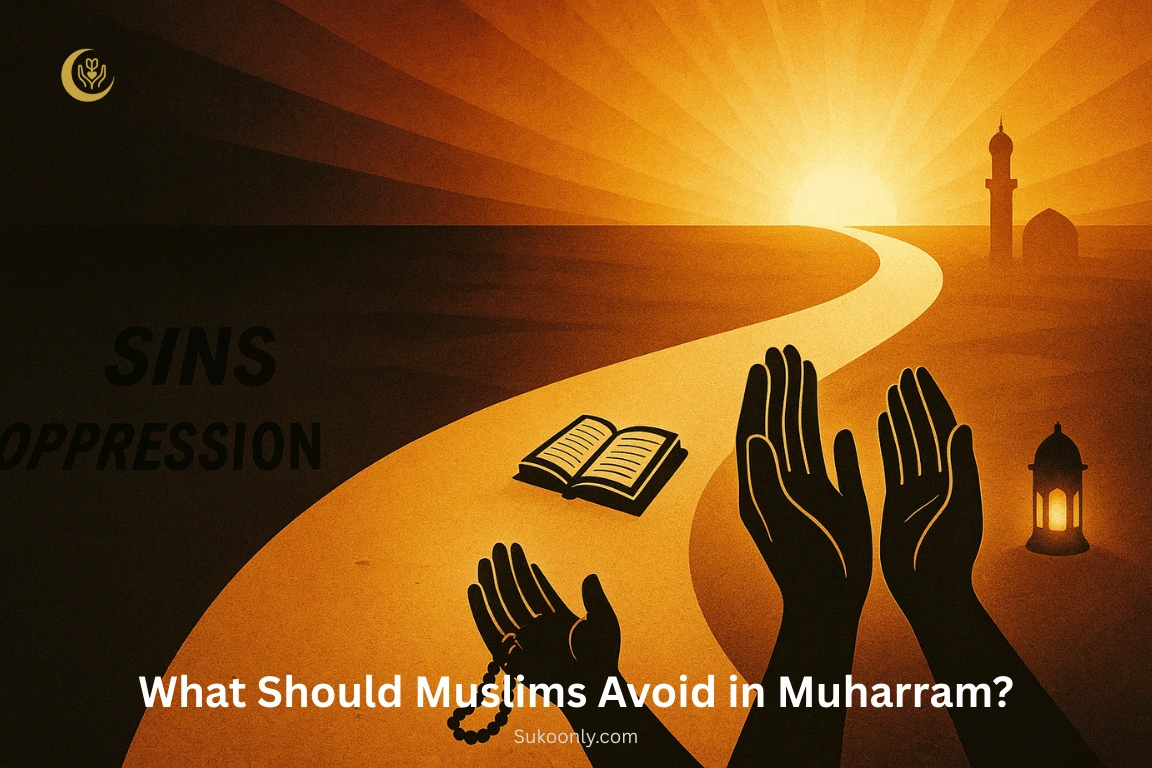
Muharram is one of the four sacred months (al-ashhur al-hurum) that Allah ﷻ mentions in the Qur’an (9:36). It’s a time that carries special weight in the eyes of Allah ﷻ, where good deeds are multiplied, and sins are taken more seriously. Because of this, Muslims are reminded to be especially mindful of what they avoid during this month.
- Fighting, bloodshed, and acts of oppression are completely forbidden in the sacred months, and Muharram is no exception.
- Sins like lying, neglecting prayers, mistreating others, or falling into injustice are even more harmful during this sacred time. Muharram calls us to purify our actions and intentions.
- Innovations (bidʿah)—practices added to the religion without any basis in the Qur’an or Sunnah—should be avoided to protect the purity of our worship and keep it in line with the teachings of the Prophet ﷺ.
- And while remembering the sacrifice of Imam Husayn ibn ʿAlī (رضي الله عنه) is meaningful and heartfelt, Islam teaches us to avoid excessive mourning or harmful cultural rituals that go against the balance and dignity of our faith.
In essence, Muharram is a month of peace, sincerity, and closeness to Allah ﷻ. By avoiding what displeases Him, we protect the sacredness of this time and open ourselves to its blessings.
Is Muharram a Month of Mourning or Reflection?
Muharram is a sacred month in Islam — a time that invites the heart to slow down, reflect, and reconnect with Allah ﷻ. It is a month of worship, fasting, and gratitude. But it is also a month that carries deep sorrow because of the painful events tied to our history.
The Prophet Muhammad ﷺ referred to it as “Shahrullah al-Muharram” — the Month of Allah (Sunan Ibn Majah 1644). He encouraged the Ummah to fast on the 10th of Muharram (ʿĀshūrāʼ) in remembrance of how Allah ﷻ saved Prophet Mūsā (عليه السلام) and his people from Pharaoh. This teaches us that Muharram is a time to remember Allah’s mercy, to give thanks, and to renew our spiritual focus.
At the same time, our hearts cannot ignore the pain of Karbala. In the year 61 AH, Imam Husayn ibn ʿAlī (رضي الله عنه), the beloved grandson of the Prophet ﷺ, was martyred for standing up against injustice. His sacrifice, made with courage and sincerity, left a legacy that continues to touch the hearts of Muslims everywhere.
For Shia Muslims, the first ten days of Muharram are observed with deep mourning through gatherings and remembrance of Husayn’s stand. Sunni Muslims also honor his memory with love and respect, reflecting on his sacrifice while focusing on fasting, turning to Allah in repentance, and upholding the guidance of the Prophet ﷺ.
So, is Muharram a month of mourning or reflection? In truth, it holds space for both. It is a time to remember Allah’s mercy, to reflect deeply on our faith, and to draw strength from the courage and steadfastness of those who gave everything for truth.
What is the Difference Between Muharram and Other Islamic Months?

Every month in the Islamic calendar carries its own blessings, but Muharram holds a special place in the heart of our faith. It is one of the four sacred months (al-ashhur al-hurum) mentioned by Allah ﷻ in the Qur’an (9:36), where fighting is forbidden and the weight of our deeds—both good and bad—is multiplied. That alone gives Muharram a sanctity that sets it apart from the rest of the year.
What makes it even more distinct is the 10th day, known as ʿĀshūrāʼ. On this day, Allah ﷻ saved Prophet Mūsā (Moses عليه السلام) and the Children of Israel from Pharaoh’s cruelty. In gratitude, Prophet Mūsā fasted. The Prophet Muhammad ﷺ encouraged us to fast on this day too, teaching us to remember Allah’s mercy with thankfulness.
But ʿĀshūrāʼ is not only a day of deliverance—it is also remembered with deep sorrow. In 61 AH, it became the day when Imam Husayn ibn ʿAlī (رضي الله عنه), the beloved grandson of the Prophet ﷺ, was martyred at Karbala. His sacrifice, made for the sake of truth and justice, left a legacy that continues to inspire hearts with courage and faith.
So while all months bring opportunities for worship, Muharram stands out. It brings together the honor of being named sacred by Allah ﷻ, the blessings of ʿĀshūrāʼ, and the powerful memory of Karbala. It reminds us of divine mercy and human steadfastness—and calls us to live with sincerity, courage, and devotion.
FAQs about Muharram
Sunni Muslims observe Muharram mainly through fasting on ʿĀshūrāʼ, voluntary fasts, prayer, and reflection, following the Prophet ﷺ. Shia Muslims emphasize mourning the martyrdom of Imam Husayn at Karbala (61 AH/680 CE), often through majālis (gatherings), sermons, and processions that highlight his sacrifice for justice and truth.
Mohammed Basheer is the founder of Sukoonly.com, an Islamic blog focused on duas, prophetic healing, and Qur’anic wisdom. He writes with sincerity and spiritual depth for seekers around the world.

