
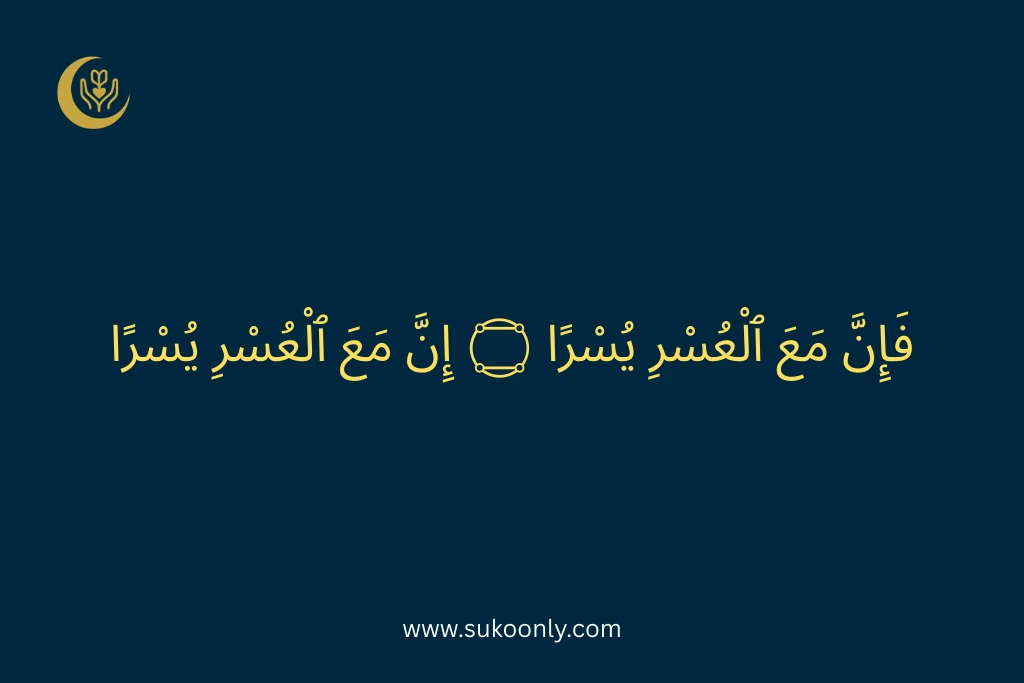
“Fa Inna Ma’al Usri Yusra, Inna Ma’al Usri Yusra” is one of the most profoundly comforting verses in the Qur’an, revealed in Surah Ash-Sharh (94:5–6). Translating to, “Indeed, with hardship comes ease. Surely, with hardship comes ease.” This repetition is not a linguistic coincidence—it is a divine reassurance. Through these verses, Allah promises that no difficulty exists without relief, anchoring this message deeply within the heart of Islamic belief.
Muslims across the world often recite this verse in times of grief, stress, or uncertainty, finding peace in its timeless wisdom. This verse, which comes from the Arabic Qur’an and was given during the early mission of the Prophet Muhammad, reminds believers that every trial has the seeds of ease and hope in it. Understanding the meaning, context, and spiritual depth of this phrase transforms it from a recitation into a source of unwavering faith and emotional resilience.Fa Inna Ma’al Usri Yusra – Arabic Text, Transliteration & Exact English Meaning
فَإِنَّ مَعَ ٱلْعُسْرِ يُسْرًا إِنَّ مَعَ ٱلْعُسْرِ يُسْرًا These two consecutive ayahs from Surah Ash-Sharh (also known as Surah Al-Inshirah, Chapter 94 of the Qur’an) are among the most quoted verses in times of hardship. Fa inna ma‘al-‘usri yusrā. Inna ma‘al-‘usri yusrā. This phonetic transliteration makes it easier for non-Arabic speakers to pronounce the verses while maintaining their original phonological structure. “For indeed, with hardship comes ease. Indeed, with hardship comes ease.”Transliteration
Exact English Meaning
(Surah Ash-Sharh – Verses 5–6, from the Qur’an)
This powerful repetition is a divine affirmation that ease (yusr) is always accompanied by difficulty (‘usr), never the other way around. The fact that Allah repeats this message in two successive ayahs highlights its spiritual and psychological significance for believers navigating life’s trials.
Which Surah Is “Fa Inna Ma’al Usri Yusra” From?
The phrase “Fa Inna Ma’al Usri Yusra” is found in Surah Ash-Sharh, also known as Surah Al-Inshirah, which is the 94th chapter of the Qur’an. These words appear in Ayahs 5 and 6, offering profound spiritual relief and divine assurance during hardship.
Key Details:
| Attribute | Value |
|---|---|
| Surah Name | Ash-Sharh (The Relief), also called Al-Inshirah |
| Surah Number | 94 |
| Verse Numbers | Ayah 5 and Ayah 6 |
| Revelation Period | Makkan |
| Total Verses in Surah | 8 |
What Is Surah Ash-Sharh About?
Surah Ash-Sharh was revealed during a time when Prophet Muhammad ﷺ faced immense emotional and societal pressure in Makkah. The Surah begins by reminding him of Allah’s past favors:
- Expansion of the chest (sharh sadr)
- Removal of burden
- Elevation of his mention
It then delivers the repeated declaration: “Indeed, with hardship comes ease.”
This chapter serves as a divine message of comfort, assuring the Prophet — and by extension, all believers — that trials are never without purpose, and ease always accompanies adversity. The repetition in Ayahs 5 and 6 emphasizes the certainty of Allah’s promise and encourages unshakeable resilience, sabr (patience), and tawakkul (trust in Allah).
Why Is the Verse Repeated Twice in the Qur’an?
In Surah Ash-Sharh (94:5–6), Allah states:
“Fa inna ma‘al-‘usri yusrā. Inna ma‘al-‘usri yusrā.” (“For indeed, with hardship comes ease. Indeed, with hardship comes ease.”)
This repetition is intentional, meaningful, and linguistically precise. In the Qur’an, repetition is a rhetorical and theological device used to emphasize certainty, heighten impact, and highlight divine truths. Scholars of tafsir unanimously agree: this verse is not merely poetic — it is a miraculous construction of comfort and conviction. The word “Inna” (إِنَّ) in Arabic translates to “indeed” or “truly,” used to assert certainty and affirmation. Repeating this phrase with “Inna” not once, but twice, removes all doubt. It’s as though Allah is firmly assuring the believer: You will face hardship — but ease is guaranteed, without exception. There’s a powerful nuance in the Arabic: This grammatical structure leads to a profound principle drawn by classical scholars: One defined hardship is surrounded by many undefined forms of ease. In both ayahs, the same specific hardship is repeated with the definite article, while ease is left open, broad, and abundant. This is a linguistic indication of mercy. The key Arabic word here is “Ma‘a” (مَعَ), which means “with.” Allah does not say “after hardship” (ba‘da al-‘usr) — He says “with hardship”, ease is already present. This means: This interpretation transforms the verse from mere future hope into a present spiritual reality — that Allah’s mercy is already near, even when suffering is at its peak. Emphasis and Absolute Assurance
The Linguistic Miracle: Al-‘Usr vs. Yusrā
Ease Comes With Hardship — Not After It
Historical Context — When Was This Verse Revealed?
The verse “Fa Inna Ma’al Usri Yusra” was revealed in Makkah during the early years of Prophet Muhammad’s ﷺ mission. At this point, Islam was still in its formative stage, and the Prophet ﷺ and his small group of followers were facing intense persecution, social rejection, and emotional isolation. Surah Ash-Sharh (94) is classified as a Makkan Surah, meaning it was revealed before the Hijrah (migration) to Madinah, when the situation was far more severe for the Muslim community.The Period of Hardship in Makkah
This was a chapter revealed in the depths of trial, not ease. The historical context amplifies the power and relevance of the verse:
- The Prophet ﷺ endured mockery, insults, and public rejection by the Quraysh.
- Early Muslims were subjected to torture, exile, and economic boycotts.
- Islam was portrayed as a threat, and believers were forced into social isolation.
- Emotionally, the Prophet ﷺ was carrying the burden of guidance with no support from his people.
In the midst of this, Surah Ash-Sharh was revealed to comfort and strengthen the Messenger ﷺ.
“Did We not expand for you your chest?” (Ash-Sharh 94:1)
“Indeed, with hardship comes ease.” (Ash-Sharh 94:6)
The verse “Fa Inna Ma’al Usri Yusra” wasn’t revealed during ease or success. It came during deep struggle, proving that Allah’s promise of relief is not delayed for better times — it is embedded within the trial itself.
For Muslims today, understanding this historical context reinforces the message:
Ease is written into the decree of hardship.
Even when circumstances seem bleak, the Qur’an reminds believers that divine support is already at work, as it was for the Prophet ﷺ in Makkah.
When Should You Recite “Fa Inna Ma’al Usri Yusra”?
“Fa Inna Ma’al Usri Yusra” appears in the Qur’an (Surah Ash-Sharh 94:5–6) and, while not classified as a prescribed dua with fixed repetition in any sahih (authentic) hadith, it holds immense spiritual value. Like many Qur’anic verses, it can be recited for reflection, comfort, and remembrance of Allah (dhikr).
Reciting this verse helps ground the believer in hope, resilience, and tawakkul (trust in Allah) — especially in times of struggle.
When experiencing anxiety, grief, sadness, or emotional overwhelm, this verse acts as a reminder of divine mercy: “Indeed, with hardship comes ease.” It helps reframe pain as temporary and aligns the heart with Allah’s wisdom, making it easier to cultivate sabr (patience). Whether facing: …reciting this verse can strengthen your spiritual resilience. It encourages a mindset of perseverance without despair, reminding us that ease is not separate, but embedded within hardship. Many Muslims recite “Fa Inna Ma’al Usri Yusra” before: It brings calm, encourages reliance on Allah, and reinforces inner confidence — not in outcomes, but in the wisdom behind them. This verse can be included in: Unlike specific duas, it doesn’t require repetition counts. The focus is on internalizing the message — that Allah never sends hardship without ease. 1. During Emotional Distress
2. During Financial or Personal Difficulty
3. Before Exams or Major Life Decisions
4. As Part of Daily Reflection and Dhikr
Related Qur’anic Verses About Patience & Relief
The message in “Fa Inna Ma’al Usri Yusra” from Surah Ash-Sharh (94:5–6) is not isolated. It reflects a recurring divine pattern throughout the Qur’an: hardship is temporary, patience is rewarded, and Allah’s help is always near.
The Qur’an often connects: “Indeed, Allah is with the patient.” This verse explicitly ties sabr with divine companionship. It reassures believers that Allah’s presence supports those who patiently endure hardship — just as He did with the Prophet ﷺ. “Do not grieve; indeed Allah is with us.” Revealed during the Hijrah (migration to Madinah), this verse captures the moment of fear when the Prophet ﷺ and Abu Bakr were hiding in the cave. It teaches believers to remain spiritually grounded even when danger surrounds them. “And whoever fears Allah — He will make for him a way out and will provide for him from where he does not expect.” This powerful verse links taqwa (mindfulness of Allah) with unexpected ease. It echoes the same promise in Surah Ash-Sharh — that ease can arrive in unseen ways, and hardship is not the end. “Allah does not burden a soul beyond that it can bear.” This ayah reinforces the wisdom and fairness of divine tests. Like Surah Ash-Sharh, it reminds believers that no challenge is given without the corresponding strength to handle it — and the relief that follows.
…as part of the believer’s spiritual toolkit during trials.“Indeed, Allah Is With the Patient”
(Surah Al-Baqarah 2:153)“Do Not Grieve — Allah Is With Us”
(Surah At-Tawbah 9:40)“Whoever Fears Allah — He Will Make a Way Out”
(Surah At-Talaq 65:2–3)“Allah Does Not Burden a Soul Beyond Its Capacity”
(Surah Al-Baqarah 2:286)
Frequently Asked Questions — Fa Inna Ma’al Usri Yusra Meaning
It is a Qur’anic verse from Surah Ash-Sharh (94:5–6) in the Qur'an. It is not a separate prophetic dua reported in hadith. However, it is permissible to recite Qur’anic verses for reflection and comfort.
No. The verse appears consistently as:
فَإِنَّ مَعَ ٱلْعُسْرِ يُسْرًا إِنَّ مَعَ ٱلْعُسْرِ يُسْرًا
Minor differences may appear only in script style (Uthmani vs Indo-Pak script), not in wording.
The first ayah begins with “Fa” (فَ) meaning “So” or “Therefore,” linking it to the previous verses in Surah Ash-Sharh.
The second repetition removes “Fa” and begins directly with “Inna”, intensifying the standalone emphasis of the promise.
This subtle structural variation strengthens rhetorical impact.
No. The word “Ma‘a” (مَعَ) means with, not after.
This indicates accompaniment — ease exists alongside hardship, even if unseen.
“Al-‘usr” contains the definite article “al”, meaning the specific hardship.
“Yusrā” appears without “al”, making it indefinite — linguistically broader.
This difference is central to classical tafsir analysis of the verse.
Primarily certainty and emphasis.
However, scholars have also pointed out that repeating the indefinite noun “yusrā” suggests multiplicity or expansion of ease.
The dominant tafsir understanding combines both rhetorical emphasis and linguistic depth.
More in the Islamic Phrases Series
Hub Page
Related Pages

Mohammed Basheer Orsala is the founder of Sukoonly.com - an Islamic resource dedicated to verified Quranic duas and Sunnah-based supplications. A self-taught Islamic researcher, he has studied classical texts and authenticated hadith collections including the works of Imam al-Nawawi, Shaykh al-Albani, Ibn Hajar al-Asqalani, and Ibn al-Qayyim. He writes to make verified Prophetic supplications accessible to English-speaking Muslims worldwide.